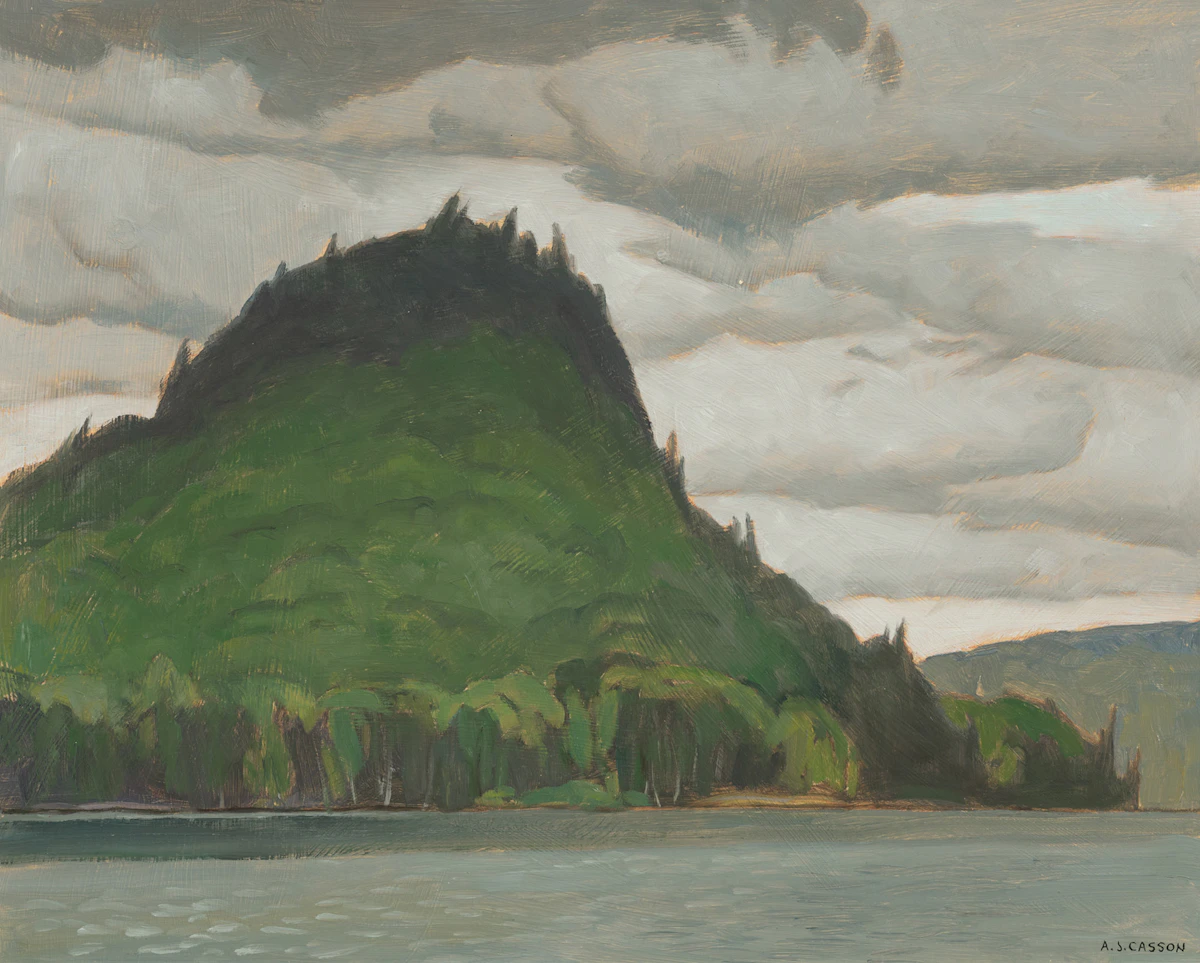
signed lower right; signed, titled and dated "July 1981" on the reverse
12 × 15 in (30.5 × 38.1 cm)
Auction Estimate:$20,000 - $30,000
Sale date:May 28, 2025
Price Realized
$22,800
(including Buyer's Premium)
Provenance
Private Collection, Toronto
Literature
Margaret Gray, Margaret Rand and Lois Steen, “A.J. Casson”, Agincourt, Ontario, 1976, page 43
A.J. Casson has played a prominent role in the development of Canadian art, quietly having built his reputation as a master painter without sacrificing the principles of his personal approach to painting. Although a professed lover of travel, Casson never went far afield. Adjacent to Algonquin Park, Lake of Bays is an idyllic oasis in the northeastern part of Muskoka. A small township with over a hundred lakes, the area is a popular destination for cottagers escaping the city. Casson frequented the area on his sketching trips, revelling in the expanse of forests, rocks, lakes, and wetlands to paint.
This dramatic landscape is dominated by a lush, green mountain rising sharply from the water’s edge. The dark, jagged crest of the "Camel’s Hump" contrasts with the softer, rolling greenery below and calm lake. The cloudy sky with sweeping brushstrokes conveys a sense of movement and atmosphere, as if a storm may be approaching or the weather is in flux. "The Camel’s Hump, Lake of Bays" is a preparatory work for a 1983 oil on canvas by the same title sold by Cowley Abbott at auction (1 December 2022). Casson changed the vantage point in the canvas and removed the water in the foreground. The artist also depicted different seasons in the two paintings; while the sketch shows a green forest, the canvas contains soft yellow and red foliage as well as a cool mist rising from the water.
"The Camel’s Hump, Lake of Bays" is a prime example of a subtly dramatic landscape of this period in Casson’s oeuvre. Regarding the artist’s legacy, Margaret Gray, Margaret Rand and Lois Steen share that, “[Casson’s] hundreds of drawings, sketches and paintings, which have recorded the beauty and the character of his land, are a great legacy indeed. But perhaps from a historical point of view A.J. Casson’s greatest contribution lies in the present-day link which he provided with that vital period when Canadian art took on its own identity. The Group of Seven laid down the foundations upon which modern art in this country has built, and Casson, although never avant-garde, has made his own unique contribution to the structure. He paints his own vision, unaffected by the tyranny of the new.”