Provenance
Gift of the Artist to Private Collection, Laurel, Delaware
By descent to Private Collection, New Brunswick
New Hope, Pennsylvania, was a vibrant artist community in the early twentieth century, drawing inspiration from the outdoor practices of French Impressionists. This included the snowy landscapes painted by Edward Redfield and Walter Elmer Schofield, as well as the luminous scenes of Daniel Garber. Unlike other American Impressionists, the artists of the New Hope School, primarily based in Bucks County, favoured thick brushstrokes and focused almost exclusively on landscape painting. While Pennsylvania Impressionism is often associated with male artists, women artists were also well-represented. Their mastery of light and colour, as evidenced in this work, rivals that of their male contemporaries, capturing the essence of a scene through carefully chosen hues.
Fern Isabel Coppedge began her artistic career in her late twenties, first studying at New York’s Art Students League before moving to Philadelphia, where she studied at the Pennsylvania Academy with Daniel Garber. She first visited Bucks County in 1917 before settling in Lumberville in 1920. Coppedge joined the Philadelphia Ten, a women’s art organization dedicated to exhibiting the works of its members. Celebrated for her winter scenes, she would eventually shift towards Post-Impressionism, adopting more whimsical colours and an abstract style.
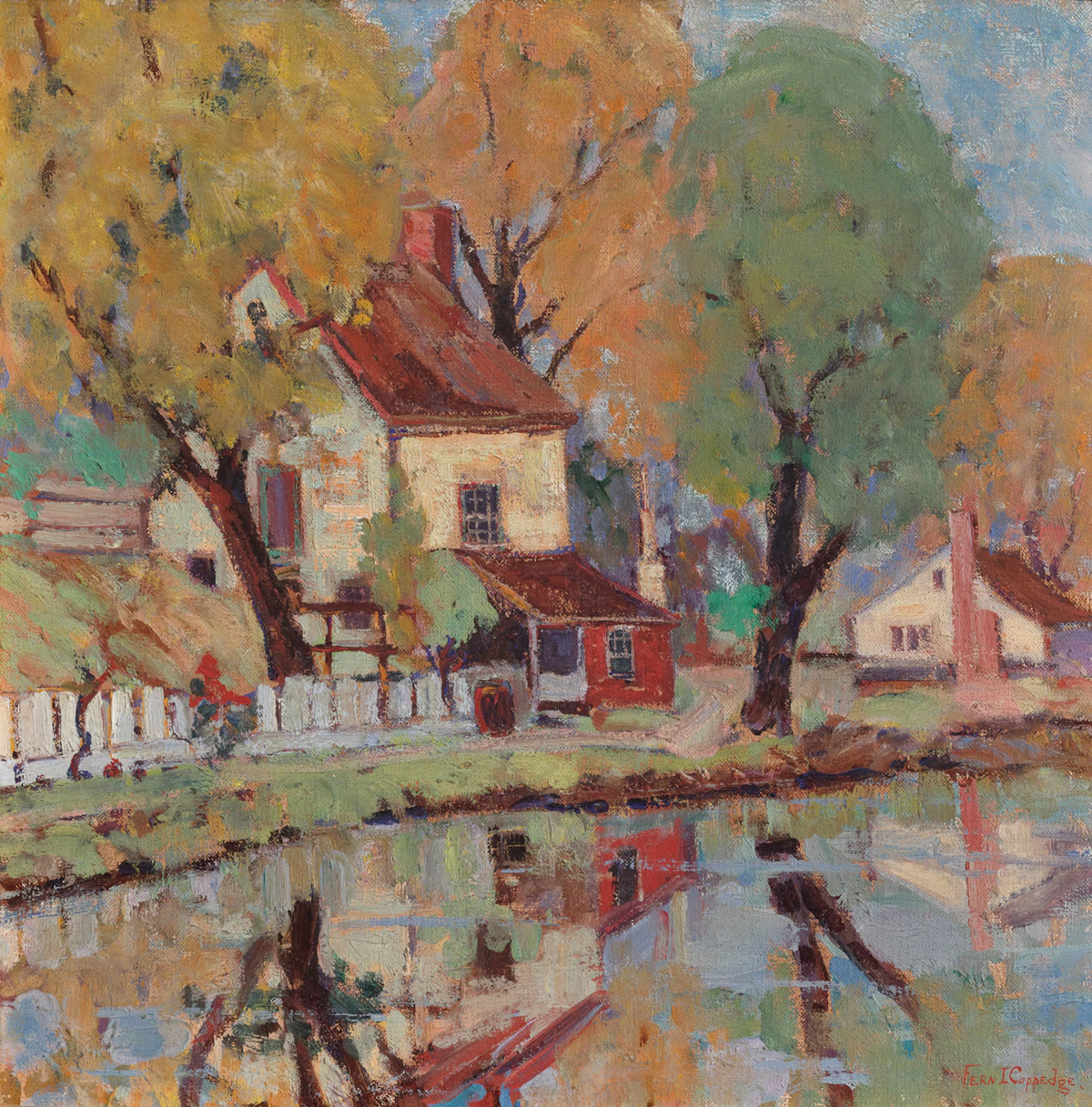
In this work, Coppedge has depicted an idyllic fall scene on the banks of the river. Towering leafy trees are tightly clustered around a house, which is rendered in textured shades of white, red, brown and gray. A white picket fence stretches horizontally to the left, and a small house with a red brick chimney is visible further down the shore. The colourful leaves—in shades of vibrant yellow, orange and green—dominate the composition, while the hazy reflection of the landscape on the water fills the lower register. With loose brushstrokes and muted colours, Coppedge captures the fleeting effects of light, blurring the lines between the reflected image and the actual scene.