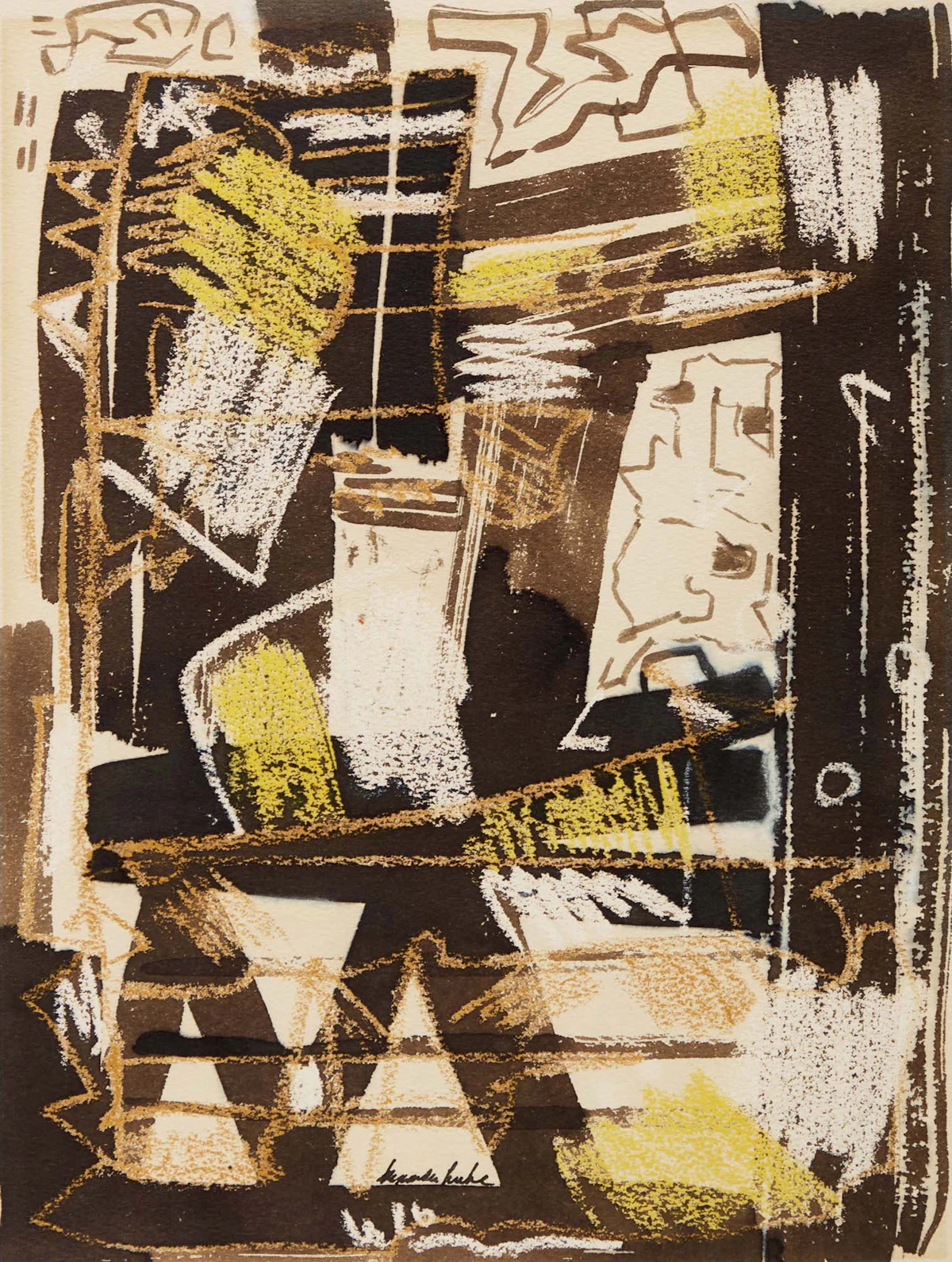
La Cromeu de des Anglais. Nice, #6 Promenade, 1955
ink and crayon on paper
signed lower middle; titled to the gallery label and reverse of the original framing
10.5 × 7.75 in (26.7 × 19.7 cm) (sheet)
Auction Estimate:$2,000 - $3,000
Sale date:September 9 - 23, 2025
Price Realized
$2,040
(including Buyer's Premium)
Provenance
Estate of the Artist
By descent to E.R.S. McLaughlin, Oshawa
Private Collection, 26 April 2004
Collection of Joan Murray
Private Collection, British Columbia
Exhibited
"Alexandra Luke", The Park Gallery, Toronto, 5-17 May 1958, no. 6 as "La Promenade des Anglais"
Literature
Jock Macdonald to Maxwell Bates, 26 December 1954, McCord Museum, Montreal.
In the late autumn of 1955, after much urging from Jock Macdonald and his wife Barbara who were visiting Europe, Alexandra Luke travelled to France to join them in Vence on the Riviera. Both Macdonald and Luke worked intensely at creating “automatics,” Luke like Macdonald using the wax resist technique to achieve accidental effects and a greater sense of space through the insistently open ground which resist creates.
Vence would have supplied Luke, as it did for Macdonald, with the necessary stimulus for non-objective work: she would have found the colour of her surroundings entering her work – the brilliant light of the warm winter and the growth forms of the area with their powder blue green olive trees and black cypress, as Macdonald described them in a letter to Maxwell Bates. Occasionally, as in her abstract paintings, she retained a detail from the scene before her, indicating the shape of the spray of water from a fountain and birds (as in Fountain in Vence), or the legs of English visitors on promenade (as in La Promenade des Anglais). Luke always valued and kept these works, not only to remember her happy trip among friends, but because they were important seminal points for her as an artist. She exhibited them, along with oils and watercolours in an exhibition of forty works at the Park Gallery in Toronto in a solo show in 1958.
Luke clearly was proud that she was able though only using the slightest of means, to evoke her own language of form and colour. Margaret Rodgers writes of Luke at this time: “Her trip to Europe…resulted in a series of charming crayon-resist works on paper that relate to her earlier automatics in terms of scale and composition; but they are also invested with a new confidence, which is evident in their emphatic use of india-ink wash over exuberantly crayoned lines.”