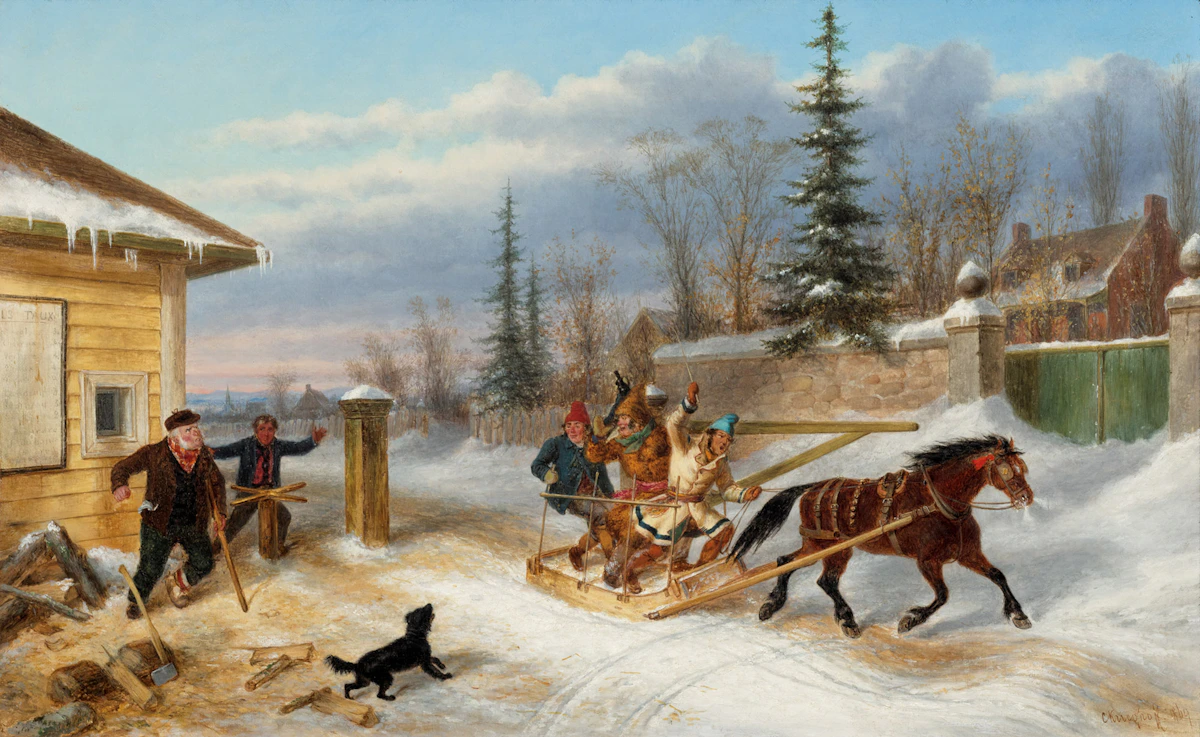
signed and dated 1869 lower right
14.25 × 22.25 in (36.2 × 56.5 cm)
(including Buyer's Premium)
Estate of George Maxwell Bell, Calgary
Joseph T. and Florence O'Connor, Vancouver, January 1974
By descent to the present Private Collection, Victoria
David Burnett, Masterpieces of Canadian Art from the National Gallery of Canada, Alberta, 1990, page 26
Ramsay Cook, "The Outsider as Insider: Cornelius Krieghoff's Art of Describing" in Dennis Reid, Krieghoff, Images of Canada, Toronto, 1999, page 148
Cornelius Krieghoff was a celebrated nineteenth-century artist known for his romanticized portrayals of Canadian life and landscapes in the years leading up to the Confederation. The avid traveller produced the majority of his artworks in eastern Canada during the fifteen years he lived in Montreal and Quebec, beginning in 1846. By 1853, Krieghoff was living in Quebec City, where he entered his most prolific artistic period. He produced a large number of canvases that were innovative in terms of iconography, style and technique. Krieghoff understood his audience’s tastes and was versatile in his themes. His paintings, often small and portable, appealed to the English-speaking governing class and British military personnel, who purchased them as souvenirs of their time in the colony. David Burnett remarks, “Krieghoff’s years in Quebec were not only the height of his success but were also the time when he produced his finest work.”
The artist’s sharp intellect and vivid imagination fully embraced the picturesque life of the habitant, along with the Canadian winters filled with sleighing and tobogganing. His keen attention to detail captured the essence of a bygone era and its people, leaving behind a valuable record of that time. His works featured portraits, genre scenes and landscapes of rural Quebec. However, it was the winter landscapes—covered in snow, featuring brightly coloured sleighs, and the colourful attire of the habitants—that brought Krieghoff the most artistic success. He understood that winter was the most iconic and visually stunning season, a time filled with sleighing parties, snowshoeing, and dances. It was with these winter scenes that he achieved his highest artistic acclaim. The winter sleighing scene became a highly sought-after subject during this time, one that Krieghoff revisited often, and it remains a cherished representation of early Canadian art, culture and life.
One of Krieghoff's most famous compositions, is the subject of this canvas, known as Bilking the Toll Gate. Dated 1869, this canvas illustrates the tensions surrounding toll roads, which were built by private contractors and often resented by local habitants. Historian Ramsay Cook describes how toll fees could consume a significant portion of a day’s earnings, leading to frustration and, at times, playful defiance—an attitude Krieghoff depicted through a mischievous, nose-thumbing passenger. The subtle drama of the scene is expertly conveyed in the faces of the characters, at some points appearing almost like caricatures with exaggerated expressions. Characteristic of Krieghoff, the artist has paid special attention to the aspects of the landscape and the attire that, in its own way, honours the region. Krieghoff’s attention to detail compliments his meticulous draftsmanship and the theatricality of the scene.
Cook references art historian Dennis Reid's argument that, “the tollgate and the tollgate keeper were identified with British authority and patronage and this visual anecdote becomes even more powerful.” This element adds a deeper political dimension to Krieghoff’s visual storytelling. Through works like Bilking the Toll Gate, Krieghoff not only documented but also subtly commented on the social and political realities of pre-Confederation Canada, cementing his place as one of the country’s most important early artists.
