Provenance
Roberts Gallery, Toronto
Joyner Fine Art, auction, Toronto, 21 November 1997, lot 58
Masters Gallery, Calgary
Private Collection, Calgary
Literature
Paul Duval, "Canadian Water Colour Painting", Toronto, 1954, unpaginated
Ian Thom, "Casson's Cassons", Kleinburg, 1988, pages 5, 18
Alfred Joseph Casson lived most of his life in Toronto where he was born in 1898. His first experience of small town Ontario was in childhood; he would make frequent visits to Meadowvale, a village west of Toronto, where he had family ties. Here, and later in Guelph, he developed a taste for rural life. After studying in Toronto with artists J.W. Beatty and Harry Britton, Casson began an apprenticeship in the commercial art firm of Rous and Mann under Franklin Carmichael in 1919. Carmichael, a member of the Group of Seven from its inception in 1920, was an important influence on the younger Casson, taking him on sketching trips and introducing him to other Group members. Around this time, Casson began to explore Ontario in a newly purchased car, sketching and painting the rural towns. He later explained that this subject matter had given him the distinct identity he sought within the Group, as did his penchant for painting in watercolour. His legacy, he believed, was a body of work that recorded for posterity the rapidly disappearing rural towns of Ontario, just as A.Y. Jackson had done in Quebec.
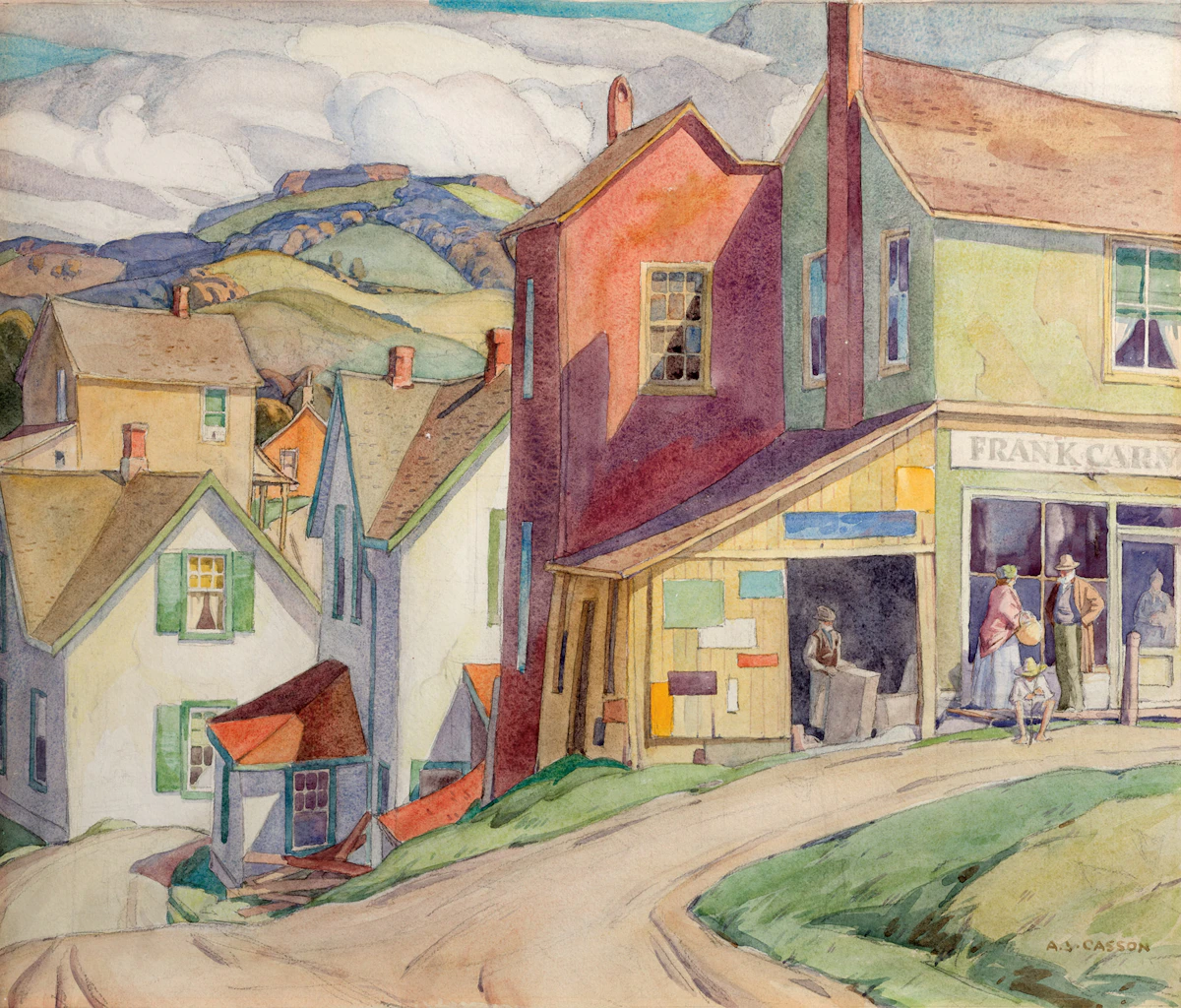
Villages outside of Toronto, such as Elora, Salem, Uxbridge, and in this instance, Bradford, were among the many places he depicted in the 1920s and 1930s. Working full-time at a commercial art firm until 1959, Casson could go further afield to paint and sketch only on weekends and holidays. "The Village Store, Bradford" exemplifies many of the defining features of his work: a nostalgic depiction of rural Ontario, a strong sense of design, and a distinctive atmosphere achieved through colour and lighting qualities that distinguished him from other members of the Group. His deep appreciation for patterning, particularly evident in his architectural subjects, extended throughout the entire composition. This painting also contains several figures standing by the entrance of the store—a rare occurrence in Casson’s work.
On the artist's dedication to watercolours, Paul Duval writes that Casson “had become one of the most powerful and expressive watercolour painters Canada has ever known. His compositions had acquired a sure formalization, his washes were laid with a consummate assurance and the boldness of his colour revealed a brilliance and depth then rarely seen in the medium.” Deep purples accentuate shadow and imperfections in the rock formations while subtle washes of grey and faint yellow illuminate the rocks to the left of the composition. Ian Thom writes, “what also emerges with startling clarity is an exquisite, emotional tension. His ability to use composition, colour, light, technique and subject matter to create images of a preternatural, haunting stillness, may be Casson's greatest achievement as a painter.”