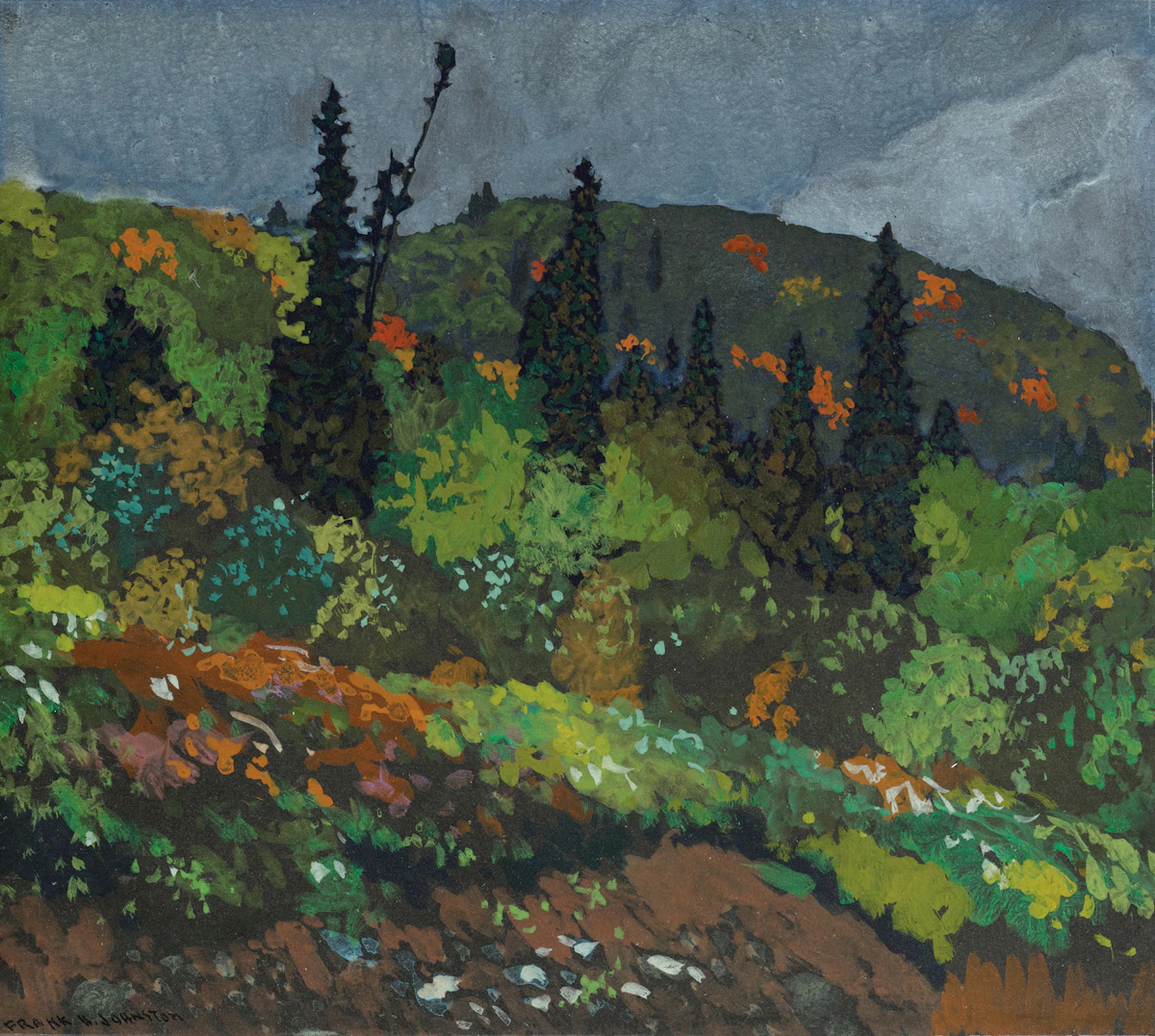
signed lower left; titled and inscribed "Hubert" and "No. 65" on the reverse
9.25 × 10.25 in (23.5 × 26.0 cm)
Auction Estimate:$15,000 - $20,000
Sale date:May 28, 2025
Price Realized
$28,800
(including Buyer's Premium)
Provenance
G. Blair Laing, Toronto
Private Collection, Ottawa
Exhibited
"Algoma Sketches and Pictures by J.E.H. MacDonald, A.R.C.A., Lawren Harris and Frank H. Johnston", The Society of Canadian Painter- Etchers, Art Museum of Toronto, April 1919, no. 65
Literature
F.H. Johnston, Toronto to Eric Brown, Ottawa, File 5.42 Johnston, Library and Archives, National Gallery of Canada, Ottawa
"Algoma Sketches and Pictures by J.E.H. MacDonald, Lawren Harris and Frank H. Johnston", The Society of Canadian Painter-Etchers, Toronto, 1919, no. 65, listed page 9
'Etchings Predominate at Art Exhibition', "Daily Star" (3 May 1919)
Algoma is intimately associated with the early history of the Group of Seven. In August 1918 Frank Hans Johnston received a commission to draw and paint the activities of the flight training schools in southern Ontario for the Canadian War Memorials program; however, a trip to Algoma with Lawren S. Harris and J.E.H. MacDonald in October interrupted his war work and set him off in a new direction. “Our trip north was a great success–we struck new country in every respect and had a wonderful time sketching for all that was in us,” he wrote to Eric Brown, director of the National Gallery.
Johnston had fifty-seven works in the Algoma exhibition at the Art Museum of Toronto in late April 1919, including "Along the Line, Algoma". The works in the three-man exhibition, which included Harris and MacDonald, were arranged chronologically and geographically following the advance of the autumn colour from Canyon, to Hubert, to Batchewana. The smaller works of this collection were made on a sketching trip along the line of the Algoma Central Railway during the last three weeks of September 1918. This work is noted as being painted in the vicinity of Hubert. The oil sketch shows a lush forest in autumn; most of the foliage is green, with a few flecks of orange and red dotting the background. The writer in the Toronto "Daily Star" admired Johnston’s contributions in the exhibition, stating, “Mr. Johnston sees nature much as a huge decoration—the blue and purple mountains with a glimpse of orange sky; the sparkle of autumn foliage against the molten grey of a placid lake—he eliminates detail and finds wide unbroken expanses.” In September 1919, Johnston returned to Algoma with Harris, MacDonald and A.Y. Jackson in preparation for the inaugural Group of Seven show in spring 1920.