Exhibited
"Canadian Small Paintings", Small Pictures Department, Canadian National Exhibition, Toronto, 24 August-8 September 1928, no. 469 as "Lake Superior Morning" at $75
"Kingston Collects: Canadian Paintings", Agnes Etherington Art Centre, Queen's University, Kingston, Ontario, 11 April-9 May 1976
Literature
J.A.B. McLeigh, "September Gale: A Study of the Group of Seven", Toronto/Vancouver, 1955, reproduced page 101 as "October on the North Shore, Lake Superior"
Lois Darroch, "Bright Land: A Warm Look at Arthur Lismer", Toronto/Vancouver, 1981, reproduced page 80 as "Sombre Isle of Pic, Lake Superior"
Roger Boulet, "The Canadian Earth: Landscape Paintings by The Group of Seven", Toronto, 1982, see page 156 for "North Shore, Lake Superior", 1928
Angela Nairne Grigor, "Arthur Lismer: Visionary Art Educator", Montreal/Kingston/London/Ithaca, 2002, page 353
In October 1927, Arthur Lismer made his first and only trip to Port Coldwell, Lake Superior with Lawren Harris. A master in planning, as A.J. Casson described Harris in 1982, he and Lismer would have hiked into the woods to set up their campsite, nestled in a small clearing which provided some shelter from the cold fall wind—they were there in October. In a graphite sketch called "Evening Session, 7:30 pm"(McMichael Canadian Art Collection), Lismer documents the arrival of two bear cubs prowling around their tent. The scene is also a self- portrait. Lismer nervously shelters upright inside the tent sporting his big round glasses, his silhouette and balding scalp visible through the tent sheathing under some form of interior night illumination, perhaps a gas lamp or candle. Harris is either nowhere to be found or oblivious to the situation. But, no doubt, mama bear is not far away from her curious cubs. Normally, Lismer’s satiric drawings are pleasurably entertaining, even his self-portraits like this one, but maybe not this time in this backcountry setting where such wildlife was no rarity. Lismer’s sketch of the Harris-Lismer campsite is one of the few works to detail the experiences of the Group of Seven at Lake Superior.
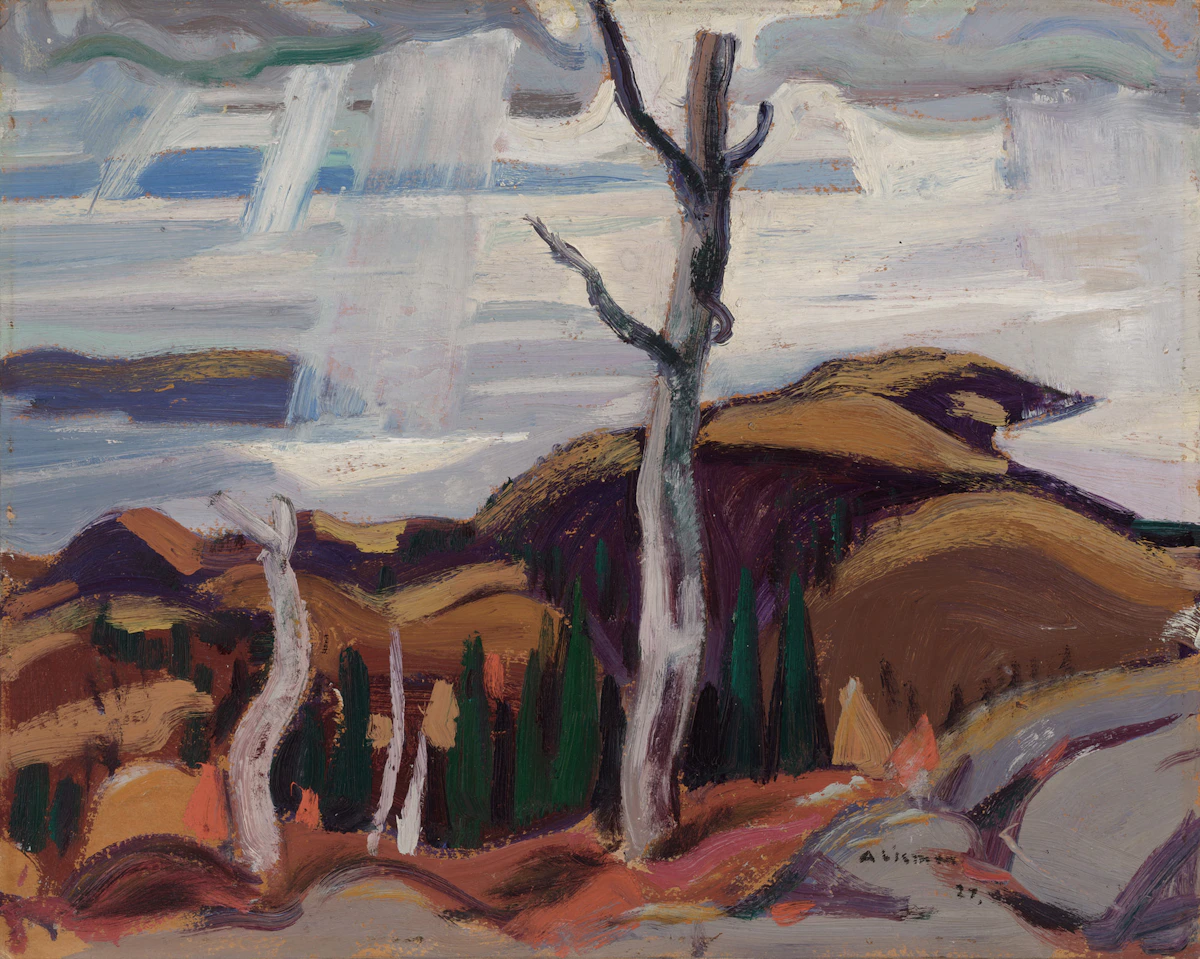
Perhaps as a result of this experience, unlike the others who did spend time painting the evening hours, it seems Lismer preferred the sharpness of a full day. His oil sketches like this one show his proclivity for strong daylight, consistent with his three Lake Superior oil sketches in the McMichael Canadian Art Collection. Lismer was rather loose about the exact title for this sketch, noting two alternate titles, and showing it under a third one. Two labels on the verso include "Morning Light, Lake Superior", and "Light Breaking Through, L. Superior" and, in the 1928 Canadian National Exhibition, it was shown as Lake Superior Morning. Common to all three is the importance of light. In this sketch, Lismer shared with Harris an interest in the common effect of the unique light pools of Lake Superior. Casson reminisced about them in 1982 when he described them, “as a curious phenomenon... where shafts of light seem to break through the clouds and illuminate the surface of the water.” Lismer’s sketch, though, resists the simplification of form common to Harris’ approach. Instead, Lismer’s technique exposes his preference for an all-over textured surface that allows even the hairs of his paint brushes to remain evenly visible. He also punctuates the foreground with the remnants of fall colour in the delightful addition of red dabs of paint, akin to the brilliance of the red-turned leaves of maple trees.
Before arriving at Lake Superior, Lismer had sketched in numerous locations across Canada, including Georgian Bay, Halifax, Algoma, Lake Mazinaw, and Gaspé Peninsula, Quebec. Although Lake Superior only forms a small part of Lismer’s larger landscape painting career, his trip there was nonetheless fruitful. He realized sketches in graphite and oil, and also two large studio canvases—"October on the North Shore, Lake Superior", 1927 at the National Gallery of Canada, and "Sombre Isle of Pic, Lake Superior", 1927 at the Winnipeg Art Gallery.
After Lismer and Harris returned to Toronto, they both exhibited their fresh new sketches of Lake Superior in the "Small Pictures by Members of the OSA" at the Art Gallery of Toronto in December 1927. All of Lismer’s six new sketches were simply called "North Shore, Lake Superior", and thus it can not be known if "Light Breaking Through, Lake Superior", was among them, given his loosened approach to precise titles. However, Lismer did surely exhibit the work in the 1928 CNE the following summer, as documented by the exhibition catalogue of "Canadian Small Paintings" and the exhibition label on the verso.
At this time in Lismer’s career, he had recently resigned from his position as Vice-Principal of the Ontario College of Art over differences with then Principal, George Agnew Reid. In September, he was appointed by the Art Gallery of Toronto to oversee and revamp the Education program, alongside then Curator, Frederick S. Haines. Amidst these critical life changes, the Lake Superior trip probably would have been welcome reprieve from a trying year of administration.
It is not entirely clear how this sketch came to be a gift from Lismer to fellow artist André Biéler, but the provenance does assure its origins from the artist’s studio. Biéler was then Professor of Fine Art at Queen’s University in Kingston, and coordinated the first opportunity for artists from across Canada to meet together in June 1941, at the influential Kingston Conference, the eventual outcome of which would lead to the formation of the Canada Council for the Arts in 1957. Biéler served as the first president of the Federation of Canadian Artists to emerge as a result of the event. As fellow educators and artists, the two had much to share and with the exchange of this sketch from artist to artist, an interest in Lake Superior.
We extend our thanks to Catharine Mastin, Independent Curator and Writer, for contributing the preceding essay.