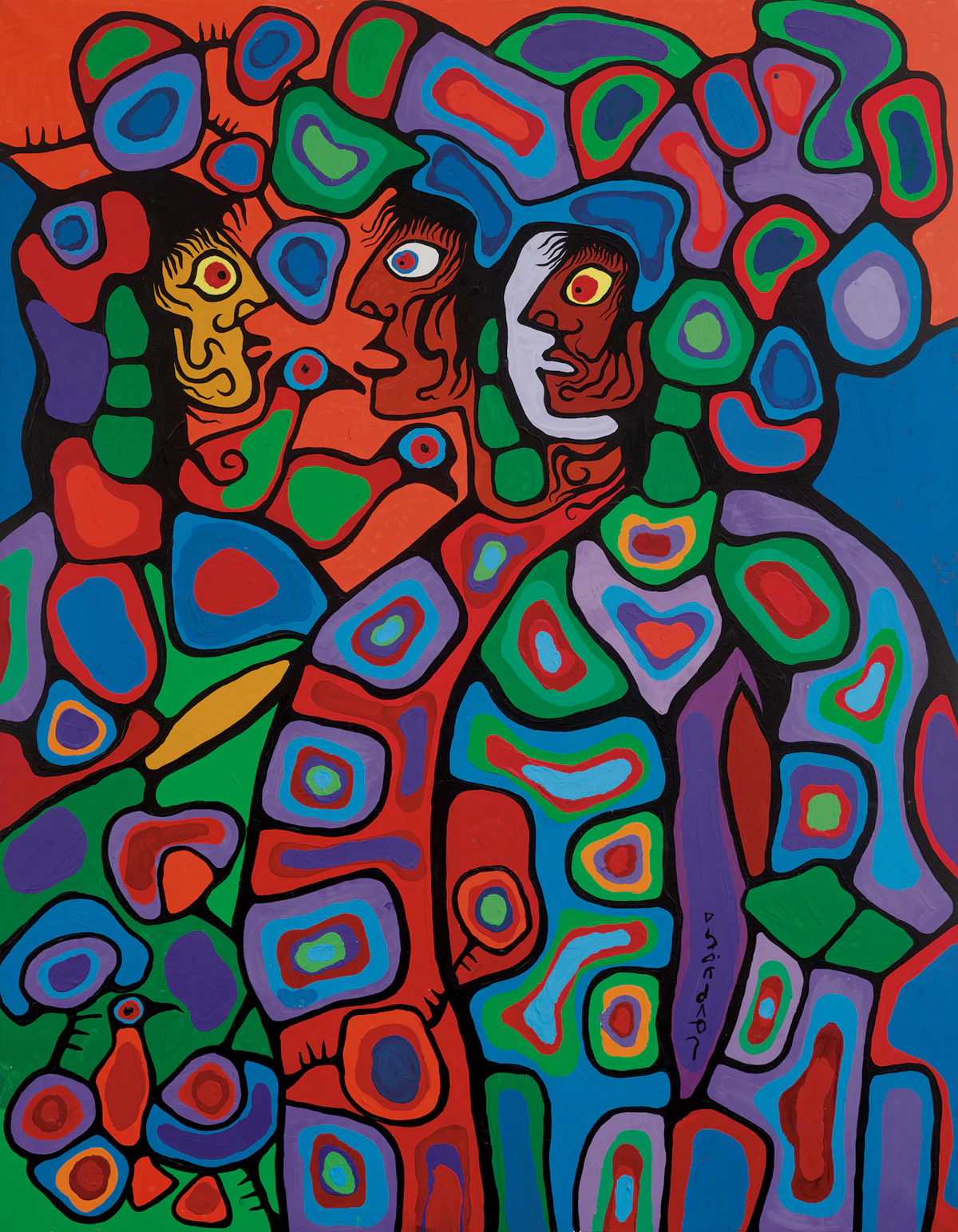
signed in syllabics lower right; titled twice and dated 1980 on the reverse
77 × 60 in (195.6 × 152.4 cm)
(including Buyer's Premium)
The Pollock Gallery, Toronto
Private Collection
Norval Morrisseau, Norval Morrisseau: Return to the House of Invention, Toronto, 2005, page 13
Norval Morrisseau is considered to be a trailblazer of contemporary Indigenous art. Norval Morrisseau was the eldest of five siblings, born to Grace Theresa Nanakonagos and Abel Morrisseau. Following Anishinaabe customs, he was sent to live with his maternal grandparents at the Sand Point First Nation (now known as Bingwi Neyaashi Anishinaabek), located on the shores of Lake Nipigon in Ontario. It was there that Morrisseau immersed himself in the rich stories and cultural traditions of his people, guided by his grandfather, Moses Potan Nanakonagos, who was a shaman trained in the Midewiwin spiritual tradition. Unlike other children his age, Morrisseau preferred the company of elders and enjoyed listening and learning about traditions or being by himself immersed in his artistic pursuits. Fascinated by local petroglyphs, Morrisseau wanted to depict things he had heard about or seen, such as sacred bears or Thunderbirds.
Conversation with Our White Brother depicts three figures, two Indigenous people and one white person, pictured in deep conversation. The white figure is surrounded by three birds. Racial politics in art was a key theme in Morrisseau’s work. As Morrisseau explains, “When the Jesuits came, the Indian was around already. The Indian did not understand them. He tried to understand them, what they were up to. He knew that they were going to be there for a while. He knew how sad it was, seeing his people, how low they were put, how they had previously enjoyed living and needed to live freely again. How do we go about doing that now? We need images. We’re going to use images ourselves.” Influenced significantly by Anishinaabe cultural traditions and his distinctive storytelling style, Norval Morrisseau created art that stood out from the trends popular in Eurocentric art communities. His artistic language featured bold black lines that outlined his subjects and segmented their inner spaces. Additionally, he employed a vibrant mix of lines, colours, and compositions that illustrated the idea of interconnectedness. For instance, a striking contrast of colours and lines could highlight differing perspectives on the relationship between humans and the land. However, Morrisseau’s deep insight into colonialism challenges the common misconception that he is merely a painter of myths.
Morrisseau was represented by Jack Henry Pollock, founder of The Pollock Gallery in Toronto. Pollock was a painter, art educator, author and gallerist who represented Canadian artists and played a defining role in the Toronto art scene for over three decades. In the summer of 1962, while teaching painting workshops in Northern Ontario funded by the Ontario Government, Pollock met Morrisseau; he immediately recognized the artist's genius and arranged for a solo exhibition at his Toronto gallery that September. The sold-out 1962 exhibition received unanimous praise and is considered both the launch of Morrisseau’s career but also one of the most important events of the burgeoning Toronto art scene at the time. Morrisseau went on to arguably become Canada's most important Indigenous artist. Pollock developed a reputation for identifying talent in young artists and was instrumental in the careers of many notable artists, including Ken Danby, Charles Pachter, Robert Bateman, Ron Martin and Jack Bush. The Pollock Gallery also exhibited an impressive array of international artists, many of whom for the first time in Canada, including Willem de Kooning, David Hockney, Josef and Anni Albers, and Victor Vasarely. Pollock became known for his discerning eye and his legacy is most closely associated with his discovery and promotion of Norval Morrisseau.
