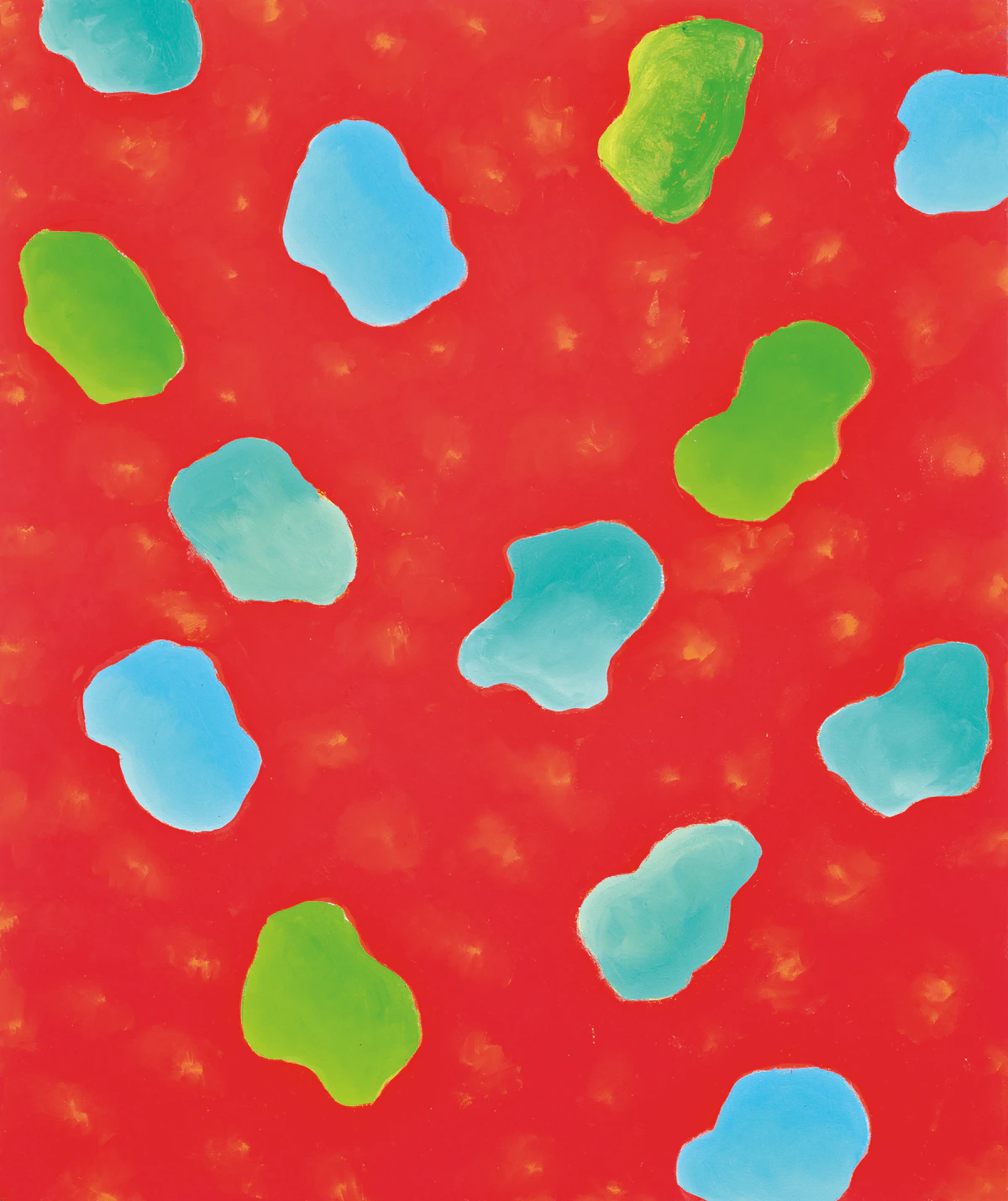
Gershon Iskowitz Foundation stamp (numbered B33) on the stretcher; unframed
40 × 33.75 in (101.6 × 85.7 cm)
Auction Estimate:$8,000 - $12,000
Sale date:November 27, 2024
Price Realized
$6,000
(including Buyer's Premium)
Provenance
Collection of the Artist
Gershon Iskowitz Foundation
Literature
Dennis Reid, "A Concise History of Canadian Painting," third edition, Toronto, 2012, page 375
Roald Nasgaard, "Abstract Painting in Canada," Toronto/Vancouver, 2007, page 244
Gershon Iskowitz gained international acclaim when he was chosen to represent Canada at the Venice Biennale in 1972. By 1976, his artwork showcased stunning, vivid shapes in contrasting colours which were meticulously arranged on intricately painted surfaces. Dennis Reid provides insight into Iskowitz's creative process, stating: “Iskowitz worked only at night under artificial light, in oils... He would gradually build up a painting, applying a layer of colour, and once it had dried, adding another on top. This technique allowed him to leave parts of previous layers visible, lightly covering others, or completely obscuring certain areas.”
Throughout the 1960s and 1970s, Iskowitz focused on exploring light from a fresh perspective. However, in 1981, he faced a new challenge: Roald Nasgaard noted that, “He wished to convey ‘a feeling of the night, a feeling of mystery with lots of depth, unity and composition.’ Iskowitz transitioned from the age of light to the era of electricity. In the 1980s, Iskowitz elevated his approach by electrifying his colours, amplifying their contrasts, and sharpening the contours of his forms.” This untitled painting further exemplifies Iskowitz's remarkable skill in handling colour harmonies, textures, and patterns.
Proceeds from this sale will benefit the charitable not-for-profit Gershon Iskowitz Foundation, which awards an annual prize to a professional Canadian visual artist for their ongoing research and artistic production.