The Deluge: "Kent Monkman" [video], Kent Monkman Studio, 11 September 2019, https://www.youtube.com/watch?v=OqbhG4BX6oU
Shirley Madill, "Kent Monkman: Life & Work" [online publication], Art Canada Institute, Toronto, page 87
"A Different Take on the Deluge," AGO Insider, Art Gallery of Ontario, 18 August 2021, https://ago.ca/agoinsider/different-take-deluge
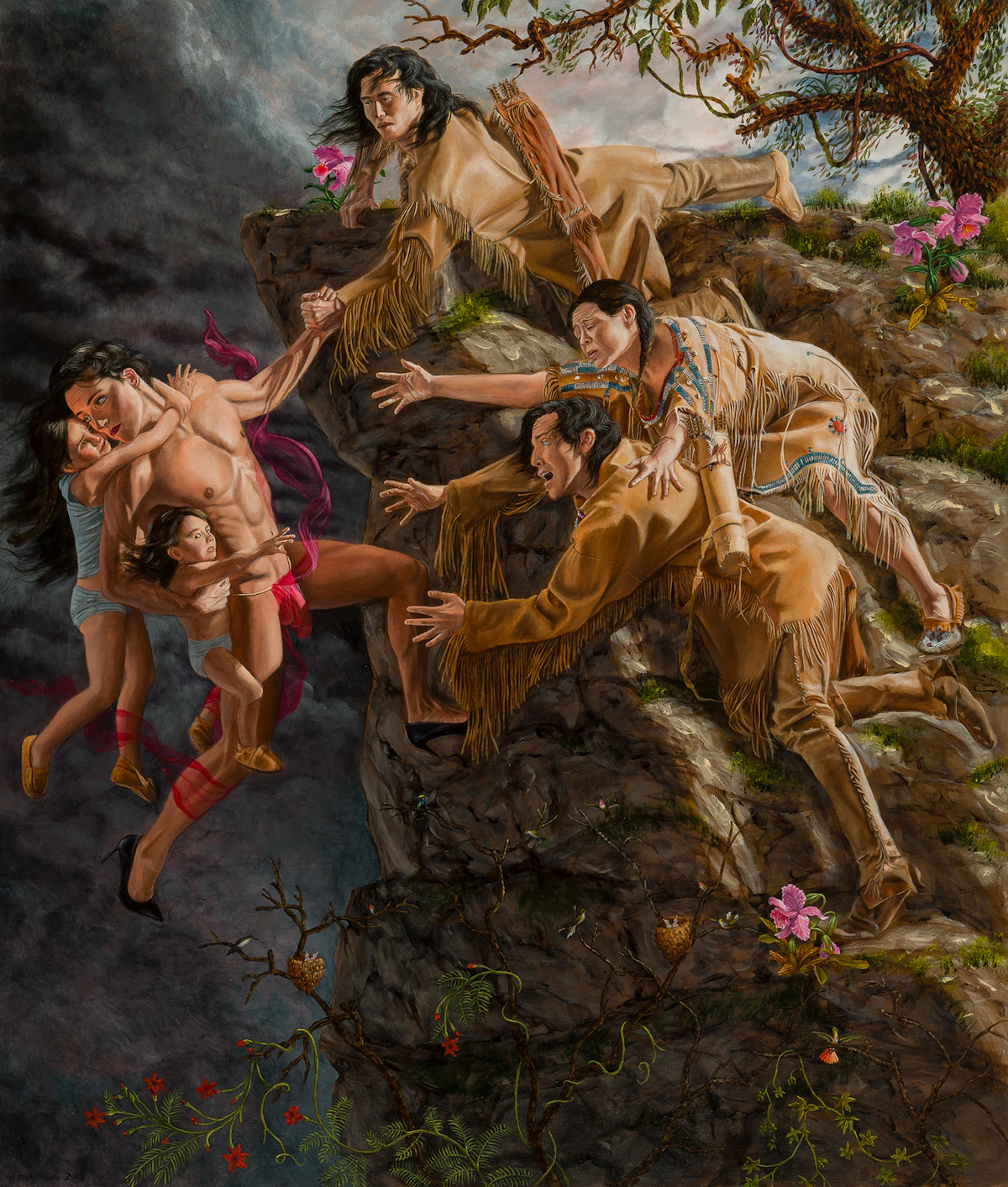
Ontario-born Cree artist Kent Monkman is known for recasting popular figures and scenes from art history with Indigenous peoples and perspectives. This painting is a magnificent, earlier version of his monumental and widely-exhibited 2019 work "The Deluge." The painting presents a narrative of an allegorical flood of settler cultures displacing Indigenous people from the lands to which they belong. Despite the many losses and adversity caused by dispossession, the resilience of the original people of Turtle Island and their connection to their culture has endured. The ancestors reach down to pull Miss Chief Eagle Testickle, a recurring character in Monkman’s work, and two children up to safety. Miss Chief, Monkman’s alter ego, is a “two-spirit” person, a figure who fulfills a traditional ceremonial role as a member of the “third gender” in many Indigenous cultures. She is a strong figure who breaks with stereotypical depictions and turns the underlying colonial power relations upside down. She celebrates the resilience of Indigenous peoples and their unbroken bonds with the land and their culture.
“'The Deluge' is a metaphorical image to imply the flood of European settlers displacing Indigenous people,” says Monkman in a video produced by the Kent Monkman Studio. “But what it depicts is Miss Chief lifting up Indigenous children who are then being handed up to adults who are clinging to a rock. These adults are dressed in traditional attire representing our ancestors.”
As in previous works, Monkman pulls references from a myriad of historical and contemporary sources to add new perspective and meaning to a traditional Western story. "The Deluge" was inspired by a visit to the Crystal Bridges Museum in Arkansas. This state is the traditional territory of the displaced Quapaw, Caddo, and Osage and was traversed by the Cherokee, Chickasaw, Choctaw, Muscogee, and Seminole, and as a result, there remain no federally recognized tribes in the state of Arkansas today. Similar colonial policies across North America led to the forced removal of Monkman’s great-grandmother’s community at St. Peter’s, Manitoba. Her family was relocated multiple times before she finally settled off-reserve.
The painting also takes inspiration from the art of historical American painters John Mix Stanley and Martin Johnson Heade, included in the collection of Crystal Bridges. Monkman comments on these influences: “I was also looking at the paintings of Stanley and Martin Johnson Heade. Heade was a botanical and natural painter, and I really just loved his paintings of hummingbirds and orchids, so I used those in this painting.”
Miss Chief’s surprisingly fashion-forward outfit is also an engaging contemporary juxtaposition. Her intricate floral beaded dress is an homage to the collaboration between Métis artist Christi Belcourt and Valentino. The Italian designer transferred images from Belcourt’s iconic 2010-11 painting "Water Song" onto clothing for his 2016 Resort collection. In the Art Canada Institute’s "Kent Monkman: Life & Work," the author Shirley Madill writes: “The act of cultural appropriation is significant in the fashion industry, which is often guilty of the explicit use of Indigenous pattern traditions in commercial clothing design without consideration of the meaning behind them. Forever 21, Urban Outfitters, and other fast fashion brands have used Indigenous aesthetics as ‘inspiration,’ sometimes leading to horrible ends. The majority of these labels have had little to no collaboration with members of Indigenous communities or with Indigenous fashion designers. One rare exception was the collaboration between [Valentino and Belcourt].” Monkman commented on this unique and successful partnership, saying, “I wanted to celebrate that collaboration because it was a very sensitive and thoughtful collaboration between a mainstream fashion house and an indigenous artist.”
"The Deluge" was loaned to the Art Gallery of Ontario for the 2021 exhibition entitled "European Art on First Nations Land." Paintings and sculptures made in Europe in the 1600s and 1700s hung alongside paintings by Indigenous artists Norval Morrisseau and Kent Monkman. Together, these works showed the AGO’s past and present, with a look towards its future. “The presence of 'The Deluge' in the AGO’s European galleries invites us to reflect on the history of settler colonialism and its continued impact,” says Caroline Shields, AGO Associate Curator and Head of European Art. "Monkman’s work helps us to understand this reality as an integral part of the history of European art.” "European Art on First Nations Land" invited visitors to consider the role European Art plays in the history of colonization and the making of Canada. Hanging near Monkman’s painting was another monumental landscape, Luca Giordano’s 'Battle of the Gods and the Giants' (circa 1692). Made centuries apart, the pairing of these two works served as a reminder of the power of art to express timeless tales of struggle and resilience.
"The Deluge" and Study for “The Deluge” are important examples from Kent Monkman’s body of work and contemporary art; the lively and detailed compositions serve as metaphors to address the violent displacement of the Indigenous peoples of North America by European settlers. As Monkman summarizes, “This painting celebrates resiliency, and a lot of my work is to honour and commend indigenous people for their incredible resiliency through acts of genocide, like the dispossession of our people from our territories. This painting is really celebrating the efforts of many people to hang on to our languages, to reclaim our languages and to find inspiration in our creativity from our own traditions.”