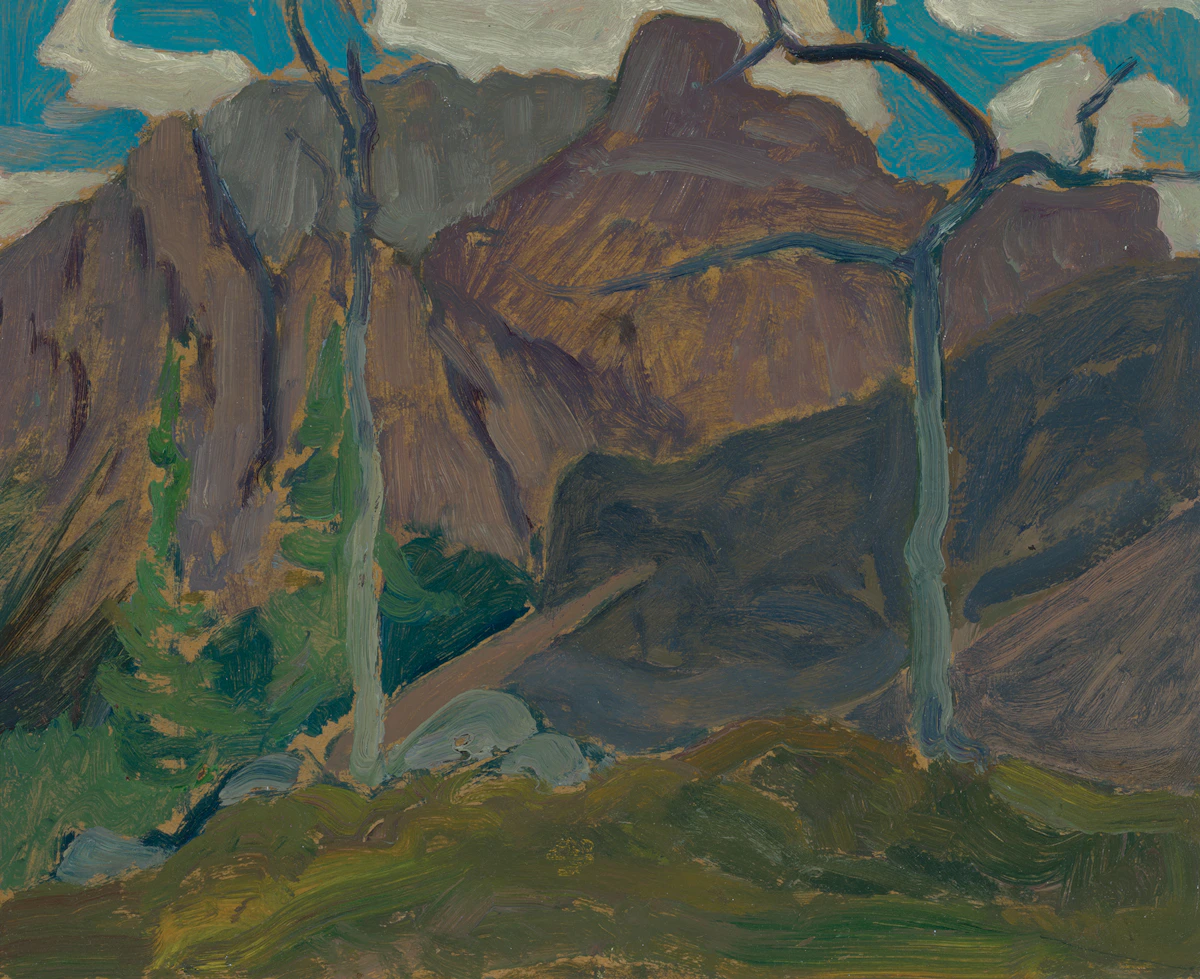
Cathedral Mountain (Wiwaxy Peaks from Above Shäeffer Lake), circa 1927
oil on board
signed and inscribed “c. 1927, Part of Cathedral Mt.” on the reverse
8.5 × 10.5 in (21.6 × 26.7 cm)
Auction Estimate:$70,000 - $90,000
Sale date:November 27, 2024
Price Realized
$70,000
(including Buyer's Premium)
Provenance
Loch Gallery, Winnipeg
Private Collection
Sotheby's, auction, Toronto, 22 November 2012, lot 101
Private Collection
Heffel, auction, Vancouver, 27 May 2015, lot 145
Private Collection, Calgary
As we learn more about J.E.H. MacDonald’s painting sojourns to Lake O’Hara in Yoho National Park, British Columbia, we find that a number of works have been incorrectly described on the back. This is the case with other members of the group as well. With Lawren Harris, we have works that he assigned titles to many years after his plein air work (at Bess’s insistence) or using place names that have changed. Owners have also ascribed incorrect place names to scenes, and researchers (myself included) have taken them at face value. "Cathedral Mountain" is one of these. The work in fact depicts the two towers of the Wiwaxy Peaks, seen from the cliffs above Schäeffer Lake.
In MacDonald’s time, he and his fellow hikers could wander at will at O’Hara, as the directive of staying on established trails to preserve fragile landscapes was not a preservation-based requirement of hikers, as it is today. In fact, many of the trails we enjoy today did not exist in his time. But MacDonald was a confident scrambler, in search of a pleasing height of land and a pleasant, not necessarily unobstructed view, with a good place to sit, preferably a nice flat rock where he could spread his painting kit to work. With his finely-tuned mountain hued-palette at hand, MacDonald wandered to many places that today are off trail, reaching overlooks, gaining expansive vistas. It is easy to imagine him sitting on his coat, pipe in the corner of his mouth, hat pulled low to shade his eyes, sketching this view of the Wiwaxy Peaks, with Mount Huber and the ridge of Mount Victoria showing. Two gnarled and wizened trees in the foreground might be a nod to the work done by the Group in eastern Canada. His confident and free brushwork is clearly visible in this delightful work, which is filled with the joyous appreciation of the Canadian Rockies that permeates all of MacDonald’s mountain works.
We extend our thanks to Lisa Christensen, Canadian art academic and the author of four award-winning books on Canadian art, including "The Lake O'Hara Art of J.E.H. MacDonald and Hiker's Guide" (2003), for contributing the preceding essay.