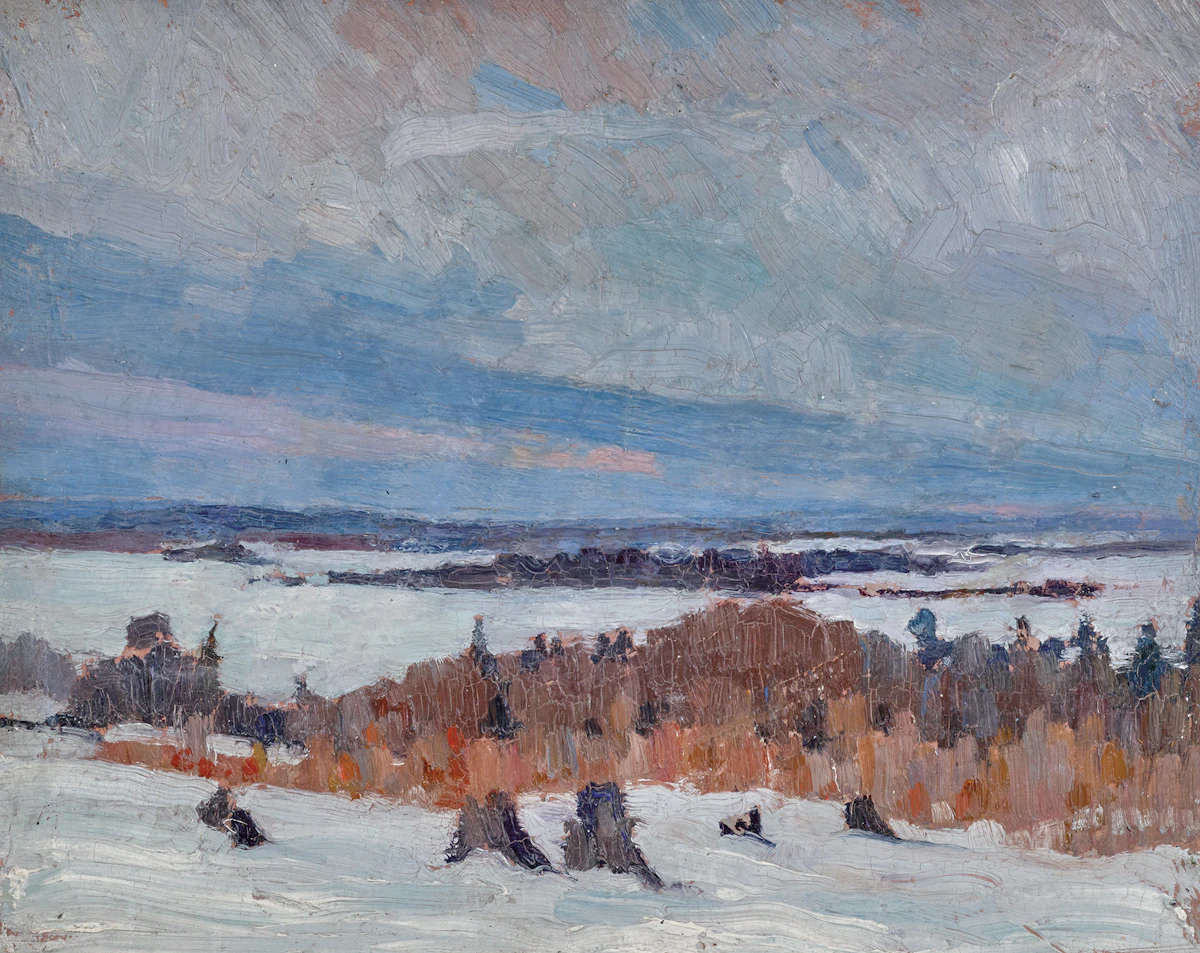
"Estate of Franklin Carmichael" stamp and inscribed "OS-4-S" on the reverse
8 × 10 in (20.3 × 25.4 cm)
Auction Estimate:$25,000 - $35,000
Sale date:November 27, 2024
Price Realized
$24,000
(including Buyer's Premium)
Provenance
Estate of the Artist
By descent to a Private Collection, Ontario
Private Collection
In the fall of 1914, Franklin Carmichael took up residence in the Studio Building, eventually sharing the space with Tom Thomson during the winter season. Thomson had only that year left the commercial art firm, Rous and Mann, in order to devote his full energies to his art, spending as much of the year as possible in Algonquin Park. Carmichael profoundly respected Thomson’s abilities as an outdoorsman and greatly admired Thomson’s painting. For Carmichael, Thomson and the other artists in their circle, life in the wild was an integral part of their visual expression of the landscape, and Thomson’s close relationship with the wilderness deeply impressed Carmichael.
In the fall of 1915, Thomson invited Carmichael to accompany him on a sketching trip to Algonquin Park. Carmichael was unable to go, as his time was already occupied with plans for his upcoming wedding. During this time, Carmichael was balancing his personal life with his passion for art and eagerness to bring change to the Canadian art tradition. The drawings and paintings created between 1915-1919 show Carmichael’s continuing interest in the “untouched” Canadian landscape, foreshadowing the groundbreaking movement that was soon to come. Carmichael was known to sketch on small panels from 1915 to 1916, before changing to a 10 x 12-inch format.