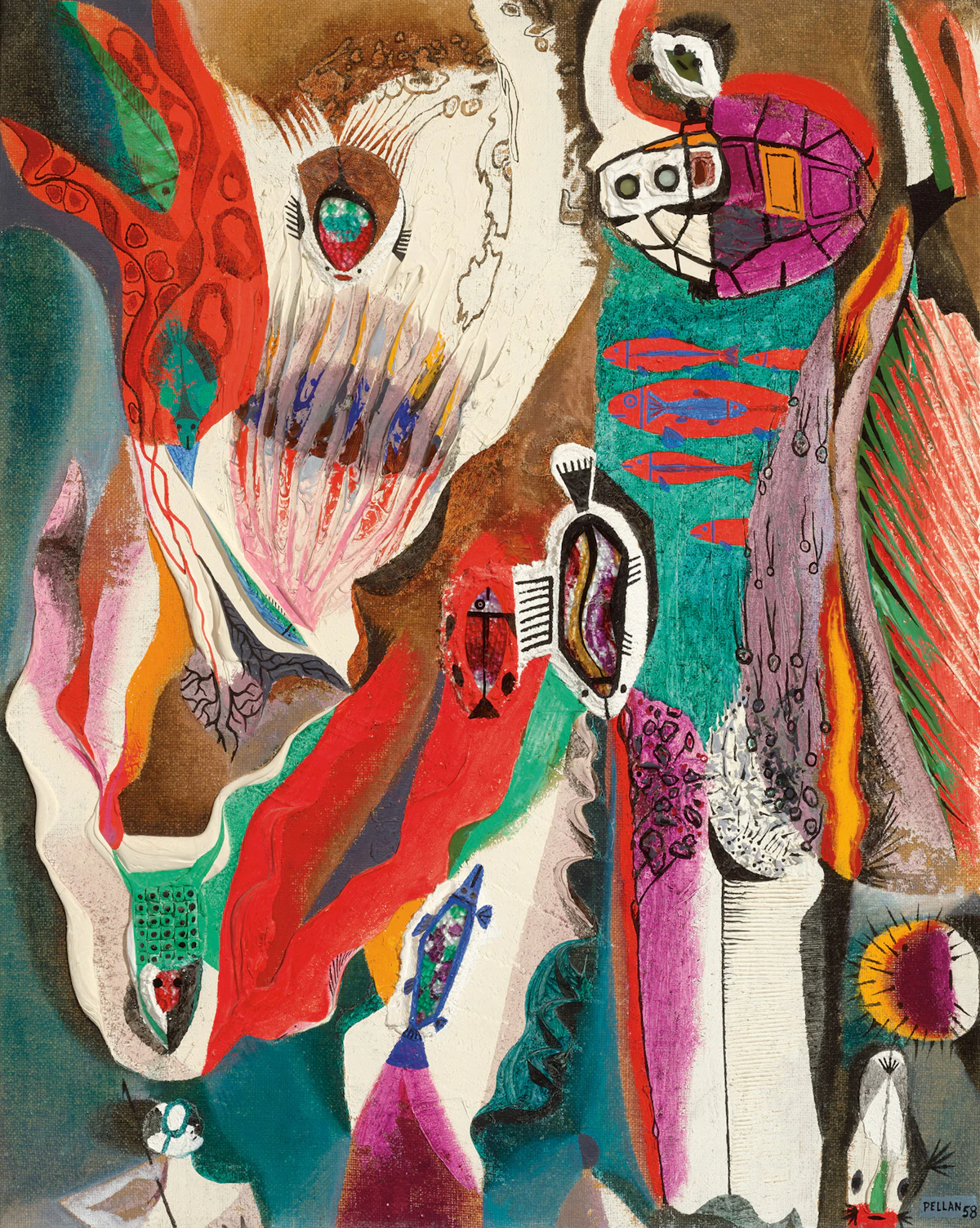
signed and dated 1958 lower right; titled and inscribed "no. 342" on the reverse
29.5 x 23.5 in (74.9 x 59.7 cm)
(including Buyer's Premium)
Roland Dumais, Montreal
Brian Garber, Montreal
Private Collection
Quebec Pavilion, Expo '70, Suita, Osaka, 15 March-13 September 1970
Passion for Art: Works from Private Collections, Glenbow Museum, Calgary, n.d.
G. de la Tour Fondue, 'Pellan', Interviews Canadiennes, Montreal, 1952, pages 125-139
Jean Seguin, 'La peinture', Antennes, vol. 4, no. 2-3, Montreal, 1957, page 15
Donald W. Buchanan, The Gallery of Canadian Art: 4, Alfred Pellan, Toronto, 1962, unpaginated, no. 29, reproduced as La chasse sous-marine, 1958
M. Théberge quoted in Pierre Roberge, 'Pionnier de l’art moderne, Alfred Pellan meurt à 82 ans', La Voix de l’Est (2 November 1988), page 19
F. Javier Monclús Fraga, Exposiciones internacionales y urbanismo: El proyecto Expo Zaragoza, Barcelona, 2006, page 74
In Chasse sous-marine, Alfred Pellan left behind the strict lines and complex compositions of the 1940s to explore plasticity. Its surface is not merely painted but physically constructed: pigment is thickened with plaster-like substance, forming ridges and layered deposits that cast small shadows. The relief becomes part of the composition’s rhythm, alternating between flat, luminous passages and dense, tactile zones. Within these textures, colour behaves almost as matter. It seems alive: it swells, contracts, and dissolves.
The work is a vibrant, layered composition of abstract and organic forms. Recognizable yet stylized elements such as fish-like forms, circular shapes, and curved figures float in almost liquid motion throughout this universe. Seemingly suspended between underwater depth and an abstract colour field, they create a dynamic between silent movement and tactile complexity. These spiralling forms that merge natural forces with dream imagery bridge Pellan’s earlier surrealist vocabulary with the exuberant materialism of the 1960s. This union rests on what Pellan described as a practice “based on emotion and revelation”, shaped through the “unpredictable means of plastic and poetic invention”.
Although Chasse sous-marine may at first appear abstract, Pellan refrained from pure abstraction because he felt it led to a standstill in art. On the contrary, he demonstrated an attachment to the human world, even when his paintings seem to dissolve it. He explained that although he often began a canvas in abstract terms, “reality, the human side, began to graft itself on top of it.” With its metamorphic forms, Chasse sous-marine captures that process. Finned shapes recall fish or marine creatures, while others resemble shells, organs, or mechanical fragments. These hybrid motifs are not representations. They are metamorphoses in which one form begins to suggest another. Their contours shift within the relief as though reality itself were being reassembled under new physical laws.
Chasse sous-marine has remained in private collections since its creation, which partly explains its absence from the scholarly literature on Pellan. Its significance, however, is clear from its inclusion in major exhibitions. The painting was shown on two occasions, most notably at Expo ’70 in Osaka, within a setting devoted to “Progress and Harmony for Mankind”. Building on Canada’s prominent role at the exposition and Quebec’s effort to showcase its modern culture abroad, Pellan’s work offered a distinctly poetic counterpart to the technological optimism of the event. Rather than progress through machinery, he proposed progress through imagination that united invention, sensuality, and wonder.
We extend our thanks to Maria Rosa Lehmann (PhD, Sorbonne University), an art historian and computer science scholar whose research bridges cultural history and technology, for contributing the preceding essay. She has held research fellowships at Brown University, Cornell University, the Université du Québec à Montréal, and the German Center for Art History in Paris. She is the author of the Art Canada Institute monograph on Alfred Pellan (2023) and co-author of a forthcoming book on artist Mimi Parent. She contributed to exhibitions, including Une brève histoire de l’avenir at the Louvre Museum (2015). Alongside her art-historical work, she designs data- driven tools for art-historical research, developing analytical platforms and algorithmic models that map the transnational circulation of the avant-garde.
