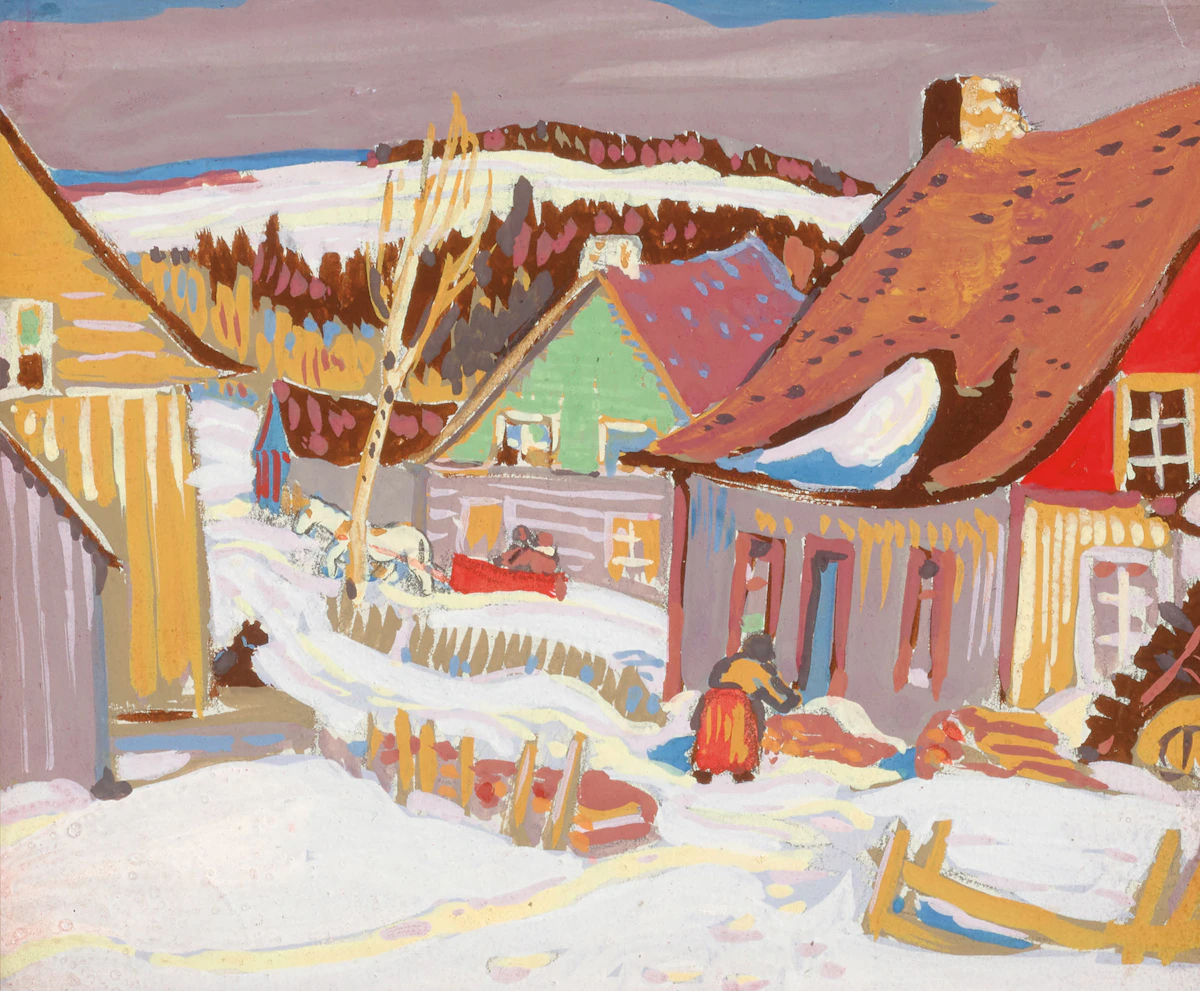
titled and dated circa 1923 on the title plate
5 x 6 in (12.7 x 15.2 cm) (sight)
(including Buyer's Premium)
A. K. Prakash & Associates Inc., Toronto
Masters Gallery, Calgary
Private Collection
The Group of Seven: Fiftieth Anniversary 1920-1970, Ottawa, 1970, unpaginated, reproduced as Near Ste. Irénée
Painted in 1923, Near Ste. Irénée captures A.Y. Jackson’s deep affection for the rural villages of the Charlevoix region, one of his most beloved painting grounds. The view, with its snow-covered road winding between brightly coloured houses and the vast St. Lawrence landscape beyond, exemplifies Jackson’s ability to infuse humble villages with rhythmic design and expressive colour. The artist’s gestural brushwork and simplified forms convey the visual harmony of the scene as well as the vitality of the people who inhabited these communities. Jackson’s recurring and charming motif of a horse and sleigh is present, plodding through the fresh snow.
Jackson first visited Charlevoix in 1920, after he had already moved to Toronto to share the Studio Building on Severn Street with fellow modern Canadian painters. From there, he embarked on regular sketching trips to rural Quebec and northern Ontario, searching for subjects that reflected both the ruggedness and the humanity of the Canadian landscape. He returned to the Charlevoix region many times, particularly the villages along the north shore of the St. Lawrence River, such as Baie-Saint-Paul, Les Éboulements, and Sainte-Irénée. The steep hillsides, clustered wooden houses, and brilliant winter light offered ideal subjects for his modern, distinctly Canadian vision. His depictions from the early 1920s, such as Near Ste. Irénée, balance modernist design with a warm, folkloric sensibility that resonated deeply with his vision of Canadian identity. These works were frequently exhibited with the Group of Seven in Toronto, where they helped define the movement’s signature vision of a distinctly Canadian art.
Jackson worked primarily in oil, and most of his works on paper were pencil or oil sketches. His gouaches are rare in the public market. The gouaches that survive often date to specific trips or commissions, and sometimes served as designs for publication. Having trained as a commercial artist early in his career, Jackson was attuned to how a composition might translate into print. Gouache, being opaque and fast-drying, allowed Jackson to create highly legible compositions with strong tonal contrasts—perfect for lithographic or serigraphic reproduction. Compared to oil, the medium’s flat planes of colour and defined outlines reproduced more cleanly in print. In the 1920s and 1930s, he occasionally provided images for Christmas cards, calendars, and reproductions through companies like Rous & Mann or for fundraising causes such as the Canadian War Memorials Fund or Canadian Artists Series. It is possible that Near Ste. Irénée was conceived with this dual purpose in mind—as both a finished artwork and a design adaptable for reproduction, its bold structure and luminous colour harmonies ideally suited to the printed page.
