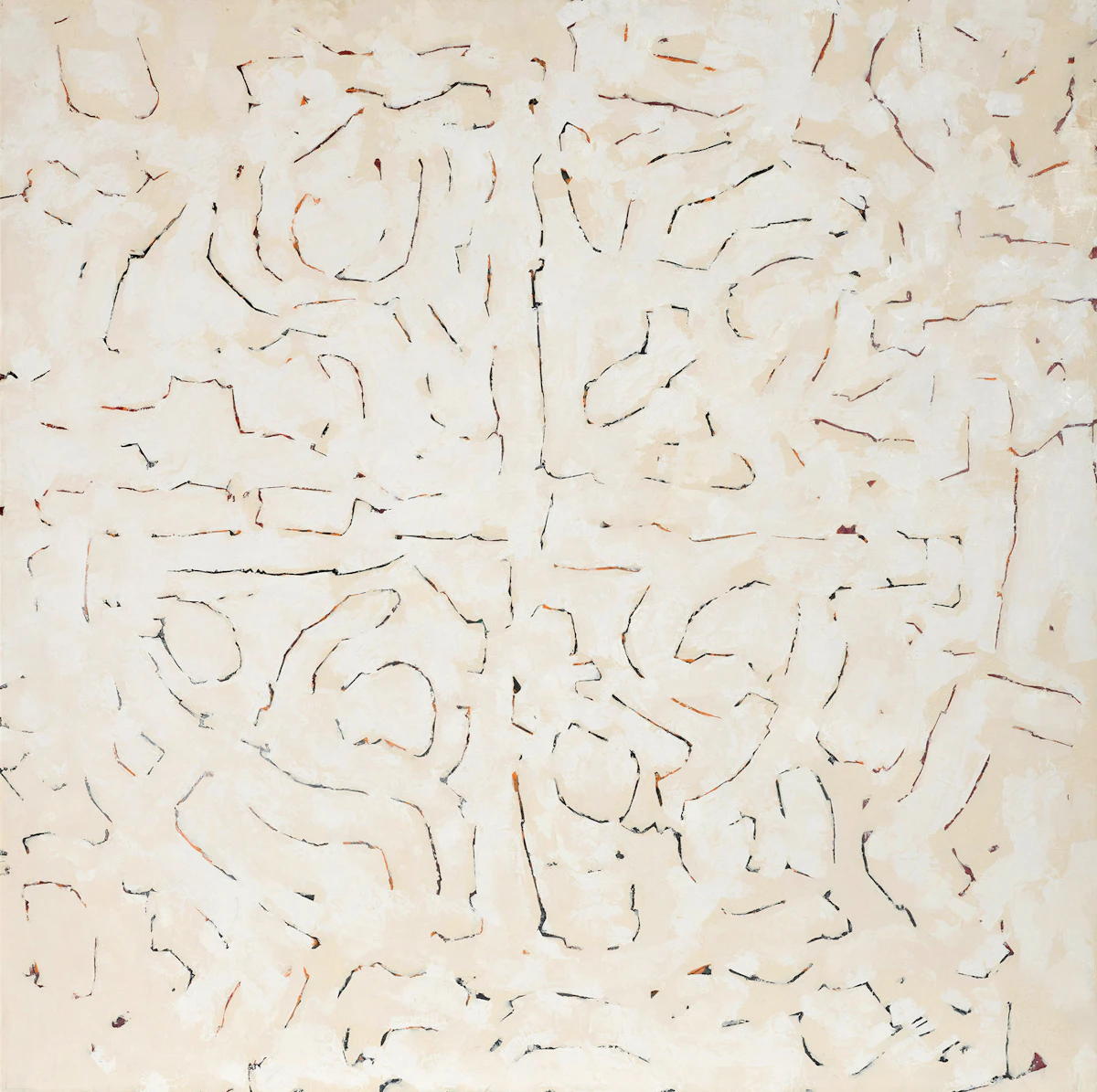
signed and dated "July-September 1961" faintly on the reverse
48 × 48 in (121.9 × 121.9 cm)
Auction Estimate:$15,000 - $20,000
Sale date:May 28, 2025
Price Realized
$16,800
(including Buyer's Premium)
Provenance
Moore Gallery Limited, Toronto
Private Collection
In 1958, Ronald Bloore, then the director of the Norman MacKenzie Art Gallery in Regina, brought national and international exhibitions to the city. He and four other abstract painters—Kenneth Lochhead, Arthur McKay, Douglas Morton and Ted Godwin—shared a common professional commitment and became a small but active artistic community. Having studied throughout Canada, the United States, and Europe before moving to Regina, the artists combined the major currents of abstract expressionism in the context of 1950s Saskatchewan.
Bloore organized "The May Show" in 1960 to coincide with the meeting of the Canadian Museums Association. The show featured the five prominent abstract artists as well as architectural drawings and models by architect Clifford Wiens and sculptures by Wolfram Niessen. The exhibition drew national attention and inspired Richard B. Simmins, Coordinator of Extension Services at the National Gallery of Canada, to select the work of the five artists for a travelling exhibition titled "Five Painters from Regina". The exhibition appeared in 1961 in Ottawa and Simmins' essay in the catalogue stressed the importance of Ron Bloore and his influence on Emma Lake Workshops. Simmins wrote that Bloore brought to Regina a set of values which challenged the other painters. Bloore painted this large untitled composition in 1961, the same year as the National Gallery exhibition with the group who would become known as “The Regina Five”.
Bloore studied archaeology throughout his undergraduate and graduate studies, which influenced the geometric forms and off-white colour palettes of his abstract work. From 1973-1974, the artist travelled to Greece, Turkey, Iran and Spain. Bloore became inspired by the symbolism and archaeological quality of the remaining architecture of these early civilizations. Upon his return to Canada the following year, Bloore destroyed all his previous work and renounced the use of colour. He hoped to achieve the same transcendental quality he felt while looking at ancient architecture. The light, monochromatic palette of this untitled work from over a decade earlier appears to foreshadow this declaration and official renunciation of colour.