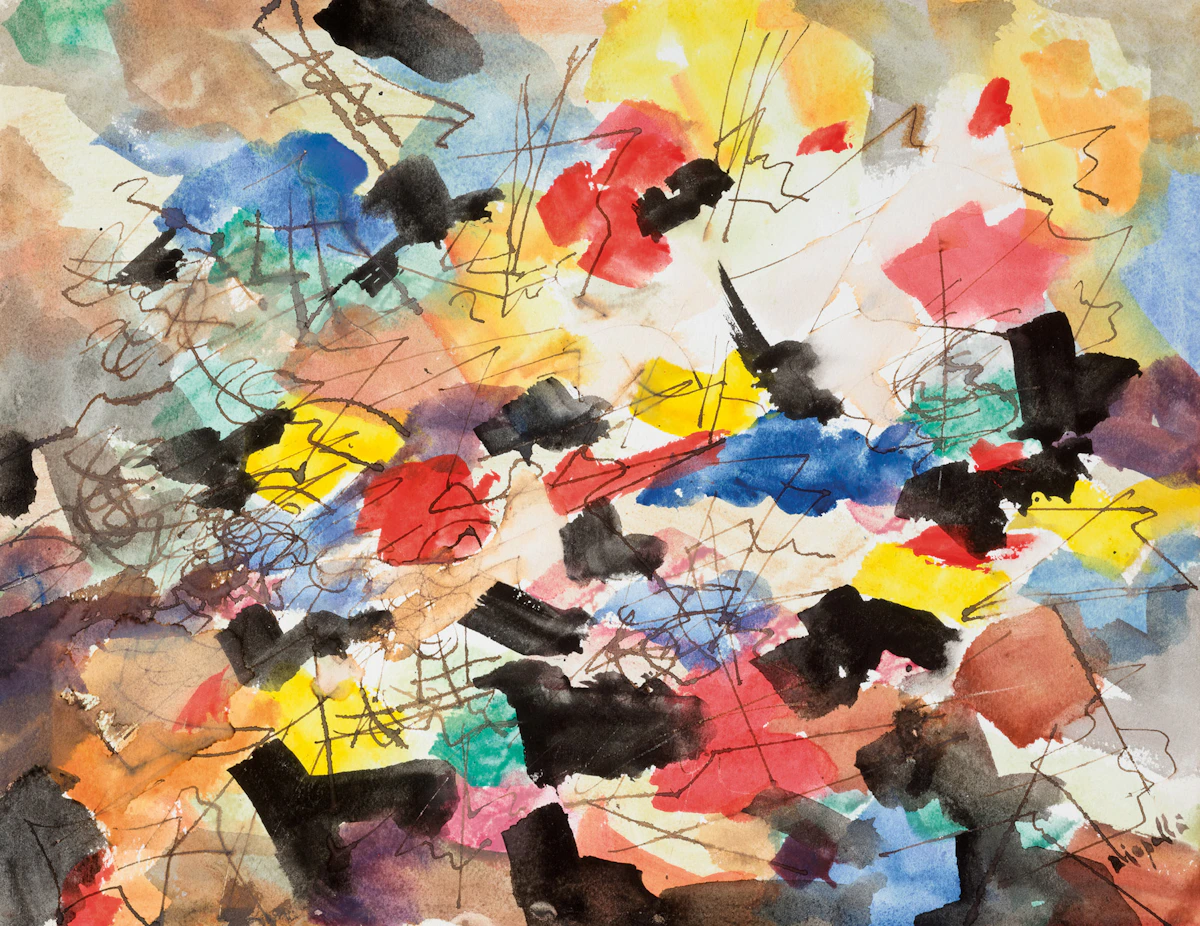
signed lower right; catalogue raisonné no. 1947.089P
10 x 12.5 in (25.4 x 31.8 cm) (sheet)
(including Buyer's Premium)
Estate of Robert Noakes
François-Marc Gagnon, Jean Paul Riopelle: Life & Work [online publication], Art Canada Institute, Toronto, 2019, page 56
After reading André Breton's Le Surréalisme et la peinture in 1945, Jean Paul Riopelle was inspired to break away from tradition to pursue non-representational painting. He used ink and watercolour to explore spontaneous, abstract forms, letting gesture, chance, and texture play a role. Riopelle created several small watercolours during these years, consisting of web-like black lines that blur the distinction between foreground and background. The use of ink and watercolour allowed looseness and immediacy–qualities that carried into his mature “mosaic” works.
In 1947, Riopelle moved to Paris to continue his career, where, after a brief association with the Surrealists, he developed his mature style of lyrical abstraction. He participated in the first Lyrical Abstraction exhibition, which took place at the Galerie du Luxembourg in Paris in 1947, and included fourteen participants such as Riopelle and Fernand Leduc. Another participant, French artist Georges Mathieu was enthusiastic about the “new Canadians” and their automatism, which he admired for its “advantageous submission to the demands of spontaneity, pictorial indiscipline, technical chance, romanticism of the brush, the overflowing of lyricism.”
Riopelle’s watercolours form a significant part of his oeuvre, revealing his artistic development as he moved from early automatic writing toward the bold, “mosaic” oil paintings that defined his mature style. These works also illuminate how post-war Canadian abstraction engaged with and transformed the legacy of European Surrealism into a distinctly local movement.
We extend our thanks to Mme Yseult Riopelle for her assistance in researching this artwork and for including the artwork within the Jean Paul Riopelle catalogue raisonné.
