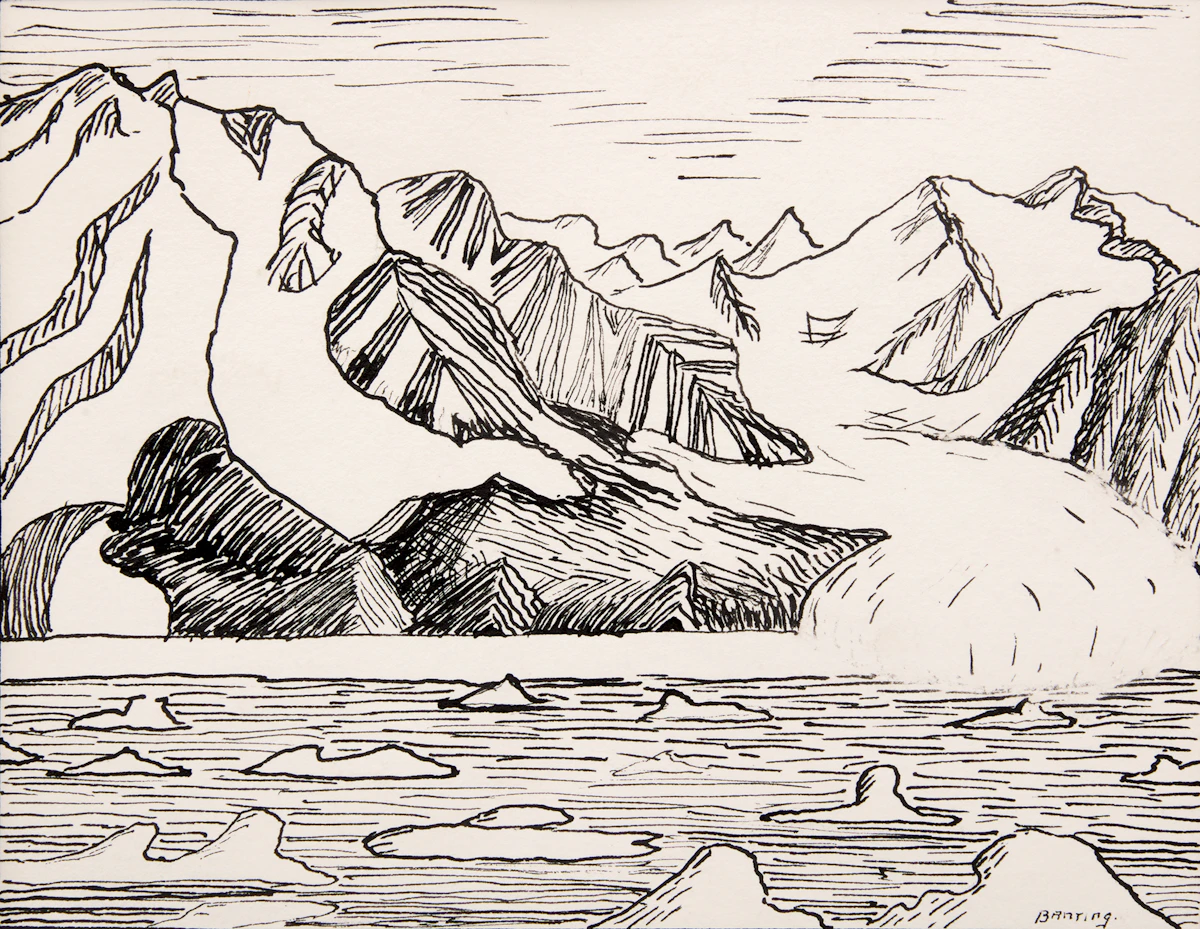
signed lower right; titled in the lower margin with further notations in the margins
4.75 × 6 in (12.1 × 15.2 cm)
Auction Estimate:$4,000 - $6,000
Sale date:November 27, 2024
Price Realized
$12,000
(including Buyer's Premium)
Provenance
Collection of the Artist
Miss Sadie Gairns, Toronto
Family of the Artist (a gift from Sadie Gairns)
Literature
Naomi Jackson Groves, "A.Y. Jackson, The Arctic", 1927, Moonbeam, Ontario, 1982, unpaginated
Michael Bliss, "Banting: A Biography", Toronto, 1984, pages 170-172 D.B.G. Fair, "Banting & Jackson, An Artistic Brotherhood", London, Ontario, 1997, pages 9-10
A.Y. Jackson and Frederick Banting spent from mid-July to September of 1927 travelling throughout the Arctic on board the "Beothic", a supply ship that served the eastern Arctic. The two friends encountered a variety of weather and light conditions in the Arctic landscape. Banting was accommodated as a guest, receiving a telegram from Ottawa less than a week before sailing, stating, “Can offer nothing luxurious. If you are prepared to face the hazards of the north and assume the responsibility Department will be glad to have you.”
This government icebreaker supplied remote settlements and RCMP posts on Baffin and Ellesmere Islands and other such areas, which are still remote to most Canadians. The first stop along this arctic route was in Godhavn, Greenland, the last Port Burwell. D.B.G. Fair describes this as “perhaps the most significant of both artists’ careers.” Immediately upon their return, Jackson exhibited his oil sketches and ink drawings at the Art Gallery of Toronto (now the AGO) and published "The Far North" in 1928.
Banting celebrates the grand drama of the Arctic in "Bylot Island" and "Etah", writing, “Sketching was done under considerable difficulty; cold and wind would have chilled the enthusiasm of a less ardent worker. The barren wastes proved to be rich in form and colour, strange rhythms and unexpected vistas.” Jackson and Banting could not keep up with capturing the passing landscape from the moving ship and reverted to pencil drawings instead of oil on small wooden panels.
Banting’s biographer, Michael Bliss, describes the men as, “fascinated by the forms and colours of the Arctic, especially the stark rocks and the interplay of light and ice. For Jackson, however, the trip seems to have meant more in the development of his sense of Canadian geography and nationalism than his evolution as a painter. Neither artist was particularly interested in the fauna of the Arctic, although Banting did procure a long narwhal tusk which still resides in the Arts and Letters Club as his gift from the North.” Over the years Banting accompanied Jackson on many sketching trips. At different times, they returned to the North shore of the St. Lawrence, travelled to the Great Slave Lake area, and visited the Group of Seven haunt, Georgian Bay.