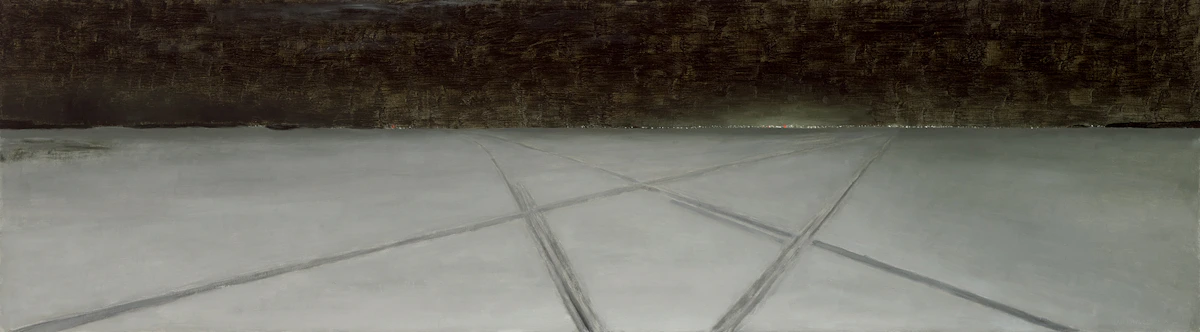
signed and dated 1967 lower right; titled on the stretcher
19.5 × 70.25 in (49.5 × 178.4 cm)
Auction Estimate:$100,000 - $150,000
Sale date:November 27, 2024
Price Realized
$120,000
(including Buyer's Premium)
Provenance
Galerie Agnès Lefort, Montreal
Edgar and Dorothy Davidson, Montreal/Ottawa, 1972
Heffel, auction, Toronto, 24 November 2011, lot 32
Private Collection, Toronto
Literature
Michèle Grandbois, "Jean Paul Lemieux: Life & Work" [online publication], Art Canada Institute, Toronto, 2016, pages 55, 61, 63
In a world that was rapidly changing around him, Jean Paul Lemieux responded with a body of work in which time seems to stand still, inviting the viewer to pause for contemplation and meditation. The artist explained that he had needed to “change environment, to get out of the country to get to know it better by observing it from a distance”. In 1955, upon returning from a one-year sabbatical in France as a grant recipient from the Royal Society of Canada, Quebec’s territory appeared to him in all its vastness and northernness. He came to grips with the fragility – and futility – of the human destiny when faced with the infinite horizons of the immense country that he called home. Jean Paul Lemieux’s work thus entered its classical period (1955-1970), which is the most familiar to art lovers and the general public. Using minimal form and colour, the artist succeeded in maximizing the expression of the Nordic Expressionist tradition: endless expanses of whiteness glisten with light under a horizon; characters of all ages cast a steady and penetrating gaze upon the viewer, exhibiting solitude and human frailty. From this point on, Lemieux’s vision of his world becomes austere, bare and masterful.
During the 1950s and 1960s, as Quebec was experiencing a period of artistic innovation with flourishing avant-garde abstract movements, Lemieux turned away from narrative to focus on the flat space of the picture plane. He never fully embraced abstraction, however; the artist rather painted large, empty landscapes with a bare horizon line or a figure in the foreground. These features came to be the defining traits of Lemieux’s “classic period”, categorized as dating between 1956 and 1970. Michèle Grandbois writes that the artist’s deserted landscapes from this time, which include "Le croisement" dating to 1967, “are charged with feelings of time passing, of death, of the human condition, and of the loneliness and smallness of human beings before the infinite horizons of the vast landscapes of Canada.” The oil painting presents a view of a snow-covered field at night, barren of any human presence save for some overlapping tracks along the ground. These tracks are also the main element that keeps the composition in the figurative realm, though on the edge of abstraction. The soft brushstrokes and very limited and muted colour palette is calming, yet almost eerie. The colour scheme is also in keeping with the period: Grandbois remarks that “his palette was now limited to just a few pigments: olive green, white, shades of ochre, earth colours, and red. [...] Lemieux used subdued, in-between shades that accorded with the meditative nature of these canvases. The softened tones parallel the evocation of memory, and the monochrome or oligochrome (reduced) palettes add to the effect of immensity created by the horizontal format.”