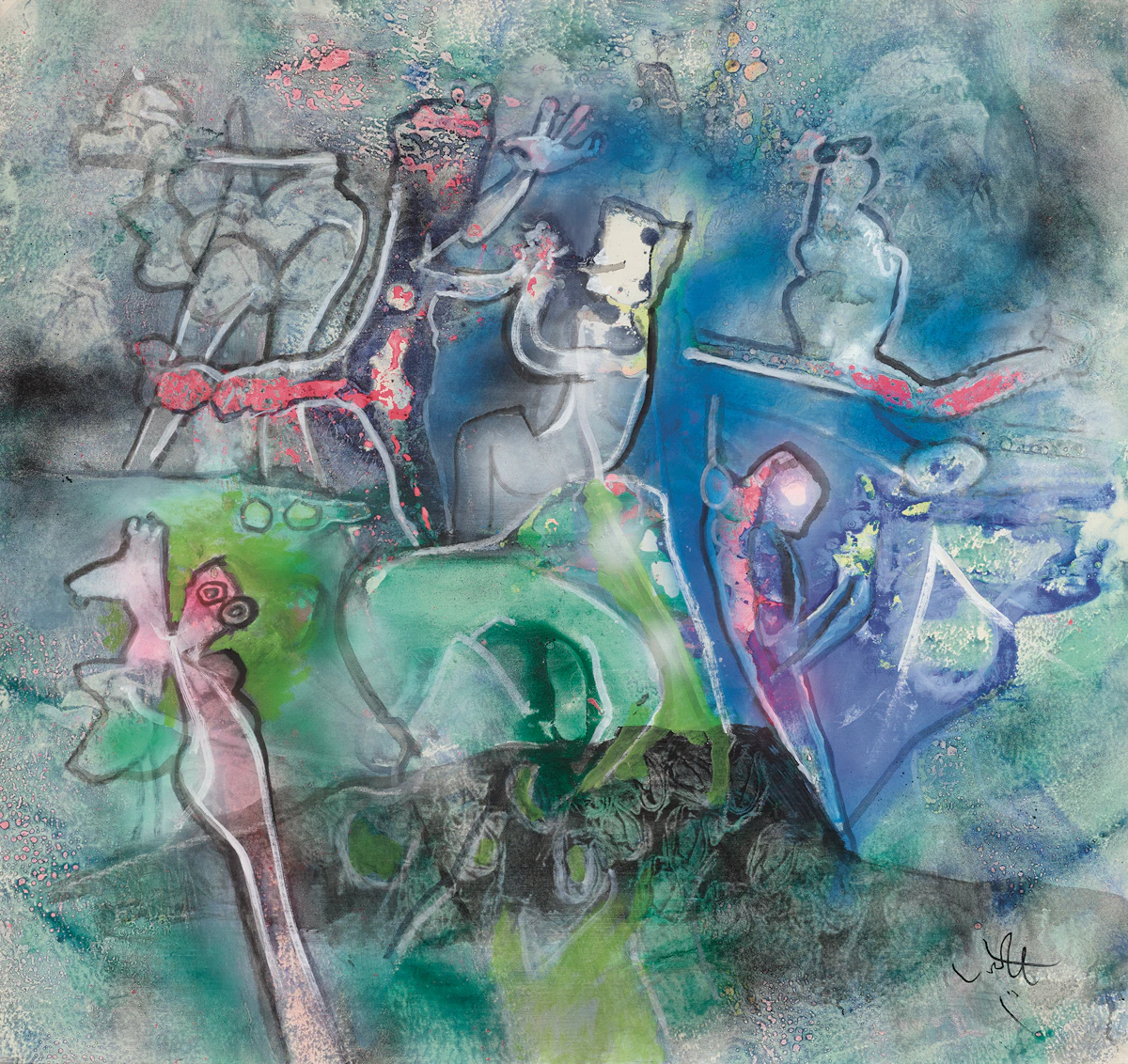
signed lower right; titled on the stretcher, dated 1990 and inscribed "90/77" on the reverse
38 × 40.25 in (96.5 × 102.2 cm)
Auction Estimate:$30,000 - $50,000
Sale date:November 27, 2024
Price Realized
$30,000
(including Buyer's Premium)
Provenance
Skot Foreman Fine Art, Miami
Private Collection
Literature
Elizabeth Goizueta, "Matta: Making the Invisible Visible", Boston, 2004, page 31
The Chilean artist Roberto Matta is widely acclaimed for his contributions to Surrealism and Abstract Expressionism through his dynamic and vibrant paintings. He was born in Santiago, Chile, in 1911 before moving to Paris in the 1930s and working as a draughtsman in Le Courbusier’s architecture studio.
With the outbreak of the Second World War, like many other European modern artists in Paris, Matta left for the United States, arriving in New York in the winter of 1939. During family visits to Spain, Matta became acquainted with the Spanish poet Frederico García Lorca, who would provide an introduction to Salvador Dalí, who, in turn, would refer him to the father of surrealism, André Breton. As well as being associated with the surrealism movement, after arriving in New York, Matta befriended abstract expressionists, including William Baziotes, Jackson Pollock, Robert Motherwell, and Arshile Gorky.
In her essay, "Roberto Matta: International Provocateur", Mary Schneider Enriquez captures the essence of the artist’s intention, “Critical to Matta’s work from the outset was the use of spontaneous expression as a means to articulate a reality unseen—meaning the place beyond the visible where time and space merge.” This is a later painting by the artist, reminiscent of his earlier works. Here, Matta pursues his exploration of anthropomorphic shapes interacting and flowing throughout the composition by pouring, wiping, spraying and brushing bright colours across the canvas. Enriquez explains further, “Even when Matta’s art lacks obvious visual references, his themes link to human beings and their place in the universe, in which the natural world plays a central role.”
Matta’s works feature prominently in public and private collections, including The Museum of Modern Art in New York, the Walker Art Center in Minneapolis, the Tate Gallery in London, and the Peggy Guggenheim Collection in Venice.
We are grateful to The Matta Archives for confirming the authenticity of this work.