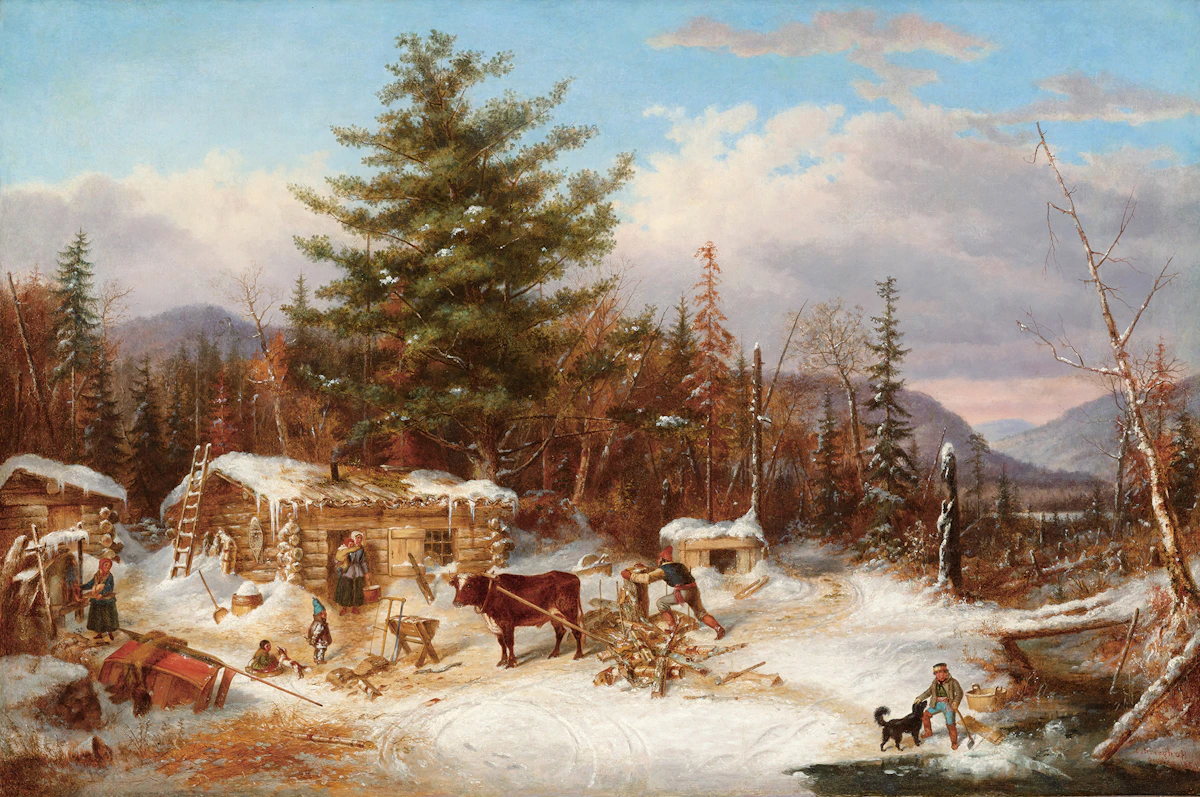
signed, dated 1859 and inscribed “Quebec” lower right
24 × 36 in (61.0 × 91.4 cm)
(including Buyer's Premium)
M. Reford, Quebec Walter Klinkhoff Gallery, Montreal A.K. Prakash & Associates, Toronto (2005) Masters Gallery, Calgary Private Collection
"Exhibition of Paintings by Cornelius Krieghoff 1815-1872", National Gallery of Canada, Ottawa; travelling to the Art Association of Montreal, February-March 1934, no. 114 as "Settler's Log House", 1856
Exhibition of Paintings by Cornelius Krieghoff 1815-1872, Ottawa, 1934, no. 114, listed page 18 as Settler's Log House, 1856 Marius Barbeau, "Cornelius Krieghoff: Pioneer Painter of North America", Toronto, 1934, page 52, listed page 107 as "Settler's Log House", 1856 David Burnett, "Masterpieces of Canadian Art from the National Gallery of Canada", Alberta, 1990, page 26 Dennis Reid, "Krieghoff: Images of Canada", Toronto, 1999, page 85
During the late 1850s to the early 1860s, Cornelius Krieghoff travelled extensively throughout Quebec-from the Ottawa River, to the Saint- Maurice River, to Shawinigan Falls, to the Eastern Townships. It was during this period that he achieved great success as an artist, with a prolific output of canvases keenly pursued by buyers. Krieghoff understood his audience’s tastes and was versatile in his themes. As David Burnett remarks, “Krieghoff’s years in Quebec were not only the height of his success but were also the time when he produced his finest work.” Krieghoff specialized in genre paintings of the people of Quebec and their lives in the nineteenth century. "The Settler’s Log House" is a remarkable anecdotal image of the beginnings of settlement in the depths of winter in the Quebec region. While pioneer life was rugged and precarious, it was also a productive and fruitful time for the artist as he recorded the industry and ingenuity of the people. Marius Barbeau, the first biographer of Krieghoff, lists twelve known versions of this subject, painted between 1855 and 1862. According to Barbeau, “The series of twelve Settler’s Log Houses in Winter (1856-1862) is characteristic of the new settlements of Stoneham and Laval in the Laurentians, where the artist frequently went with Lorette guides and Quebec sportsmen to hunt the moose and the wild deer. It also opens up a chapter in pictorial forest life which has left deep traces in the character of many French-Canadian people.” A similar variant to this 1856-1859 painting is "Settler’s Log House", an 1856 canvas in the collection of the Art Gallery of Ontario. Both canvases depict a house built of round logs on cleared land, with figures of a habitant family in various stages of work. However, "The Settler’s Log House" has the addition of an outbuilding, along with the main house of round logs. Krieghoff has possibly depicted a settlement in its second year on the land, as there is no horse or sleigh, just a sturdy ox and sledge placed squarely as the central focus. The family is represented hard at work with all the figures in the family in the midst of executing their designated tasks. Only the smallest of children remain idle, while still engaging in the cold, winter environment by sledding and playing with the dog. This harmonious family of self-sufficiency offers an image where man lives in unity with nature. Dennis Reid remarks on "Settler’s Log House" in the collection of the AGO, stating, “A huge pine tree immediately behind the house, seeming to shelter it, exemplifies the strength of this ‘natural order’. A brilliant sky celebrates it.” This sentiment of natural order and strength is shared in "The Settler’s Log House", as the enormous pine tree in the background solidifies both the composition and the orderly homestead scene. The sumptuous elements of this painting are rendered in Krieghoff’s quintessential masterly hand. From the architectural detail of an early settler’s home, to the aspects of habitant life and the picturesque Laurentian mountains rising in the background, the work is a compositional delight, brimming with immense detail, rich colour and descriptive tone. Reid shares, “It was two or three years after moving to Quebec before Krieghoff returned with any real interest to habitant scenes, but in 1856 a series of ambitious canvases began to appear.” "The Settler’s Log House" is certainly one of these ambitious canvases representing early settlement in Canada. Krieghoff would have encountered these farmsteads up the St. Maurice and Shawinigan Rivers, in the hinterlands up the Montmorency and beyond Lake St. Francis. Krieghoff produced dignified paintings that were romantic in nature, evoking the deep roots of the people he encountered and leaving a view of historical Canada in his vision. Reid argues for “the complex genesis of Krieghoff’s images of Canada”, in which this canvas holds a prominent place. The rarity of a canvas with such an abundance of figures, exquisitely rendered detail and narrative strength is paramount. Brimming with pathos, sentimentality, drama, and, above all, accuracy, Krieghoff’s works are a true record of his surroundings.
