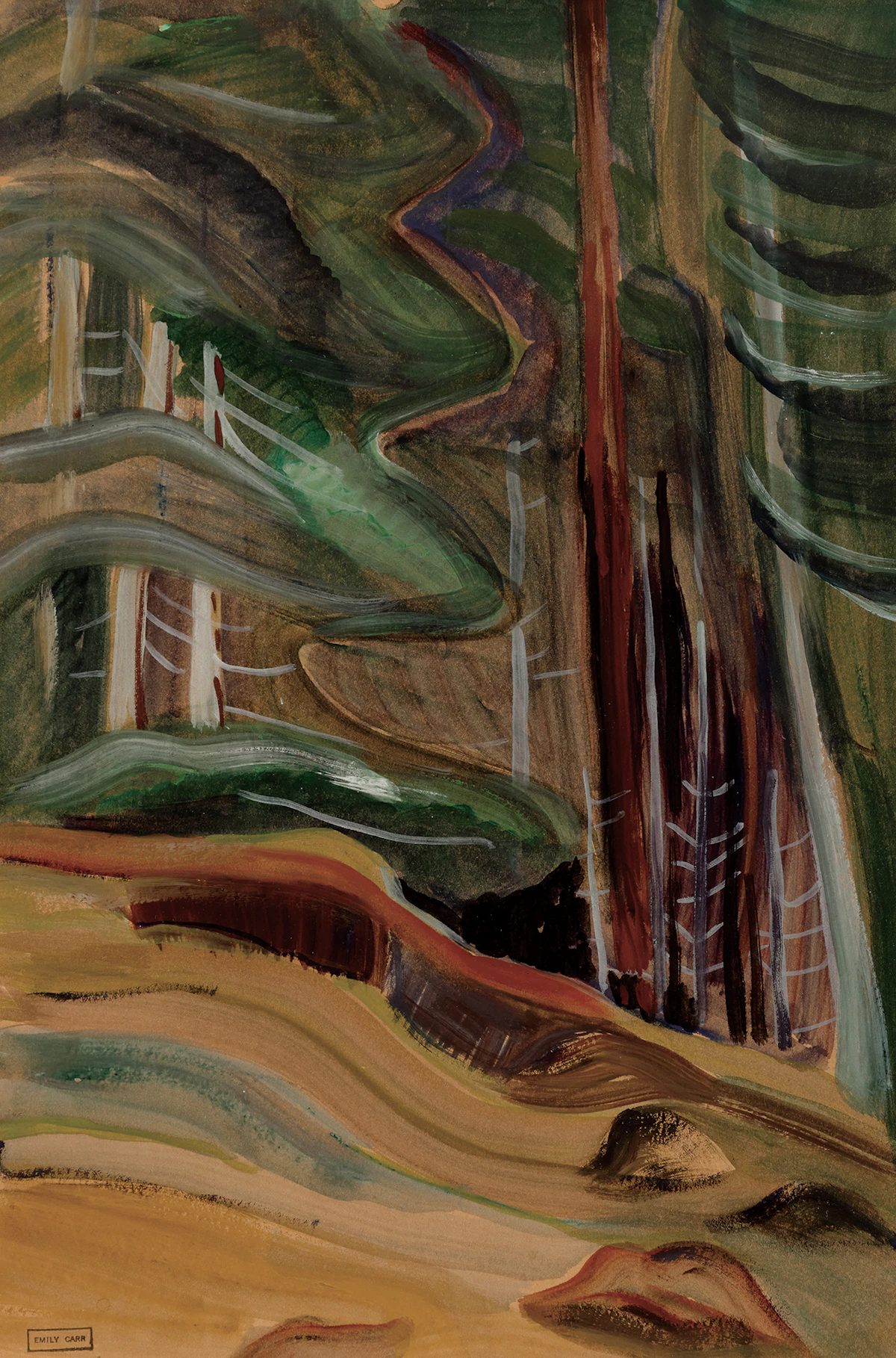
Lisa Baldissera, “Emily Carr: Life & Work” [online publication], Art Canada Institute, Toronto, 2021, page 91
Emily Carr’s late period works demonstrate the artist's commitment to a subject of central importance to her: the natural beauty and mystery of the forest. After suffering a heart attack in 1937, Carr’s health increasingly curtailed her ability to paint outdoors. But with characteristic determination, the artist simply adapted her methods and utilized a central base, from which she could manage short excursions. She also adjusted her preferred materials, opting to paint with diluted oil on paper. Carr used oil–based commercial house paint rather than artist’s oils, which she thinned with solvents to a creamy consistency. This allowed her to quickly build her compositions, starting with thin washes, then add thicker paint while responding immediately to her observations and emotions. Working with oil on paper allowed Carr not only greater portability, but also the immediacy of watercolour in a more robust medium.
“The Forest Edge” is infused with the directness and honesty characteristic of Carr’s late paintings. Here the artist appears to rejoice in the natural rhythms she found in forest glades. The entire pictorial surface is alive with fluid movement. In areas, the paint is applied with the translucence of watercolour. The light in the painting is subdued but present, as in the interior of a gothic cathedral. The unadorned immediacy of this work conveys the artist’s feeling of humility before nature, a feeling bound up with her deeply–held spiritual beliefs. Writing on Carr’s late period works of 1937–42, Lisa Baldissera observed: “The works from these final years... emerge from the depths of the forest: light and open sky play a greater role, and movement in nature is married to her brushwork. The static forms of earlier work give way to roiling, open mark making and loose passages of colour. These works are atmospheric, light, and vibrant, and reference a wide variety of styles.”