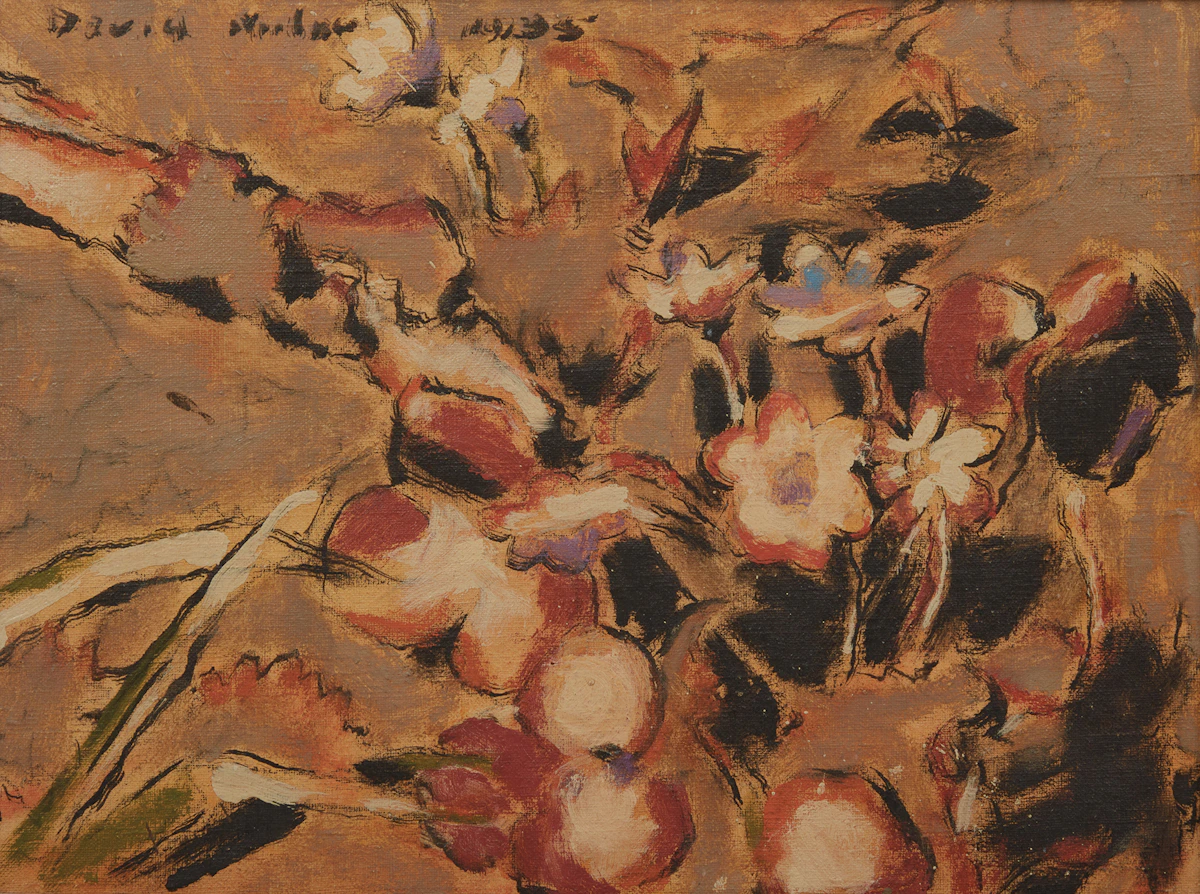
signed and dated 1935 upper left; Milne catalogue raisonné no. 304.20
12 × 16 in (30.5 × 40.6 cm)
Auction Estimate:$40,000 - $60,000
Sale date:December 6, 2023
Price Realized
$45,600
(including Buyer's Premium)
Provenance
The Rt. Hon. Vincent Massey, Port Hope
Laing Galleries, Toronto
Isabelle Erskine, London, Ontario
By descent to a Private Collection
Joyner Waddingtons, auction, Toronto, 3 June 2013, lot 40
Private Collection, Toronto
Exhibited
“David Brown Milne”, Kitchener–Waterloo Art Gallery, 11 January– 3 Februrary 1963
“The David Milne Cameo Exhibition”, London Regional Art Gallery, 16 July–12 September 1982
Literature
Rosemarie L. Tovell, “Reflections in a Quiet Pool: The Prints of David Milne”, Ottawa, 1980, page 7
Heather Bruce, “The David Milne Cameo Exhibition”‚ London, 1982
Ian M. Thom, “David Milne”, Vancouver/Toronto, 1991, page 133
David Milne Jr. and David P. Silcox, “David B. Milne: Catalogue Raisonné of the Paintings, Volume 2: 1929–1953”, Toronto, 1998, page 602, reproduced page 601, catalogue raisonné no. 304.20
“Primary Sources”, David Milne B list 33, UTA; Massey inventory, NAC; Laing sale records, unnumbered, Estate of Blair Laing
David Milne returned permanently to Canada in 1929, famously living and painting in the rural landscapes of Temagami, Weston and Palgrave. In April 1933, Milne parted ways with his wife Patsy and undertook a canoe trip on Lake Couchiching, before settling at the remote Six Mile Lake in Muskoka, Ontario in a cabin he constructed himself. It was during this period that the artist spent his days painting, journaling and maintaining a humble lifestyle in the seclusion of the wilderness. In his personal journal entries, Milne wrote: “I have too the taste for few and simple things extended to an almost abnormal dislike for, and impatience with, possessions that are more than bare essentials. I like to think that my leaning toward simplicity in art, is a translation of hereditary thrift, or stinginess, into a more attractive medium.” This period was an exceptionally productive time for the artist and would see him explore a focus on landscape and still-life painting that express a deep spiritual connection to the natural world.
“Bush Flowers” was completed in 1935 and illustrates the artist’s unique approach to colour and composition during the 1930s. Milne often employed a sparse and reduced palette that included the use of whites, greys and blacks to create an area of strong contrast known as a “dazzle spot.” Authors Milroy and Dejardin describe Milne’s so-called dazzle spot as being designed to direct the viewers’ eye toward the essence of a painting. Often referred to as the Master of Absence, David Milne was known for his ability to reduce a painting to its bare essentials, yet still retain its essence. Milne observed that: “The painter gets an impression from some phase of nature … he simplifies and eliminates until he knows exactly what stirred him, sets this down in colour and line and so translates his impression into aesthetic emotion.” Though directly influenced by the well-known French Impressionists Claude Monet and Henri Matisse, Milne’s unique ability to capture the essence of his subject, rather than its details, made him distinct.
By the mid 1930s, Milne's art would flourish under the patronage of Alice and Vincent Massey, whose association with the Canadian art dealer Douglas Duncan propelled the artist into a broader community of influential writers, critics and collectors. This association marked the beginning of a long-term friendship and by 1938, Duncan became the exclusive representative of Milne’s work. From Six Mile Lake, paintings were sent to exhibitions in Toronto, Ottawa, Chicago, New York and the Tate Gallery in London, England. The artist’s Six Mile Lake period lasted from 1933 to 1939 and encapsulates the inventiveness and clarity of vision that are hallmarks of the artist’s oeuvre.