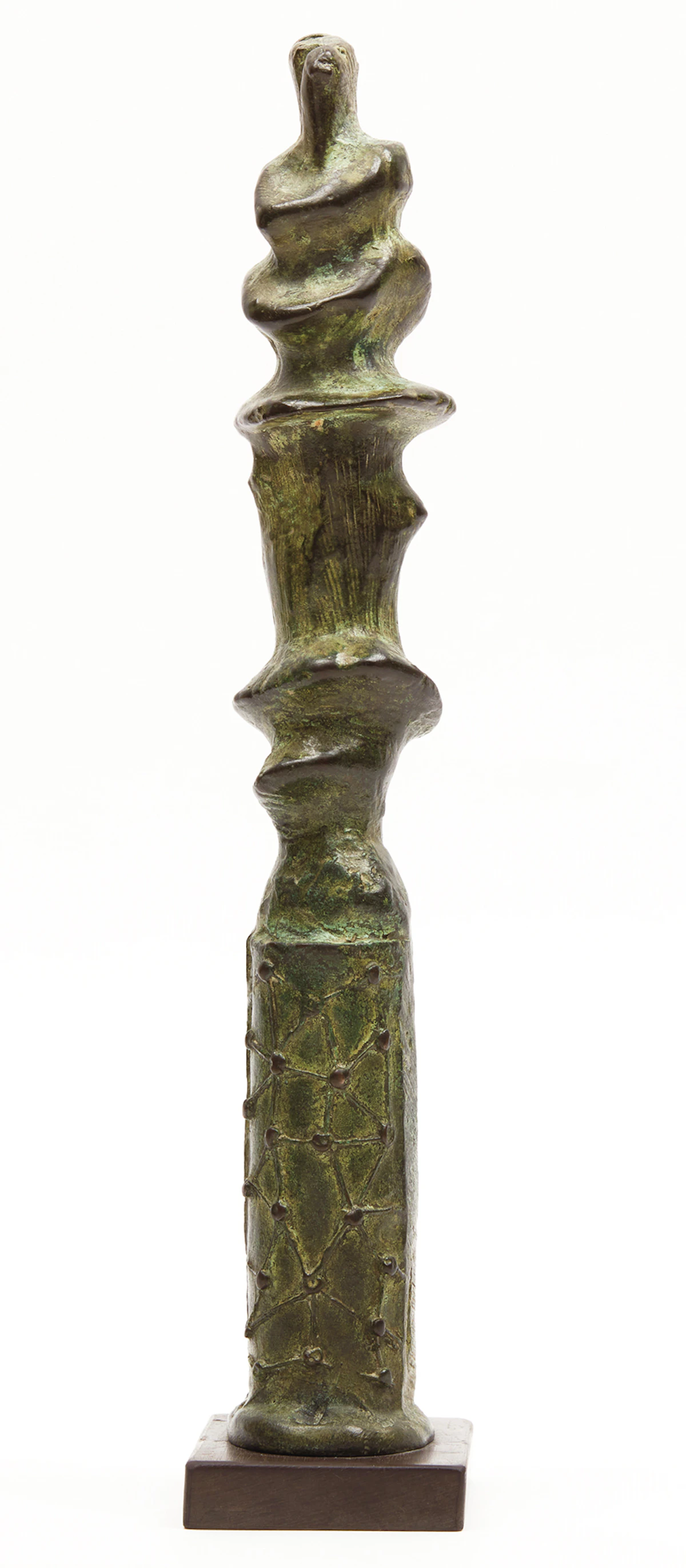
Foundry Fiorini Limited, London, United Kingdom. From an edition of 9
12.5 x 2 x 2 in (31.8 x 5.1 x 5.1 cm) (overall, including base)
Auction Estimate:$15,000 - $20,000
Sale date:May 30, 2024
Price Realized
$15,600
(including Buyer's Premium)
Provenance
William Enterprises Inc., Beverly Hills, no. 1579
Private Collection
These bronze sculptures dating from 1955 are from one of Henry Moore’s most prolific periods when he became the leading artist of post-war humanism, expressing the British ideology of social cooperation and reconstruction through ambiguous and universal figures. Unlike the First World War, the years following World War II in Britain did not lead to raising sculptural monuments to the dead. As art historians Penelope Curtis and Fiona Russell explain: “the sculpture of Moore, memorialised places... [because] it was the British landscape, and the way in which that landscape appeared to embody a British ‘way of life’ which had been in greatest danger.”
The association of Moore’s sculpture with Britain’s landscape would thus become
a dominant motif within the critical positioning of his work. These two bronzes, measuring less than twelve inches each, are representations on a smaller scale of Moore’s series of large "Upright Motives", reminiscent of North American totem poles and works from New Ireland in Papua New Guinea. Their verticality and abstract features ultimately reveal Moore’s return to some of the concerns of his pre-war Surrealist phase. His vocabulary of organic forms, whether reclining or upright, leads to a universal reading of his work, providing an image of humankind that is both contemporary and timeless.