Laing Galleries, Toronto
Kastel Gallery, Montreal
Private Collection, Montreal
Sotheby’s Canada, auction, Toronto, 19 November 2007, lot 180
Private Collection, Ontario
Exhibited
“Paysages du Québec 1900-1948”, Musée Marc–Aurèle Fortin, Montreal, 22 June –3 September 2001
Although Homer Watson had almost no formal training, his acclaimed rural landscape paintings made him one of the central figures in Canadian art of the late 19th and early 20th centuries. A native of Doon, Ontario, the young artist practiced by copying pictures in books. He moved to Toronto for a year in 1874, followed by a few months in New York State, where he discovered the Hudson River School of painters. He returned to Doon in 1877 where he committed himself to painting and began to achieve significant recognition. Upon viewing his work in an 1882 exhibition, Irish poet Oscar Wilde declared Watson to be “the Canadian Constable,” and Wilde commissioned a painting for his own collection.
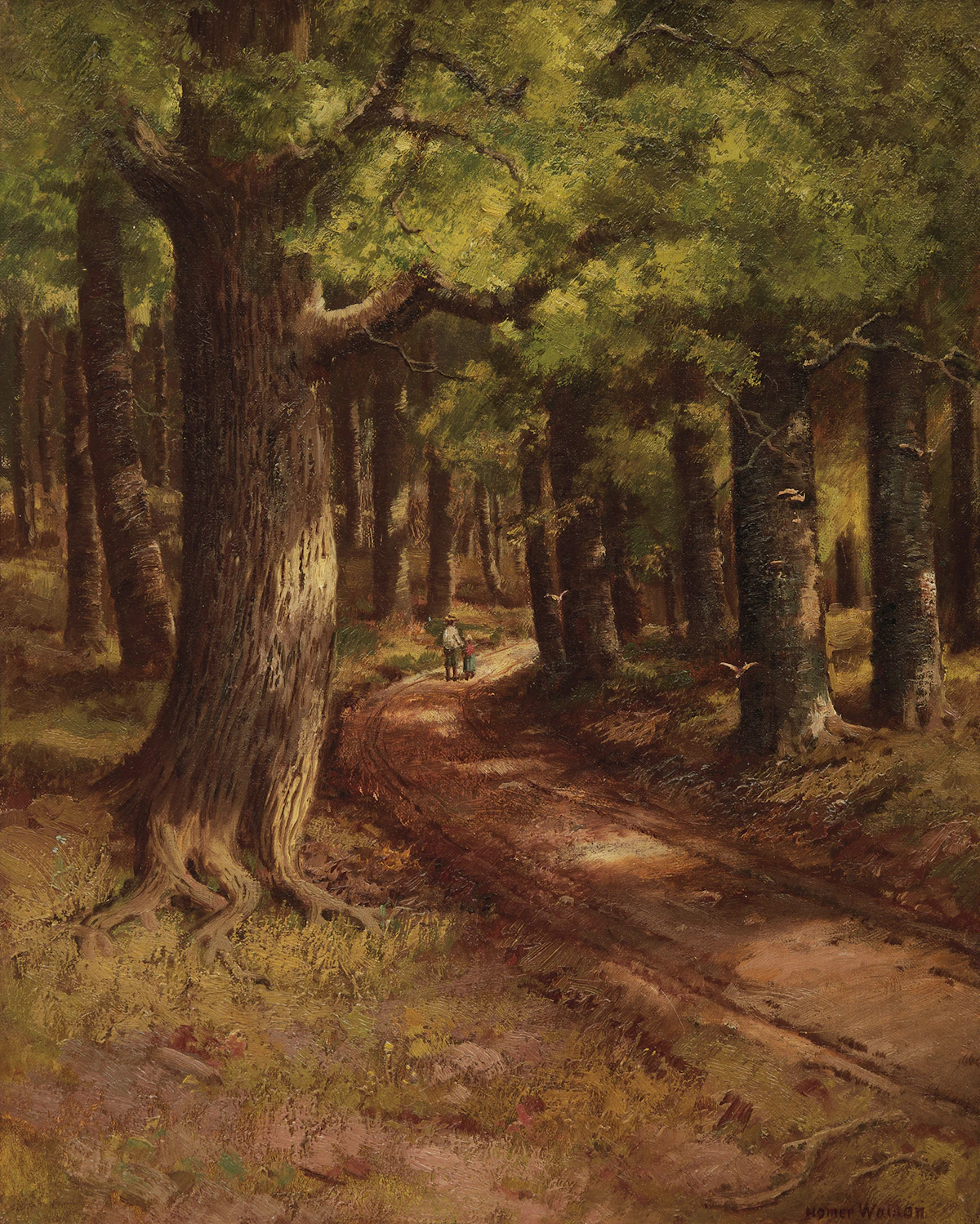
Despite increasing success and travels abroad, Watson always returned to Doon, convinced, as he later recalled, that he would find “ample material” for artistic expression “among old associations, among the nooks that wove themselves into my early days, and in a certain village nestling among the hills.” This oil on canvas presents a charming depiction of his hometown, with two figures walking through a wooded path. The fine detail in the tree bark and the soft, dappled light coming through the trees demonstrate Watson’s strong artistic abilities, particularly as a largely self-taught painter.
Following the artist’s death and later the death of his sister, the Watson family home became the Doon School of Fine Arts in 1948; it ran until 1966, drawing such distinguished teachers as Frederick Horsman Varley and Carl Fellman Schaefer. In 1980 the property was designated a national historic site. Purchased by the City of Kitchener, it opened a year later as the Homer Watson House and Gallery.