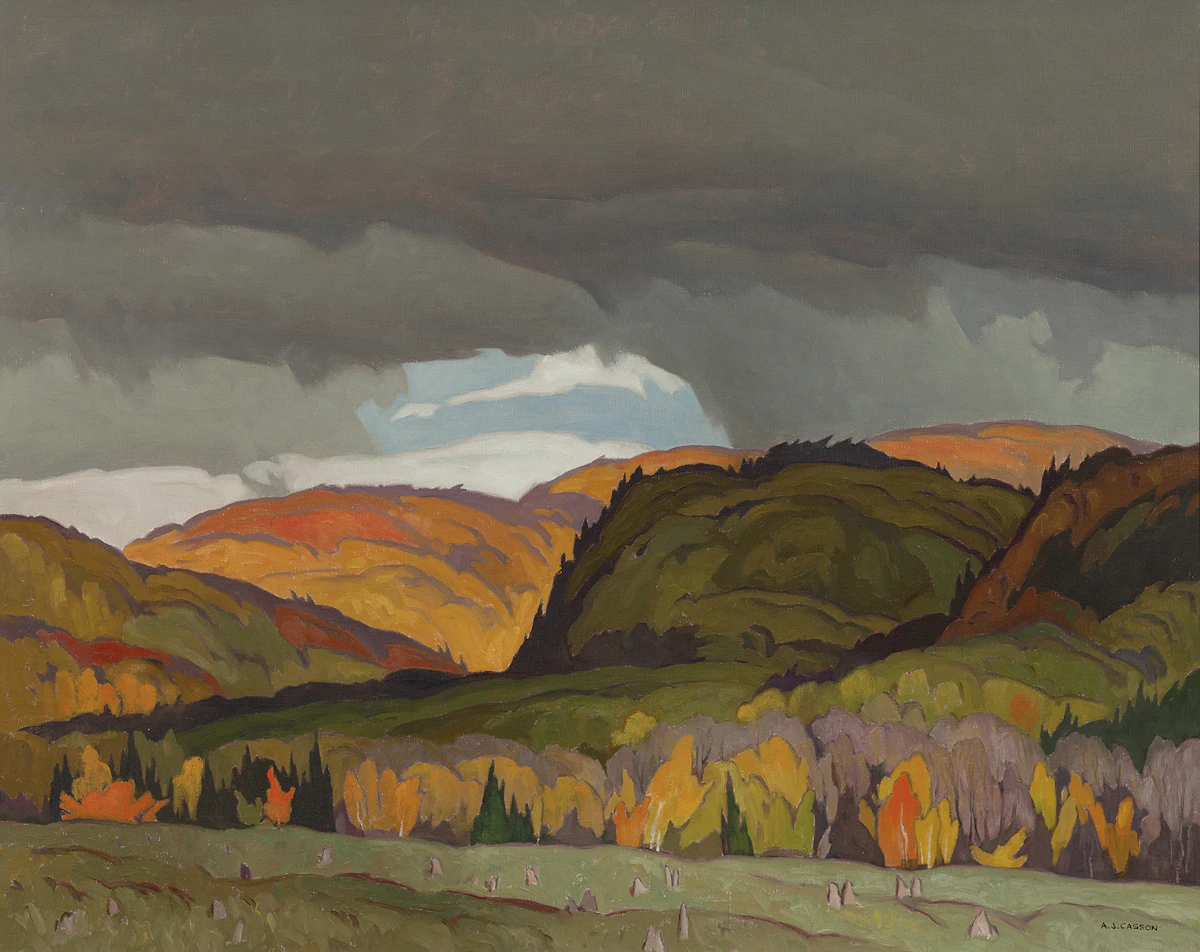
signed lower right; signed and dated 1976 on a label on the reverse
24 × 30 in (61.0 × 76.2 cm)
Auction Estimate:$60,000 - $80,000
Sale date:December 6, 2023
Price Realized
$72,000
(including Buyer's Premium)
Provenance
Private Collection, Toronto
Literature
Margaret Gray, Margaret Rand and Lois Steen, “A.J. Casson”, Agincourt, Ontario, 1976, page 43
Hubert De Santana, ‘A Painter’s Life: A.J. Casson looks back on 60 years at the easel’, “Canadian Art”, Spring 1985, pages 64-69
A.J. Casson has a played a prominent role in the development of Canadian art, quietly having built his reputation as a master painter without sacrificing the principles of his personal approach to painting. Although a professed lover of travel, Casson never went far afield. Ontario is Casson’s place. He knows and loves the varying landscape of the province: from the pastoral rolling countryside, where a few houses and stores cluster at a crossroad, to the craggy heights of the lonely landscape where only the wind through the trees breaks the silence.
In this canvas there is a softness to both the colour palette and the handling of brushwork emphasizing a more reserved depiction of the Canadian landscape. The work showcases Casson’s dedication to the Ontario landscape in this subtle rendering of the popular region. Common to Casson’s work throughout his career is a limited colour palette. In a 1985 interview, the artist recalls this strategy as being present since his early days with the Group of Seven, when “exhibitions were flaming with colour.” He elaborated by stating: “Well, I’ve always thought that if you want to stand out, don’t follow the herd. I was inclined to go into subtle greys, to get away from the gaudy. I painted a few gaudy ones, but they never appealed to me.” “Rain Clouds” is a prime example of a subtly dramatic landscape of this period in Casson’s oeuvre.
Speaking to the artist’s legacy, Margaret Gray, Margaret Rand and Lois Steen share that, “[Casson’s] hundreds of drawings, sketches and paintings, which have recorded the beauty and the character of his land, are a great legacy indeed. But perhaps from a historical point of view A.J. Casson’s greatest contribution lies in the present-day link which he provided with that vital period when Canadian art took on its own identity. The Group of Seven laid down the foundations upon which modern art in this country has built, and Casson, although never avant-garde, has made his own unique contribution to the structure. He paints his own vision, unaffected by the tyranny of the new.”