Laing Galleries, Toronto
Ken Thomson
Loch Gallery, Toronto
Acquired by the present Private Collection, November 2005
Exhibited
“Embracing Canada: Landscapes from Krieghoff to the Group of Seven”, Vancouver Art Gallery; travelling to the Glenbow Museum, Calgary; Art Gallery of Hamilton, 30 October 2015‒25 September 2016
Literature
J. Russell Harper, “Krieghoff”, Toronto, 1979, pages 44 and 137
Dennis Reid, “Krieghoff, Images of Canada”, Toronto, 1999, pages 58 and 59
Louise Vigneault, ‘Portraying Indigenous Peoples in Nineteenth Century Art: Conciliatory, Resistant, Immutable’ in Ian Thom, et al., “Embracing Canada: Landscapes from Krieghoff to the Group of Seven”, Vancouver/London, 2015, page 18, reproduced page 29
Cornelius Krieghoff’s images of Canada’s Indigenous people are some of his most acclaimed within a wide range of subject matter. Depictions of the Indigenous population make up approximately one- third of the artist’s known body of work. As J. Russell Harper notes, Krieghoff portrayed “man unspoiled by the complexities of artificial and unnatural civilization.” Krieghoff settled in Montreal in 1846, where he regularly painted the people of Caughnawaga, a reserve south of the island. He produced large canvases for wealthy clients and very small ones for those with modest incomes. In 1853 the artist moved to Quebec and revisited this preferred subject throughout the city and its surrounding regions, including the Lorette Reserve. While Canada was undergoing major constitutional changes in addition to industrialization and urbanization during Krieghoff’s two decades in the country, the artist rarely depicted evidence of this transformation in his artworks. Rather, he was firmly preoccupied with French-speaking ‘habitants’ and the Indigenous People of rural life. Impressed by the presence of Indigenous communities, Krieghoff did depict them with humour as he did the French Canadians. Dennis Reid notes that the artist’s German roots would have probably inspired a profound respect for the peoples who maintained an organic link with nature and who resisted “civilization”.
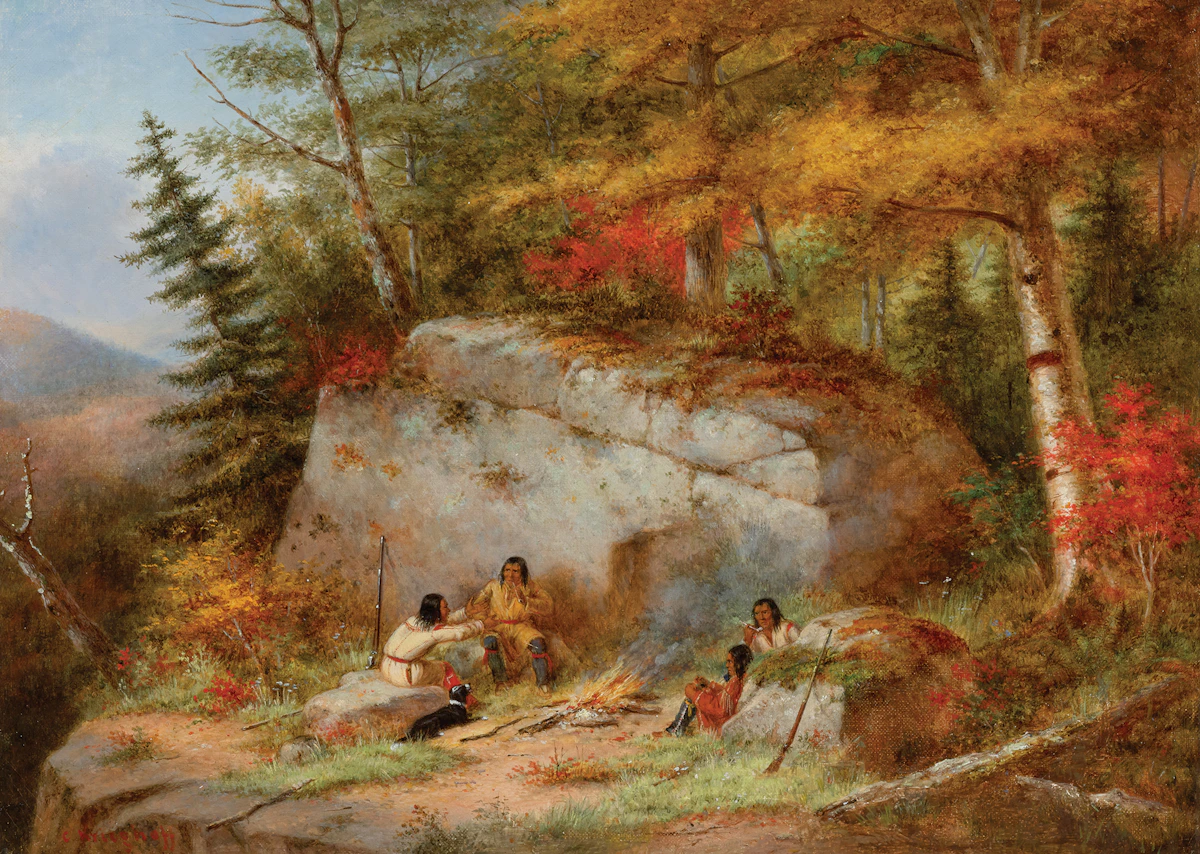
In “The Mid-day Halt”, circa 1860, Krieghoff depicts four Indigenous men seated around a fire in an autumn forest. Displaying the artist’s strong attention to detail, the scene has many finely painted elements, including the figures’ dress, their pipes and rifles, and their accompanying black and white dog. In the “Embracing Canada: Landscapes from Krieghoff to the Group of Seven” exhibition catalogue, art historian Louise Vigneault comments on this oil painting, remarking that “’The Mid-day Halt’ present[s] an autumnal landscape wherein hunters gather around a fire at the foot of a massive rock onto which trees cling - a motif that seems to symbolize resistance to uprooting, echoing the condition of the communities that were under pressure to be removed from their territories.”
Vigneault expands on this common depiction of Indigenous People in the landscape, writing “Over the course of the nineteenth century, as Canada moved from the challenges of colonization to those of urbanization and industrialization, the figure of 'the Native' played the roles of intermediary for the environment and model for political resistance and cultural perpetuation.”