Mr. Crossland, Toronto
G. Blair Laing, Toronto, 1966
Peter Bronfman, Montreal, by 1971
Waddington Galleries, Montreal
Mortimer & Jean Lesser, Port Hope, Ontario, by 1985
Acquired by the present Private Collection, May 1999
Exhibited
“Hommage à Arthur Lismer”, Galerie Walter Klinkhoff, Montreal, September 1997, no. 2
“Embracing Canada: Landscapes from Krieghoff to the Group of Seven”, Vancouver Art Gallery; travelling to the Glenbow Museum, Calgary; Art Gallery of Hamilton, 30 October 2015‒25 September 2016
Literature
Arthur Lismer, “Algonquin Park First Impressions May 1914”, manuscript, McMichael Canadian Art Collection, Kleinburg, Gift of Marjorie Lismer Bridges, 1981
Irene B. Wrenshall, ‘The Field of Art’, “Toronto Sunday World”, 26 July 1914, page 14
Ottelyn Addison, “Tom Thomson: the Algonquin Years”, Toronto, 1969, page 28
Dennis Reid, “Le Groupe des Sept/The Group of Seven”, Ottawa, 1970, page 74
Joan Murray, “Tom Thomson: Design for a Canadian Hero”, Toronto/ Oxford, 1998, pages 55‒57
Charles C. Hill, ‘Tom Thomson, Painter’, in Dennis Reid, et al, “Tom Thomson,” Toronto/Ottawa/Vancouver, 2002, pages 124‒125, 312‒313
Ian Thom, et al., “Embracing Canada: Landscapes from Krieghoff to the Group of Seven”, Vancouver /London, 2015, reproduced page 94, caption page 201
In January 1911, following studies in Antwerp, Arthur Lismer, a native of Sheffield, England, came to Toronto to work as a graphic designer. By February he was working for Grip Limited where he met Tom Thomson and J.E.H. MacDonald and was soon sketching in the farmlands around the outskirts of Toronto.
In May 1914 Lismer travelled to Algonquin Park to canoe and paint with Tom Thomson. “I reached Canoe Lake ... about ten o’clock in the evening, after a stuffy 9 hours in the train,” wrote Lismer soon after his return. He brought along “two dozen 12 1⁄2 x 9 1⁄2 three ply veneer boards of birch wood back and front & soft pine inside, & good for sketching”. Yet this sketch is not painted on plywood, a support used by Jackson and Thomson that spring and which posed problematic over time, but on a wood panel. “We were there just after the ice had gone out of the lakes & before it had completely gone from the south slopes of the shores of the lakes. We were there before the maple & birch
burst into leaf & we stayed to see the wonderful miracle of a northern spring come again. We were there when the first spring flower came up, and bravely faced the frosty nights & chilly mornings.” For approximately two weeks the artists canoed across Canoe and Smoke lakes to Ragged Lake on the south west edge of Algonquin Park, before leaving soon after 24 May.
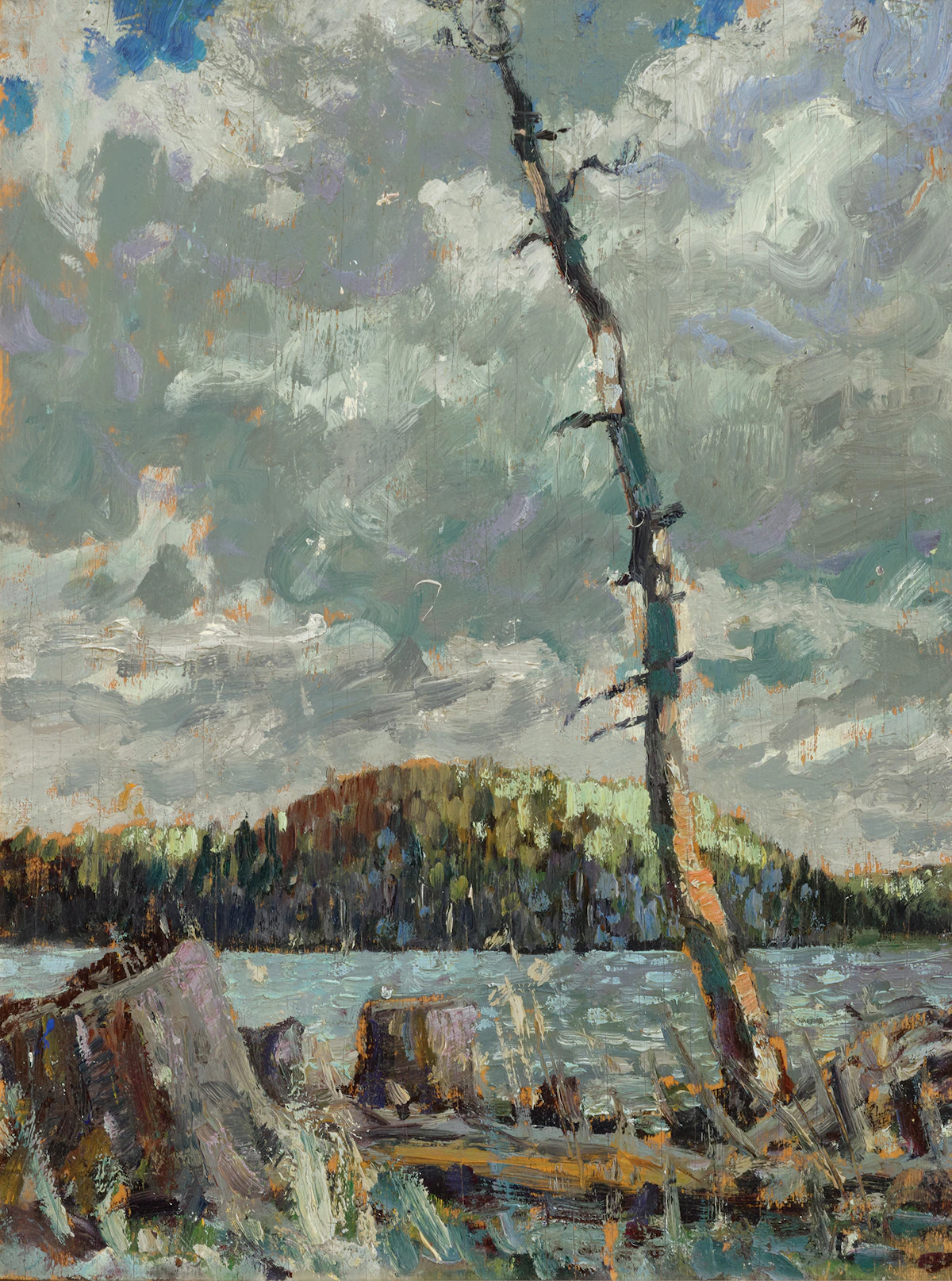
This superb sketch clearly evokes the cold air of May and the rough terrain of the park. A stump, touched with lavender, and a bare, thin tree banded in orange, green, white and brown, link the nearby shore to the stormy sky above, the clouds similarly touched with lavender. Aggressive brushstrokes, also seen in Lismer’s sketch of Tom Thomson’s tent painted that May, depict the wild foliage and logging detritus in the foreground while the water and background hill are painted with broken, parallel strokes, the hill in blue, browns and mint green. The stillness of the shore contrasts with the rapidly moving clouds and fleeting sunlight highlighting the crests of the hills.
The immediacy and freshness of Lismer’s Algonquin sketches were greatly appreciated by Irene Wrenshall when she visited the Studio Building in July. “The great call of the wild is having a great fascination for the artists these days, and we obtain glimpses of the north woods painted at all seasons of the year from the brushes of artists who, tho not despising the quieter scenes of old Ontario, find a vigor about the northern stretches that give the keenest inspiration. Just as the snow was melting over the hills this spring, Algonquin Park was chosen by a number of the Toronto artists. Among the latest who returned was Mr. Arthur Lismer, who is at present working on a number of larger pictures inspired by the small impressionist sketches which he brought back with him from the north country. ... It seems almost a pity that we do not see at the exhibition more of these small sketches – the inspiration of the moment when the artist is full of the spirit of the out of doors.... It must be remembered tho that these small canvasses (sic) are merely impressions, notes that the artist will tell you, of a moment which passing so quickly necessitates a hurried putting down of colors and impressions of instantaneous effects of light and shade, which have no meaning for the public. Nevertheless we obtain from them glimpses of the changing moods of nature such as we seldom get from a studio picture tho it might reflect the mood or the intention of the artist much more clearly.”
We extend our thanks to Charles Hill, Canadian art historian, former Curator of Canadian Art at the National Gallery of Canada and author of “The Group of Seven‒Art for a Nation”, for his assistance in researching this artwork and for contributing the preceding essay.