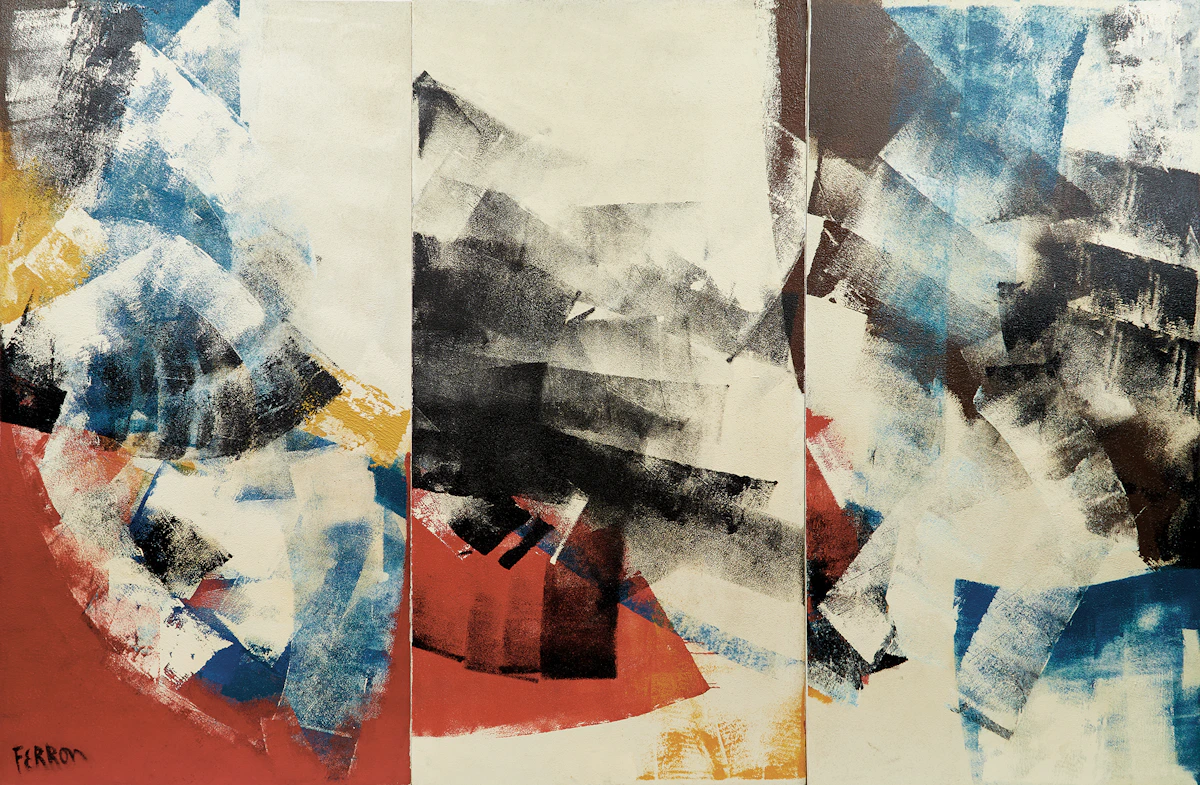
Marcelle Ferron remained faithful to automatism throughout her career; she was driven by the aesthetic, the solidarity of the group, and especially the teaching of Borduas, who promised her at their first meeting that he would show her how to find the “joy” in her painting. Ferron had undergone an artistic crisis in the period preceding her meeting with Borduas in 1946, and his art and personality had a life-changing and enduring effect on the young painter. A signatory of the Refus Global in 1948, Ferron was one of seven women to sign the manifesto, and one of the youngest to do so, at age twenty-four.
By the mid-1950s Ferron had achieved significant success in Quebec and Canada. She moved to Paris in 1953 and exhibited throughout Europe until 1965. Ferron was granted a silver medal at the Sao Paulo Biennale in 1962, which marked the most recognition a female artist from Quebec had ever received. Marcelle Ferron was inspired by a new image of the modern artist as someone who assumes a social role. Back in Quebec, the avant-garde movements and progressive thinkers of the 1950s led to a resurgence in public art. According to art historian Louise Vigneault, “through her support of progressive ideals, her constant renewing of aesthetic and technical parameters and her special connections to Quebec society and culture, [Ferron] would succeed in defining a new artistic identity, based simultaneously on resistance and rootedness.” In the summer and autumn of 1963, Marcelle Ferron created a twelve-panel mural to display at the Caisse d’économie des employés du Canadian National (today known as the Caisse d’économie du Rail) in Pointe Saint-Charles in Montreal. The mural was inaugurated in the spring of 1964. The panels have since been broken up; this lot comprises three of the original twelve. While Ferron is well-known for her palette knife-applied impasto, she executed these paintings using paint rollers, likely due to their large size. Spontaneity is still maintained as a characteristic of the work; the rollers create layers of bands in uneven thicknesses.
These mural paintings marked the beginning of Ferron’s dedication to public art, and by 1966 Ferron abandoned painting to work in stained glass for several years. She was drawn to creating public art that would reach out to the “ordinary people” she loved so much. Famous examples of her work can be seen in the stained glass murals of Champ-de-Mars and Vendôme metro stations in Montreal. Ferron’s magnificent public works, both murals and stained glass, contributed to making contemporary art accessible to a wider popular audience.