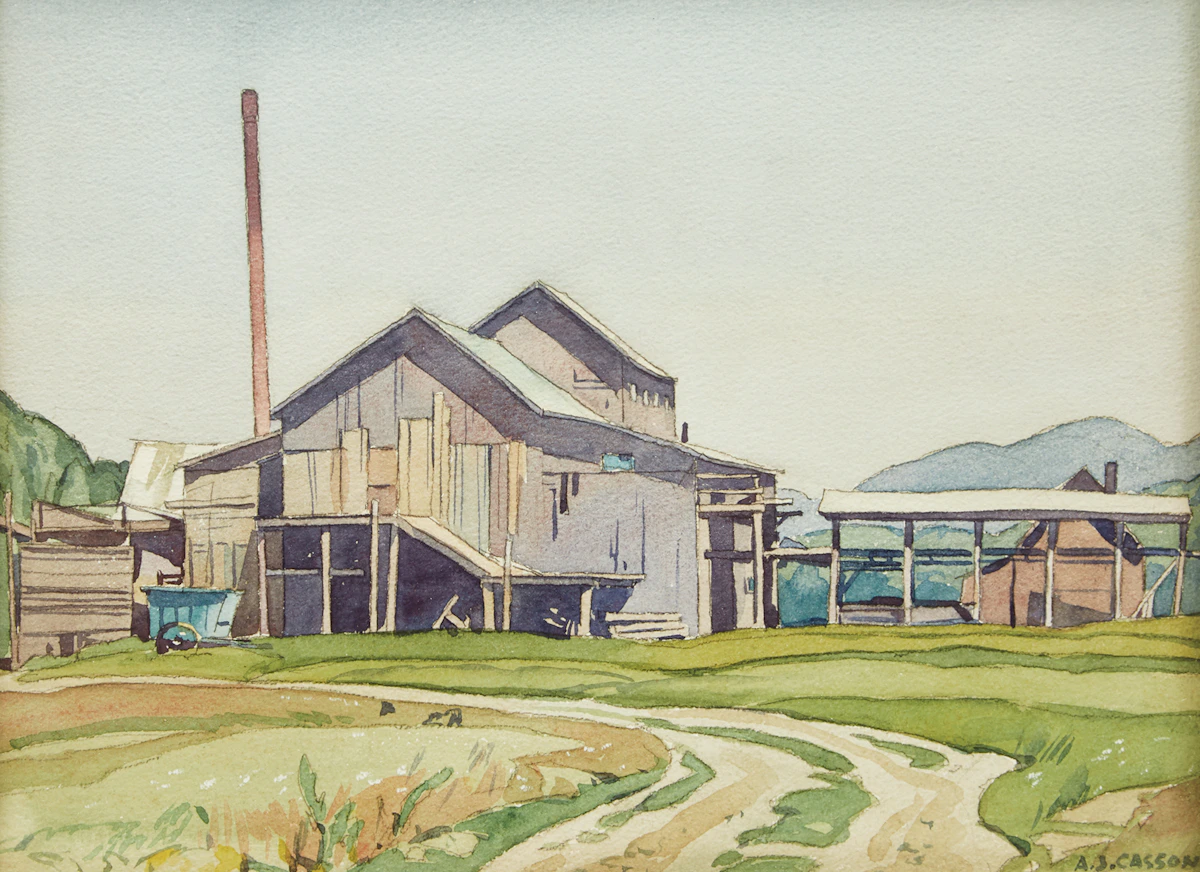
signed lower right; titled and dated 1955 on a gallery label on the reverse
9.75 × 12.75 in (24.8 × 32.4 cm) (sight)
Auction Estimate:$15,000 - $20,000
Sale date:June 8, 2023
Price Realized
$28,800
(including Buyer's Premium)
Provenance
Roberts Gallery, Toronto
ArtCore, Toronto
Private Collection, Toronto
Literature
Paul Duval, “Canadian Water Colour Painting”, Toronto, 1954, unpaginated
A.J. Casson was one of the few members of the Group of Seven who held a long standing commitment to practicing in watercolour and mastering the medium. Paul Duval writes that Casson “had become one of the most powerful and expressive watercolour painters Canada has ever known. His compositions had acquired a sure formalization, his washes were laid with a consummate assurance and the boldness of his colour revealed a brilliance and depth then rarely seen in the medium.” “Mill Near Elephant Lake” is a crisp watercolour landscape, with a strong attention to detail in the architectural structures. Known as both a “rebel” and a “traditionalist”, this work displays both the traditional characteristics of the Group as well as elements of abstracted design, reminiscent of Casson's work as a graphic designer. “Mill Near Elephant Lake” was painted in 1955, which was a busy and successful time in Casson’s career, shortly prior to his retirement. He was awarded the Gold Medal for Excellence in Canadian Advertising the previous year, and in 1955 he was appointed Vice-President of the Art Gallery of Ontario, a position he would hold until 1959.
Casson’s retirement from Sampson-Matthews in 1958 enabled him at last to devote himself full-time to painting. In 1961, Casson and his wife travelled to Britain with architect Bruce Brown and his wife. Brown was an amateur artist, and the purpose of the trip was to be a watercolour painting holiday, demonstrating once again Casson’s lifelong interest in the medium.