James Spooner, Toronto
Mr. C.W. Irwin, Toronto
By descent to Mrs. Dalton Wells
G. Blair Laing Ltd., Toronto
Private Collection
Exhibited
“Canadian Section of the Colonial and Indian Exhibition”, London, from 4 May 1886 (James Spooner loaned three Fowlers titled “Canadian Dead Game”)
“Dominion of Canada Industrial Exhibition, Department of Fine Arts”, Toronto, 27 August‒12 September 1903, no. 211 or no. 212 as “Game” (loaned by James Spooner)
“Canadian National Exhibition: Department of Fine Arts”, Toronto, 26 August‒9 September 1907, no. 73 as “Canadian Game” (loaned by C.W. Irwin)
“Loan Collection of Paintings by Deceased Canadian Artists, Fourth Loan Exhibition”, The Art Museum of Toronto, 24 January‒22 February 1911, no. 54 as “Canadian Game” (loaned by C.W. Irwin)
“Retrospective Loan Exhibition of Paintings by Members of the Ontario Society of Artists Covering the First Half-Century of the Society’s History”, Art Gallery of Toronto, 11 February‒12 March 1922, no. 54
“Inaugural Exhibition, Art Gallery of Toronto”, 1926, no. 213 or no. 222
“Selection of Watercolours by Daniel Fowler”, Art Gallery of Toronto, December 1935, no. 208 (loaned by C.W. Irwin)
“Daniel Fowler of Amherst Island”, Agnes Etherington Art Centre, Queen’s University, Kingston; travelling to the Art Gallery of Greater Victoria; Dalhousie Art Gallery, Halifax; National Gallery of Canada, Ottawa and Art Gallery of Ontario, Toronto, January‒November 1979, no. 55 (loaned by C.W. Irwin)
Literature
“Dominion of Canada Industrial Exhibition”, Department of Fine Arts, Toronto, 1903, no. 211 or no. 212 as “Game”, reproduced
Frances K. Smith, “Daniel Fowler of Amherst Island”, Kingston, 1979, no. 55, reproduced page 59
Born in Kent, Daniel Fowler studied under the draughtsman and watercolourist J.D. Harding, who introduced him to a form of studio art that he would later reject for being overly mannered and uninspired. Instead, by following the traditions of English landscapists and learning to work “en plein air”, Fowler was able to discover an intense appreciation for his immediate surroundings, not unlike that of John Constable’s affection for his native Suffolk.
Fowler emigrated to Canada in 1843, where he settled on an isolated farm on Amherst Island, near Kingston, and dedicated himself to becoming a gentleman farmer. He would eventually return to his pencils and brushes in 1857, at the age of forty-seven, following a short trip to London, where he re-immersed himself in art by attending exhibitions at the Royal Academy and befriending old acquaintances, all the while glimpsing the rise of the Pre-Raphaelite Brotherhood. Inevitably, their appeals to simplify art and be truthful to nature strongly resonated with him as he began to sketch from nature and study the variations of colour “in situ” for the first time.
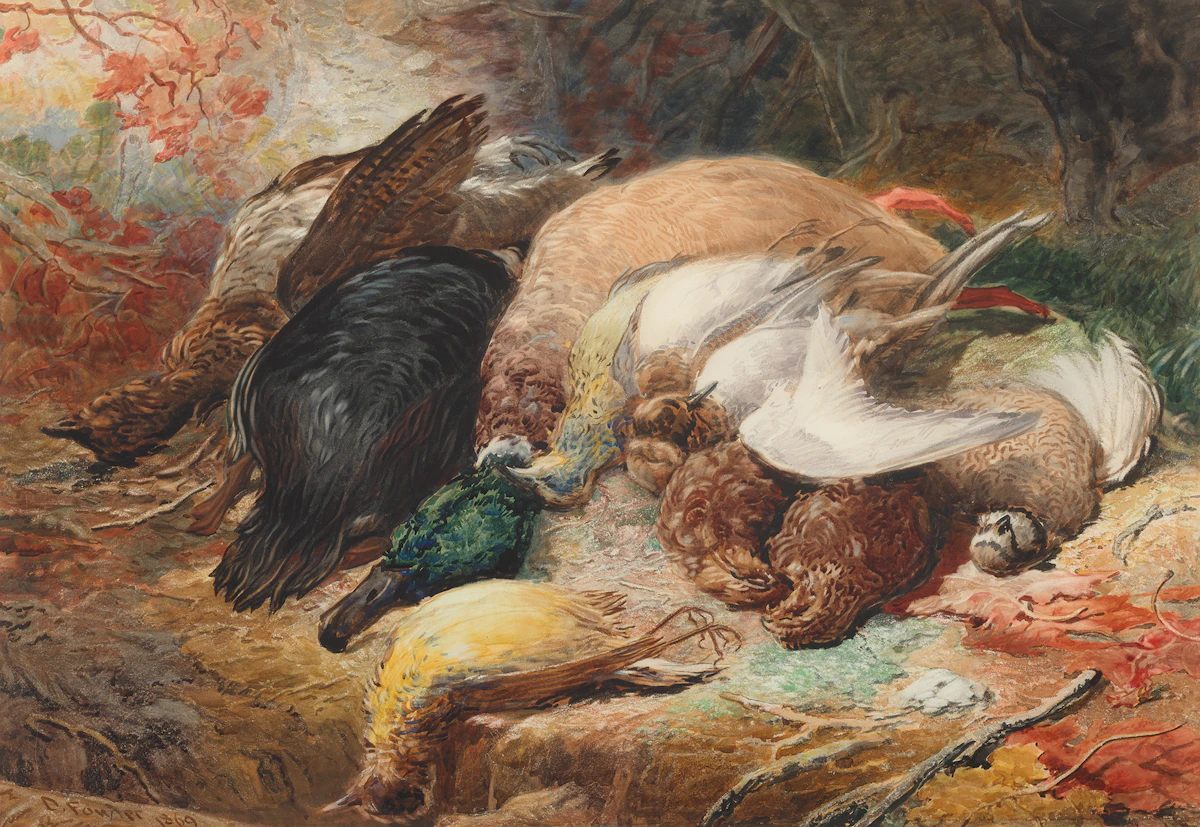
His rural surroundings would have offered him a wealth of subjects, from dead game, and peaceful meadows to fallen trees in nearby fields. Here, Fowler presents game birds lying in a heap against the forest floor. By painstakingly depicting the feathers of various breeds of birds, the artist highlighted minor differences in surface and tone. In order to create such vivid representations, Fowler would work the background with dense colour and, once dry, would then scrape away the surface of the paper to create texture and white highlights. This background technique, a testament to Fowler’s skill and expertise, enabled him to create these intensely vibrant works.
In 1873, Fowler began to exhibit his watercolours with the Ontario Society of Artists, of which he was a founder member, before joining the Royal Canadian Academy in 1880.