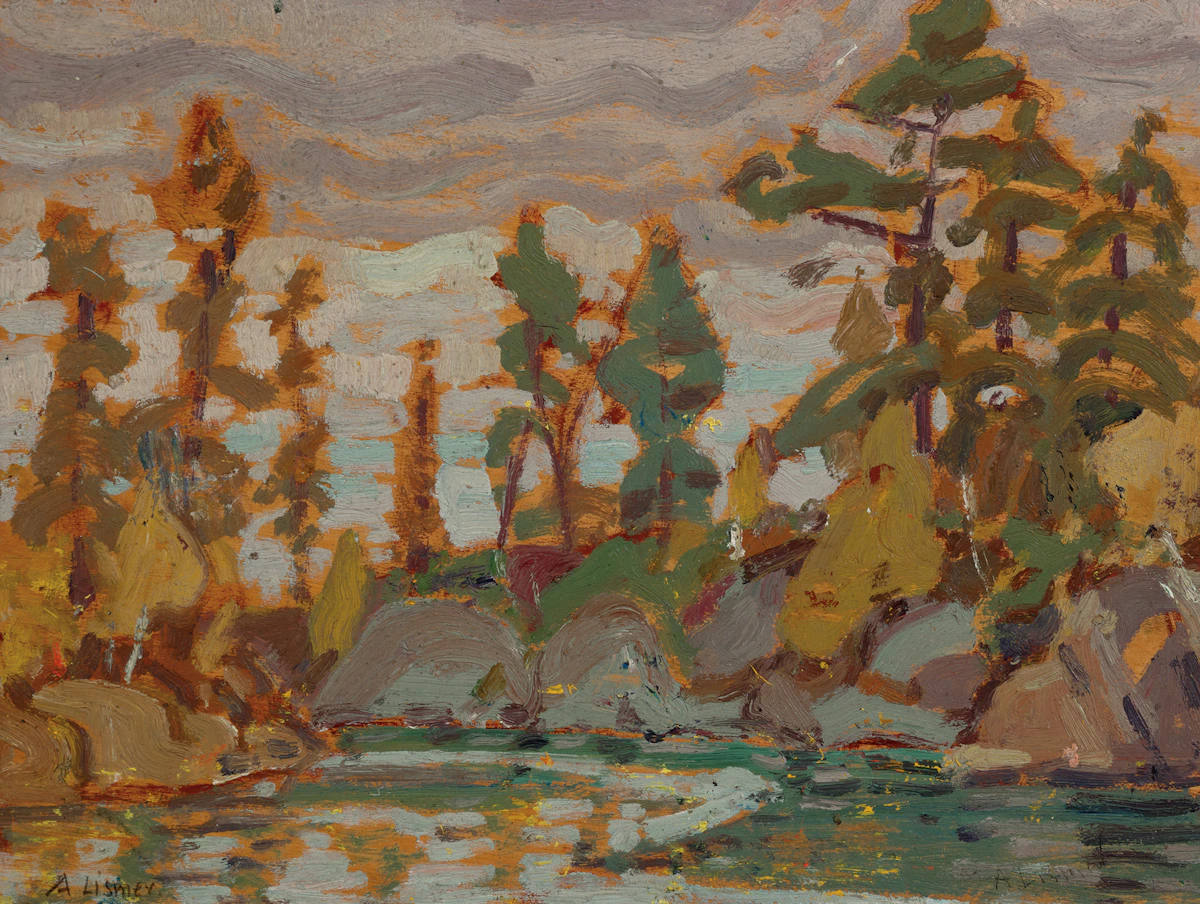
signed lower left and lower right; signed and inscribed “MacGregor [sic] Bay, Georgian Bay” on the reverse
9 × 12 in (22.9 × 30.5 cm)
Auction Estimate:$25,000 - $35,000
Sale date:June 8, 2023
Price Realized
$78,000
(including Buyer's Premium)
Provenance
The Artist
Dr. James Lawson, Toronto, by 1948
Framing Gallery, Toronto
Acquired by the present Private Collection, circa 1965
Exhibited
“Collector’s Canada: Selections from a Toronto Private Collection”, Art Gallery of Ontario, Toronto; travelling to Musée du Québec, Quebec City; Vancouver Art Gallery; Mendel Art Gallery, Saskatoon, 14 May 1988‒7 May 1989, no. 73
“Hommage à Arthur Lismer”, Galerie Walter Klinkhoff, Montreal, 6‒20 September 1997, no. 10, as circa 1923
“Embracing Canada: Landscapes from Krieghoff to the Group of Seven”, Vancouver Art Gallery; travelling to the Glenbow Museum, Calgary; Art Gallery of Hamilton, 29 October 2015‒5 September 2016
Literature
F. B. Housser, “A Canadian Art Movement: The Story of the Group of Seven”, Toronto, 1926, page 179
Dennis Reid, “Collector’s Canada Selections from a Toronto Private Collection”, Toronto, 1988, no. 73, reproduced page 68
Ian Thom, et al., “Embracing Canada Landscapes from Krieghoff to the Group of Seven”, Vancouver/London, 2015, reproduced page 100, caption page 201, as 1923
Georgian Bay was Arthur Lismer’s favourite painting site for over two decades. Teaching full time winter and summer at the Ontario College of Art, he had little free time and holidays were usually family affairs, travelling with his wife Esther and daughter Marjorie. He first painted around Dr. James MacCallum’s cottage on Go Home Bay on Georgian Bay in 1913, returning in 1920. As Dennis Reid has written, it was only in 1923 that Lismer painted at McGregor Bay and he first showed McGregor Bay subjects in the “Ontario Society of Artists’ Small Picture Exhibition” late October that year. The artist often dated works when they were sold or donated and, as dates were of no interest to him, just the creative process, he frequently provided erroneous dates, as in this instance.
Fred Housser has described the area as “a corner of Georgian Bay which none of the other group members have painted, a deep inlet on the north shore in the region of Manitoulin Island known as McGregor Bay. Here the character of the country differs from that further south. You are close to a range of high hills, the Cloche Mountains.... Channels writhe in and out among the rocky islands and quickly turn to careering (sic) whitecaps when ruffled by the wind. The islands which clutter the bay rise high and sheer from the water.” It was here that Lismer painted studies for “The Happy Isles” (University of Saskatchewan) and “The Island, McGregor Bay” (private collection), both included in the 1925 Group of Seven exhibition.
With a remarkable lightness of touch Lismer has delineated the multicoloured rocks, dark pines in variant greens, and rapidly moving clouds rising from turquoise blue to purple greys. The touches of red enhance the bare wood of the panel that is deftly used to suggest forms, such as the tree distant centre, and the space around them. No whitecaps here, just calm water on a late summer day.
We extend our thanks to Charles Hill, Canadian art historian, former Curator of Canadian Art at the National Gallery of Canada and author of “The Group of Seven‒Art for a Nation”, for his assistance in researching this artwork and for contributing the preceding essay.
Arthur Lismer - McGregor Bay, circa 1923 | Cowley Abbott