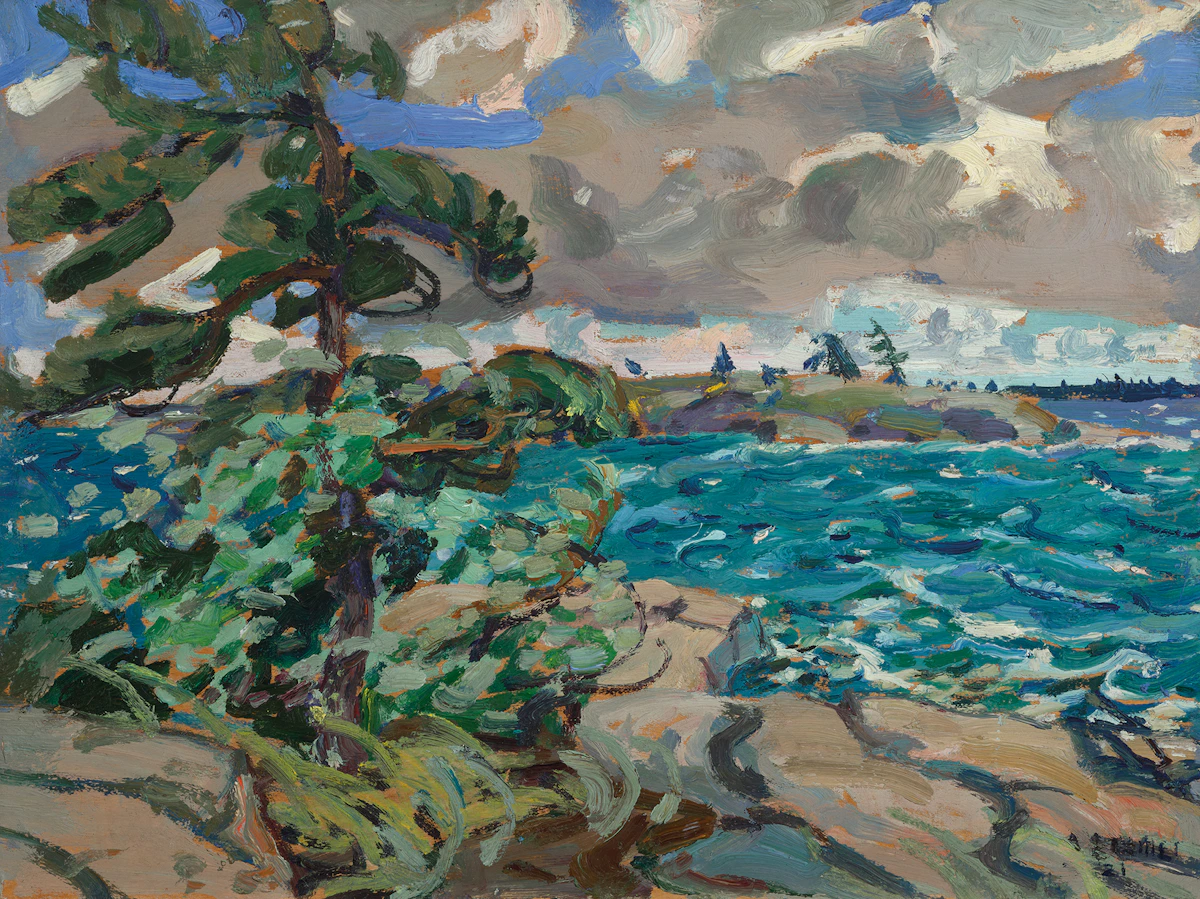
signed and dated 1921 lower right; signed and titled on the reverse
11.5 × 16 in (29.2 × 40.6 cm)
Auction Estimate:$100,000 - $150,000
Sale date:June 8, 2023
Price Realized
$432,000
(including Buyer's Premium)
Provenance
Private Collection, Toronto
Acquired by the present Private Collection, 1981
Exhibited
“Collector’s Canada: Selections from a Toronto Private Collection”, Art Gallery of Ontario, Toronto; travelling to Musée du Québec, Quebec City; Vancouver Art Gallery; Mendel Art Gallery, Saskatoon, 14 May 1988‒7 May 1989, no. 72
“Hommage à Arthur Lismer”, Galerie Walter Klinkhoff, Montreal, September 1997, no. 9
“Beaver Tales: Canadian Art and Design”, University of Toronto Centre, 16 September‒6 December 2008
“The Group of Seven: Revelations and Changing Perspectives”, McMichael Canadian Art Collection, 22 May‒20 September 2010
“Painting Canada: Tom Thomson and the Group of Seven”, Dulwich Picture Gallery, London, United Kingdom, no. 49
“Embracing Canada: Landscapes from Krieghoff to the Group of Seven”, Vancouver Art Gallery; travelling to the Glenbow Museum, Calgary; Art Gallery of Hamilton, 29 October 2015‒5 September 2016
“Collectors’ Treasures II/Trésors des collectioneurs”, Annual Loan Exhibition, Galerie Eric Klinkhoff Inc., Montreal, 24 October‒7 November 2020, no. 22
Literature
F.B. Housser, “A Canadian Art Movement The Group of Seven”, Toronto, 1926, pages 153-154, 177-178
Arthur Lismer, “Outline for Picture Study, September Gale by Arthur Lismer, A.R.C.A.”, Ottawa, 1932
Barry Lord, ‘Georgian Bay and the Development of the September Gale Theme in Arthur Lismer’s Painting 1912-21’, in “National Gallery of Canada Bulletin”, Vol. V, nos. 1-2, (1967) pages 28-38, 49
Marjorie Lismer Bridges, “A Border of Beauty Arthur Lismer’s Pen and Pencil”, Toronto, 1977, page 28
Lois Darroch, “Bright Land: A Warm Look at Arthur Lismer”, Toronto/ Vancouver, 1981, pages 61‒62
Dennis Reid, “Collector’s Canada Selections from a Toronto Private Collection,” Toronto, 1988, no. 72, reproduced page 67
Maria Tippett, “Stormy Weather: F.H. Varley, A Biography”, Toronto, 1998, pages 76‒79, 128‒129
Martha Kelleher, ‘In the Spirit of Nationalism’, in “Beaver Tales Canadian Art and Design”, Toronto, 2008, reproduced page 19
Katerina Atanassova, ‘Defining the North Searching for a Visual Language’, in “Painting Canada Tom Thomson and the Group of Seven”, London, 2011, page 38, reproduced page 118
Charles C. Hill, ‘No Timid Play of Subtleties but Bold and Massive Design: the Group of Seven and the Canadian Landscape’, in Ian Thom, et al., “Embracing Canada Landscapes from Krieghoff to the Group of Seven”, Vancouver/London, 2015, pages 86, 2015, reproduced
page 99
The outbreak of war in 1914 proved devastating to Toronto’s graphic art industry where most of the future members of the future Group of Seven earned their livings. In the fall of 1916 Arthur Lismer left for Halifax to teach at the Victoria School of Art. The Halifax period proved to be productive, but he longed to return to Toronto and in fall 1919 he was appointed vice-principal of the Ontario College of Art. Teaching and administration proved to be demanding, leaving little time to paint. All of his works included in the first exhibition of the Group of Seven from 7 to 27 May 1920 had been previously exhibited.
However, even before the Group show had closed, Lismer, Lawren Harris and A.Y. Jackson left Toronto to paint around Mongoose Lake in Algoma with Dr. MacCallum. MacCallum then invited Lismer and Fred Varley to spend time at his cottage on Go Home Bay in Georgian Bay. Lismer had previously painted there in the fall of 1913 and spring 1915. On the latter occasion he painted the sketch for “A Westerly Gale, Georgian Bay” (sketch and canvas in the National Gallery of Canada, acc. nos. 4743 and 1368), a storm blown pine on a high foreground against open water and rocky islands, the precursor of “A September Gale”. Varley exhibited Georgian Bay canvases in the spring of 1917 resultant from a visit the previous year, and Maria Tippett has argued that his famous canvas, “Stormy Weather, Georgian Bay” (sketch and canvas in National Gallery of Canada, acc. nos. 4582 and 1814), resulted from this 1916 trip to the Bay. However, it is more likely that Lismer and Varley painted at Go Home Bay in the summer of 1920 and painted their respective canvases, “September Gale” and “Stormy Weather, Georgian Bay”, during the winter of 1920-1921. Both canvases are tributes to Tom Thomson’s “West Wind” (Art Gallery of Ontario, acc. no. 784) and were included in the Group of Seven exhibition in May 1921.
“A September Gale” was possibly the most ambitious painting Lismer had painted to date and was preceded by two oil sketches and one small canvas. Barry Lord has given the most complete discussion of the development of the final painting though the existence of the oil sketch being offered here was not known when he wrote in 1967.
Lord identified the oil sketch, dated 1920, now in the Vancouver Art Gallery, as the first study of the theme. The wind blown pine is rudimentarily sketched in and the wind blown clouds and sky dominate the composition. In the small canvas in the National Gallery, also dated 1920, the somewhat spindly tree takes centre stage, breaking the picture plane at the top, rising from behind the rocks rather than in the midst of them, reeds and a root are detailed lower right, and, as Lord writes, “Space is found for the two subsidiary tree forms to the left, although they remain quite flabby and inconclusive.”
In the oil sketch being presented here, the tree is rooted in the rocks, surrounded by broadly sketched foliage, compressed between the upper and lower edges of the panel and the rocks lower left, energizing the landscape. The foreground root has been eliminated, the light is more luminous and the channel between the islands enlarged. The lessons learned in this superb sketch will be incorporated in the final canvas of 1921 in which the tree retains the simplified design and the compression of the sketch. The space is opened at the left further enlarging the “flabby” subsidiary trees, and the islands at the right become more distant. In enlarging the sketch forms have become more sculptural, as seen in the clouds and waves, in the rocks lower left and in the reeds that now bend in the wind.
Arthur Lismer has written most evocatively of this painting. “[A]mong the outer islands and shoals stretching far out into the main channel ... the rocky islands are more broken and rugged, and the trees take on forms and shapes that result from the constant buffeting of storm and ice. The little pines have taken tenacious hold in clefts and crannies of the broken rock wherever they could send down a clinging root into the rare pockets of soil....'September Gale'... is essentially a picture of movement; everything in it is alive with related action or rhythm ... it is like a nature symphony with clashing chords and deep undertones of menace – orchestration with many instruments striving to achieve a powerful expression.”
We extend our thanks to Charles Hill, Canadian art historian, former Curator of Canadian Art at the National Gallery of Canada and author of “The Group of Seven‒Art for a Nation”, for his assistance in researching this artwork and for contributing the preceding essay.