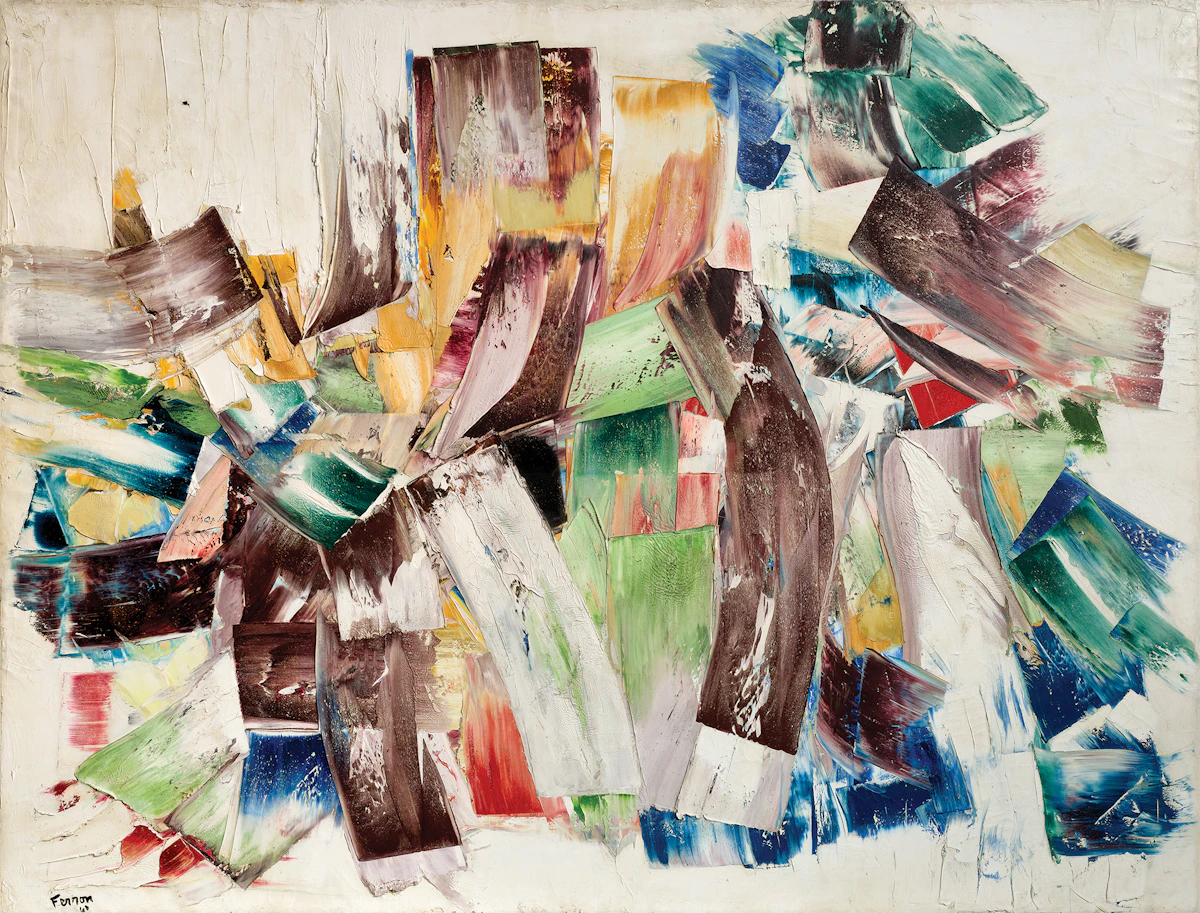
signed and dated 1960 lower left; signed (twice) and dated 1960 on the reverse
74.75 × 98.5 in (189.9 × 250.2 cm)
Auction Estimate:$550,000 - $750,000
Sale date:December 1, 2022
Price Realized
$1,260,000
(including Buyer's Premium)
Provenance
Acquired directly from the Artist by Alexander Orlow for the Peter Stuyvesant Collection, Amsterdam, 1960
Sotheby’s Canada, auction, Toronto, 2 June 2010, lot 107
Mayberry Fine Art, Winnipeg
Private Collection, British Columbia
Exhibited
“Collection Peter Stuyvesant”, representing the Netherlands at La Foire Industrielle de l’Allemagne à Berlin-Ouest, West Berlin, 21 September‒7 October 1962
“The Peter Stuyvesant Collection”, Museum of Modern Art, Melbourne (travelling exh.), 1964
“The Art Gallery in the Factory/Le musee dans l’usine”, Pavillon de Marsan Palais du Louvre, Paris; travelling to Palais des Beaux Arts à Bruxelles, Brussels; National Gallery of Canada, Ottawa; Rothmans Art Gallery, Stratford; Montreal Museum of Fine Arts, 28 September 1966‒6 October 1968
Literature
Arnold Witte, ‘The myth of corporate art: the start of the Peter Stuyvesant Collection and its alignment with public arts policy in the Netherlands, 1950–1960’, “International Journal of Cultural Policy”, 27:3, pages 344-357
Marcelle Ferron is remembered as a painter, stained-glass designer, and the creator of important public art. She was an active member of the avant-garde group Les Automatistes in Montreal from 1946, a student and protege of Paul-Émile Borduas, and a signatory to the 1948 manifesto “Refus global” (“Total Refusal”) that he initiated. This vanguard document was a call to liberate artistic and cultural expression, both personally and in the province, and was pivotal in the mid 20th-century modernization of art and culture in Quebec. With Borduas and other leading reformers, Ferron initially adopted the expressive form of abstraction inspired by Surrealism and based on abstract imagery from the unconscious and ‘automatic’ techniques, echoes of which we see in the free forms of “Sans titre” from 1960.
Like many other progressive artists in Montreal and Quebec at this time, including Jean-Paul Riopelle, Ferron felt the need for wider horizons. In 1953 she moved to Paris, where she joined a supportive community of expatriates and was favoured by the French avant- garde. Exhibiting in France and Montreal from the mid‒1950s on, she returned to Quebec in 1966. In France she had learned the techniques of glass artist Michel Blum, and in Montreal expanded her pictorial ideas into stained glass at Expo ’67’s International Trade Centre and in the Champ-de-Mars metro station (installed in 1968). The latter was the first non-figurative art in the metro system. She designed the towering stained-glass “Permanent Memorial for the Six Million Jewish Martyrs of the Nazi Holocaust” for Concordia University in Montreal (1970). In 1983, she was the first woman to be awarded the prestigious Prix Paul-Émile-Borduas. She became a Grand Officer of the Ordre national du Quebec in 2000.
“Sans titre” has a notable pedigree. It was one of the original paintings commissioned in 1960 for what became The Peter Stuyvesant Collection, a large body of cutting-edge abstract art formed in the Netherlands by Alexander Orlow (1918–2009), managing director of the Turmac cigarette factory in Zevenaar, The Netherlands. Orlow collaborated with two state organizations to mobilize a public facing policy for this new art (the Fondation Européenne de la Culture and the Nederlandse Kunststichting (‘Dutch Art Foundation’). The mission was to enliven factory environments with works that expressed a “joie de vivre”.
Large, vibrant, and dynamic, “Sans titre” is indeed irrepressible. The bold forms move to their own rhythms. At the same time, we can readily feel that they were made by a painter who is moving physically in the space of the canvas. Compellingly animated from a distance, the sweeping forms perform what can be imagined as a perpetual dance of transformation. Close up or standing back, we can appreciate her skillful use of hue, texture, and movement. Colours meld and reappear; forms materialise and vanish into the shallow space of the picture surface, kept on this level by a white ground. Ferron has used abundant pigment in parts of this painting: edges appear and form a temporary topography. Her touch is also smooth, light, even sweet in other areas. A welter of movement, the canvas also resolves in passages where Ferron moves from one sort of paint application to another and in which definite shapes emerge. For example, in the lower right, she deploys bright blue and blue-green forms across the white ground. Using a large hard-edged implement, she drags the colours into one another, sometimes building up ridges, sometimes working the paint so thin that it looks like water. Like liquid too, nothing stands still here. The ability to suggest movement also depends on light in “Sans titre”, the tonal and chromatic range of its pigments and the gloss of the surface. While this work was made years before her stained-glass installations, in retrospect, it seems as if a painting like “Sans titre” is the perfect departure point for a medium that literally filters and spreads light. Historically and formally, Sans titre is closely linked to Ferron’s commitment to an art for the public.
We extend our thanks to Dr. Mark A. Cheetham for contributing the preceding essay. Mark A. Cheetham is the author of two books on abstract art: “The Rhetoric of Purity: Essentialist Theory” and “The Advent of Abstract Painting and Abstract Art Against Autonomy: Infection, Resistance, and Cure since the ‘60s”. He is a professor of Art History at the University of Toronto.