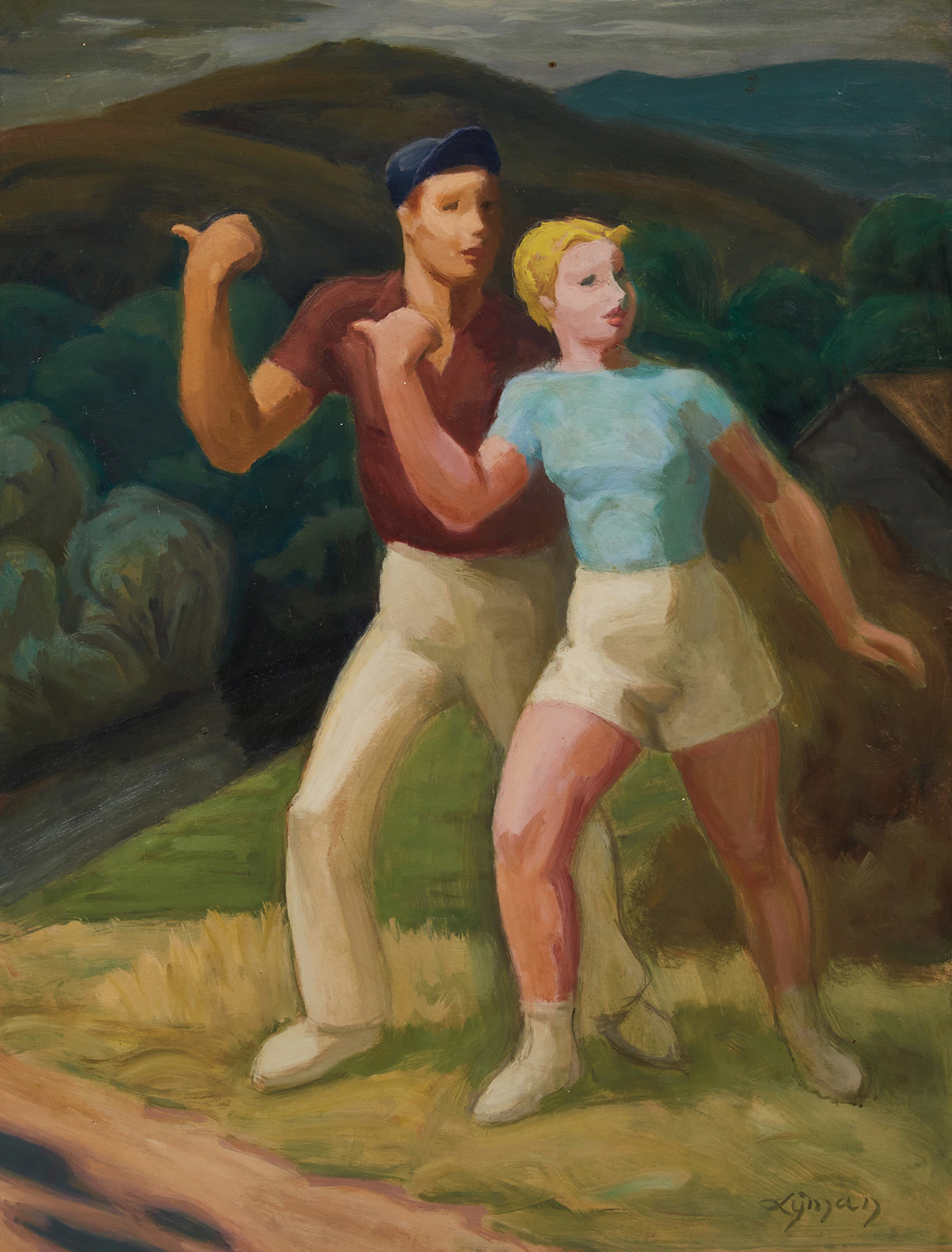
signed lower right; an interior painted on the reverse which is signed, titled “Tu Changeras” and inscribed “par Michel Seymour”
26.5 × 20 in (67.3 × 50.8 cm)
Auction Estimate:$17,000
Sale date:December 1 - 31, 2022
Price Realized
$25,200
(including Buyer's Premium)
Provenance
The Artist
Dominion Gallery, Montreal
Private Collection, Toronto
Exhibited
“Art of Our Day in Montreal”, Art Association of Montreal, 1940
“Canadian Paintings”, San Francisco Museum of Art, 1942
“John Lyman 1913-1943”, Dominion Gallery, Montreal, 1944
“John Lyman/Goodridge Roberts”, Externat Classique Sainte-Croix, Montreal, 1945, no. 1
“John Lyman: 1886‒1967”, Agnes Etherington Art Centre, Kingston; travelling to Art Gallery of Ontario, Toronto; Edmonton Art Gallery; Winnipeg Art Gallery; London Regional Art Gallery; Musée du Québec; Musée d’art contemporain, Montreal, 26 September 1986‒ 14 February 1988, no. 59
Literature
‘Beauty Not Stressed at Annual Exhibit’, “The Gazette” (Montreal), 23 November 1940, page 10
P. Dumas & J.P. Humphrey, ‘Lyman’, “Le Quarter Latin”, vol, XXVI, no. II, 17 December 1943, III
M. Gagnon, “Peinture modern”, Montreal, 1943, page 77 (second edition)
P. Dumas, “Lyman, Collection Art Vivant”, Montreal, 1944, reproduced page 23
‘John Lyman Works Shown’, “The Standard” (Montreal), 18 March 1944, page 17
N. Shaw, ‘John Lyman’, “Northern Review”, vol 1, no. 2, February/ March 1946, page 19
Louise Dompierre, “John Lyman: 1886‒1967”, Agnes Etherington Art Centre, Kingston, 1986, no. 59, page 17, reproduced page 164
Leaving Canada in his early twenties, John Lyman would spend much of the following eighteen years in Europe. His contact with Henri Matisse and James Wilson Morrice would prove crucial to his artistic development, forming a deep influence that would be shared through several generations of Canadian painters. Lyman’s artistic practice centered on an investigation of light, colour, line and form. In 1931, Lyman would return to settle permanently in Canada. In his mid-forties and largely unknown in Canada’s artistic community, Lyman determinedly set about correcting this situation. He founded the Contemporary Arts Society in 1939, an artist association which came to form a central hub of artistic activity in Montreal through the 1940s. Lyman served as president until 1945, with Paul-Émile Borduas as vice-president.
“Hitch-Hikers” features a young couple leaning into the same active stance, their limbs aligned in a visually satisfying repetition of form. Lyman has emphasized the sculptural quality of the figures, endowing the two with doll-like faces. Here the artist is more concerned with creating a rhythmic, formal composition rather than depicting the individual personalities of his subjects. Strong light directs our attention to the couple, while gently falling away into the darker, subdued tones of the landscape in the background. Writer Louise Dompierre observed, “Within a carefully structured and tightly controlled composition, comparable in solidity to a piece of architecture, lies an equally controlled energy and subtle sensuality. It is in this purposely restrained approach, verging on stiffness but not rigid, suggestive but not obvious, that lies Lyman’s greatest qualities.”
Lyman spent his summers in St‒Jovite, Quebec, a small resort town. This work was likely painted during the summer of either 1939 or 1940.