The Artist
Dr. John D. Robins, Toronto
Mrs. John D. Robins, Toronto, 1952
Acquired by the present Private Collection, circa 1966
Exhibited
“Lawren S. Harris, Urban Scenes and Wilderness Landscapes 1906‒1930”, Art Gallery of Ontario, Toronto, 14 January‒26 February 1978, no. 131
“Collector’s Canada: Selections from a Toronto Private Collection”, Art Gallery of Ontario, Toronto; travelling to Musée du Québec, Quebec City; Vancouver Art Gallery; Mendel Art Gallery, Saskatoon, 14 May 1988‒7 May 1989, no. 63
“Annual Group of Seven Dinner, featuring works of art by Lawren S. Harris”, York Club, Toronto, 18 February 1998
“Embracing Canada: Landscapes from Krieghoff to the Group of Seven”, Vancouver Art Gallery; travelling to the Glenbow Museum, Calgary; Art Gallery of Hamilton, 30 October 2015‒25 September 2016
Literature
Jeremy Adamson, “Lawren S. Harris: Urban Scenes and Wilderness Landscapes 1906-1930”, Toronto, 1978, page 158, reproduced page 159, undated
Larry Pfaff, ‘Portraits by Lawren Harris: Salem Bland and Others’, “RCAR”, V:1 (1978), pages 21-27
Dennis Reid, “Collector’s Canada: Selections from a Toronto Private Collection”, Toronto, 1988, no. 63, reproduced page 62 as circa 1923 Megan Bice, “Light & Shadow: The Work of Franklin Carmichael”, Kleinburg, 1990, page 53
Paul Duval, “Lawren Harris: Where the Universe Sings”, Toronto, 2011, reproduced page 218, 411 as circa 1923
C. Hill, ‘No Timid Play of Subtleties, but Bold and Massive Design: the Group of Seven and the Canadian Landscape’, in Ian Thom, et al., “Embracing Canada: Landscapes from Krieghoff to the Group of Seven”, Vancouver/London, 2015, pages 87-88, 201, reproduced page 130
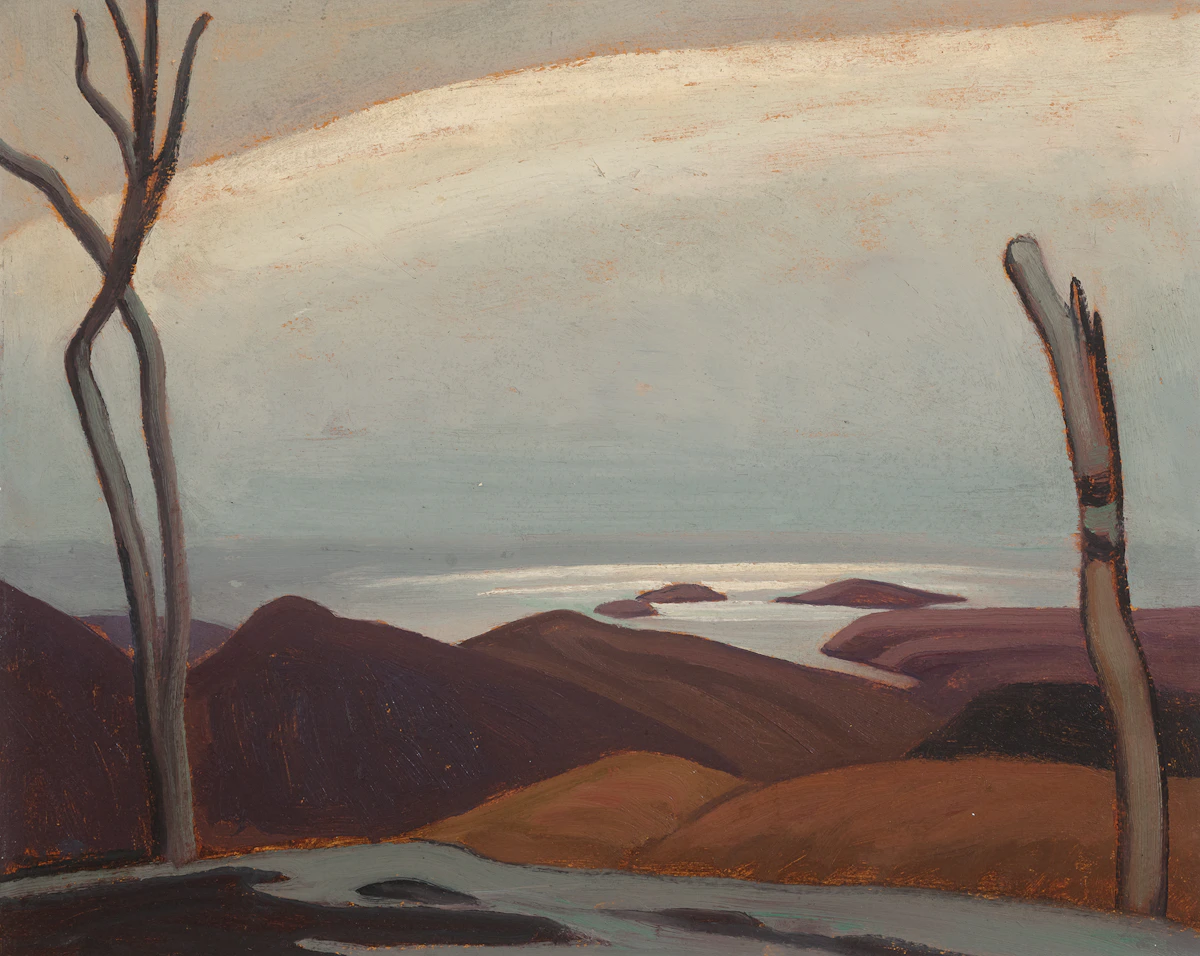
Lawren Harris had a long career, his work evolving from a naturalist style in the years prior to World War I to abstraction in the 1930s. He is perhaps best known for the geometric Lake Superior landscapes that he painted in the 1920s; yet these same paintings have frequently been misdated. Harris’ practice of recycling the same titles for different paintings and ultimately abandoning descriptive titles for numerical appellations (e.g. Lake Superior I, II, III, etc.), hasn’t helped in identifying which works were exhibited when. One clue helps to at least identify oil sketches painted in the early and late twenties. In response to an enquiry from the Montreal artist Prudence Heward about purchasing one of his Lake Superior sketches from the Annual Exhibition of Canadian Art at the National Gallery of Canada, Harris wrote to the gallery’s director, Eric Brown, on 15 February 1927, “Will you tell the lady she can have a sketch for $60.00 including frame. This is less than I have been selling the recent sketches for. They are considerably larger than the sketches of two years ago and earlier and in some cases have received as much attention as large canvases.” From this we know that in 1925 Harris’ vision of this austere landscape demanded a larger support and that he switched from panels approximately 10 1⁄2 x 13 1⁄2 inches (26.6 x 34.6 cms) to panels about 12 x 15 inches (30.5 x 38.1 cms), the size of this sketch.
The exploration of Canada’s many landscapes saw the artist members of the Group of Seven travel from Toronto to Georgian Bay and from Algonquin Park to Algoma. Following their regular practice they painted their canvases in their Toronto studios from oil sketches and drawings realized in front of the motifs. Lawren Harris first painted on the north shore of Lake Superior in the fall of 1921, when he spent a few days at Rossport with A.Y. Jackson. He would return to the north shore almost every autumn for the next six years, exploring its various landscapes, especially the region near Port Coldwell and Pic Island. Yet on 7 October 1925, A.Y. Jackson wrote from Coldwell, where he was sketching with Harris and Frank Carmichael, to Norah Thomson, book buyer for the T. Eaton Company stores: “We are back in our old haunts, and it is pretty good stuff. It is three years since we did any work here and it all looks new. ... The Coles chocolates were eaten on my birthday on Slate Island.” In 1926 Harris returned to Lake Superior with Franklin Carmichael, in 1927 with Arthur Lismer, and in 1928 with Carmichael and A.J. Casson.
Harris painted numerous sketches of this region, framing the high foreground with bare stumps overlooking the vast expanse of the lake. In contrast to many other north shore sketches, the palette is predominantly brown, orange and mauve, not the blues so commonly found in his works of the late twenties. Nor is Pic Island the central motif of the composition. Here the barren shore extends towards three small rocky islands just emerging from the water. If Coldwell was their base, Franklin Carmichael’s map of their camping and painting sites shows they worked around Foster Island in 1925 and Jackson’s letter to Norah Thomson confirms they painted on Slate Island that year. Harris’ paintings show him ranging from Port Coldwell and Detention Island, to Foster and Pic islands and Jackfish Bay, with numerous rocky islets in between.
This oil sketch belonged to John Robins, professor of English at Victoria College in Toronto. He met Harris at the Arts and Letters Club and wrote articles for “The Canadian Forum”, a publication with which the members of the Group of Seven were also involved. Around 1920 and in the mid-twenties Harris painted a number of portraits, all of people with whom he had personal connections, not clients. In 1925 he painted Robins’ portrait. It was probably around this time that Robins acquired this painting of Lake Superior.
This oil sketch became the source for an undated canvas, merely titled “Lake Superior”, now in the Art Gallery of Ontario (76/145). When Harris and his new wife, Bess, moved to New Hampshire in 1934, Bess’ friend Doris Mills offered to inventory the oil sketches and
canvases Harris had left in storage in Toronto. This sketch was not included in the Mills inventory (Library and Archives of the National Gallery of Canada) as it had already been acquired by John Robins. The canvas was inventoried as “Lake Superior Painting 6” and titled “Lake Superior No. IV”. It is possible that Mills derived the title from an inscription on the stretcher. Harris had exhibited five canvases in the February 1928 Group of Seven exhibition at the Art Gallery of Toronto: “Lake Superior I, II, III, IV and V”. The AGO canvas is most likely catalogue number 21, “Lake Superior IV” in that exhibition, in which case the canvas was probably painted around 1927. As was usual with Harris when working up a canvas from a sketch, few changes were made in the enlargement though painted in a lighter tonality.
We extend our thanks to Charles Hill, Canadian art historian, former Curator of Canadian Art at the National Gallery of Canada and author of “The Group of Seven – Art for a Nation”, for his assistance in researching this artwork and for contributing the preceding essay.