The eldest member of the Painters Eleven, Hortense Gordon’s career spanned from her early beginnings as a landscape artist inspired by French Impressionism, to her unique interpretation of abstract expressionism. She and her husband John Gordon spent their summers of the 1930s in Europe. There the avant-garde movements caught Hortense’s imagination and she began to experiment with abstraction. The couple made fifteen trips to Europe together up until John’s death in 1940. Gordon made her first abstracts in the 1930s and became fully dedicated to this new form of expression following a visit to the Museum of Modern Art in New York City. In 1946 at the Brantford Public Library, she opened an exhibition of 50 works by herself and her husband, a showing which included some of her first abstracts. In 1952, Gordon held her first solo exhibition in New York City and it was very well-received. The following year, Hortense Gordon met with the members of the Painters Eleven, at the invitation of Ray Mead, and found in the like-minded artists connections she had searched for throughout her career.
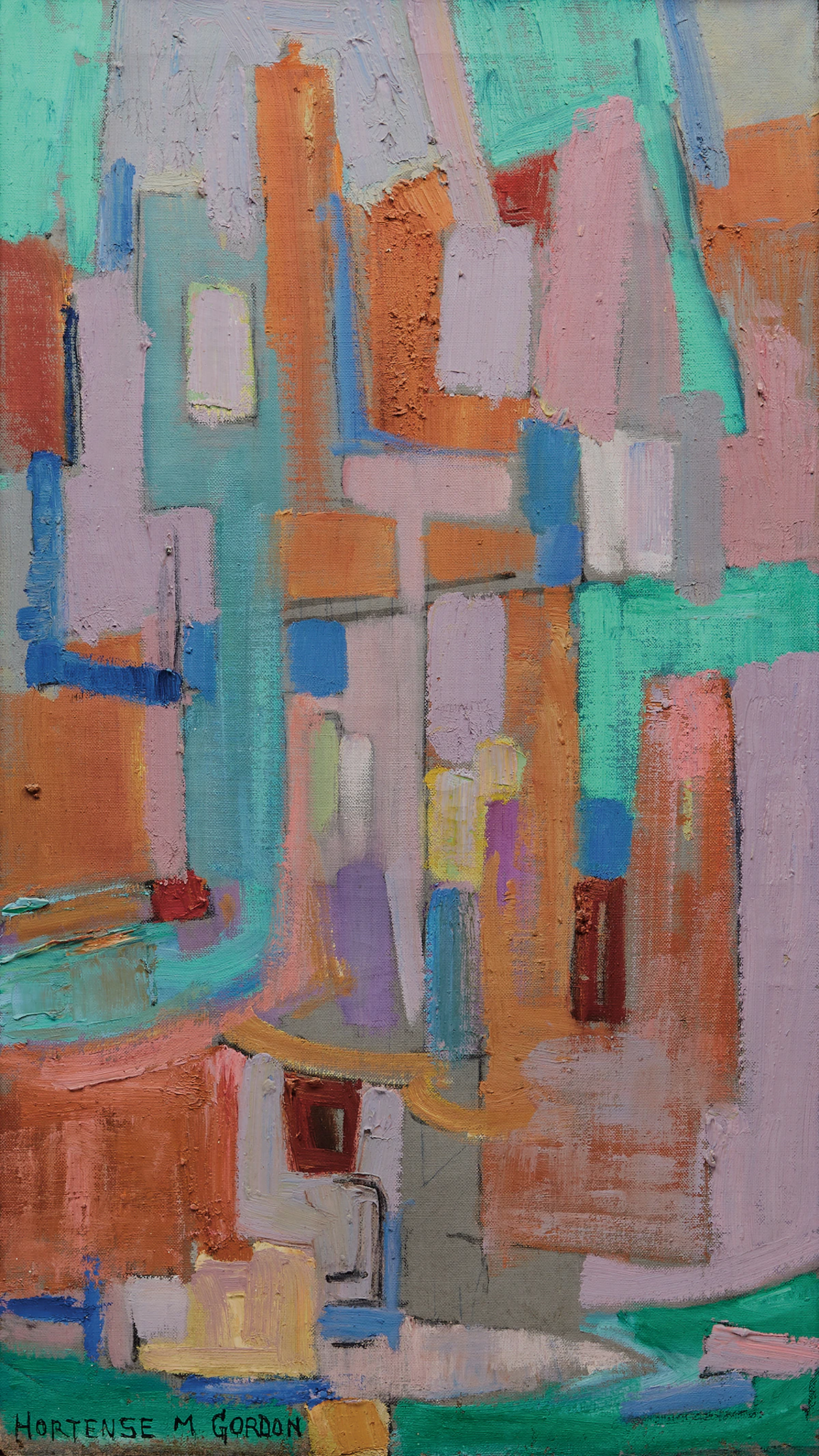
Working on a smaller scale than her Painters Eleven compatriots, Hortense Gordon’s abstract works, such as “Venetian Canal”, were more intricate, with tighter compositions in a vertical format. While others in this group were non-objective in their painting, Hortense Gordon always started her work with an object or experience of the elements as a basis, yet she remained within the realm of the abstract in all her work. “Venetian Canal”, painted in “circa” 1960 around the time Painters Eleven disbanded, may have been inspired by one of her many trips to Europe with her husband.
An invitation from the 1961 Gallery Moos exhibition is included with this lot.