Masters Gallery, Calgary
Private Collection, British Columbia
Exhibited
“Manhattan Cycle Exhibition”, Toronto, Ottawa, Fredericton, Winnipeg, Saskatoon, Calgary, Edmonton, Victoria and Vancouver, 1947-48
Literature
Laura Brandon, “Pegi by Herself, The Life of Pegi Nicol MacLeod”, Canadian Artist, Montreal/Kingston, 2005, pages 148-49 and 152
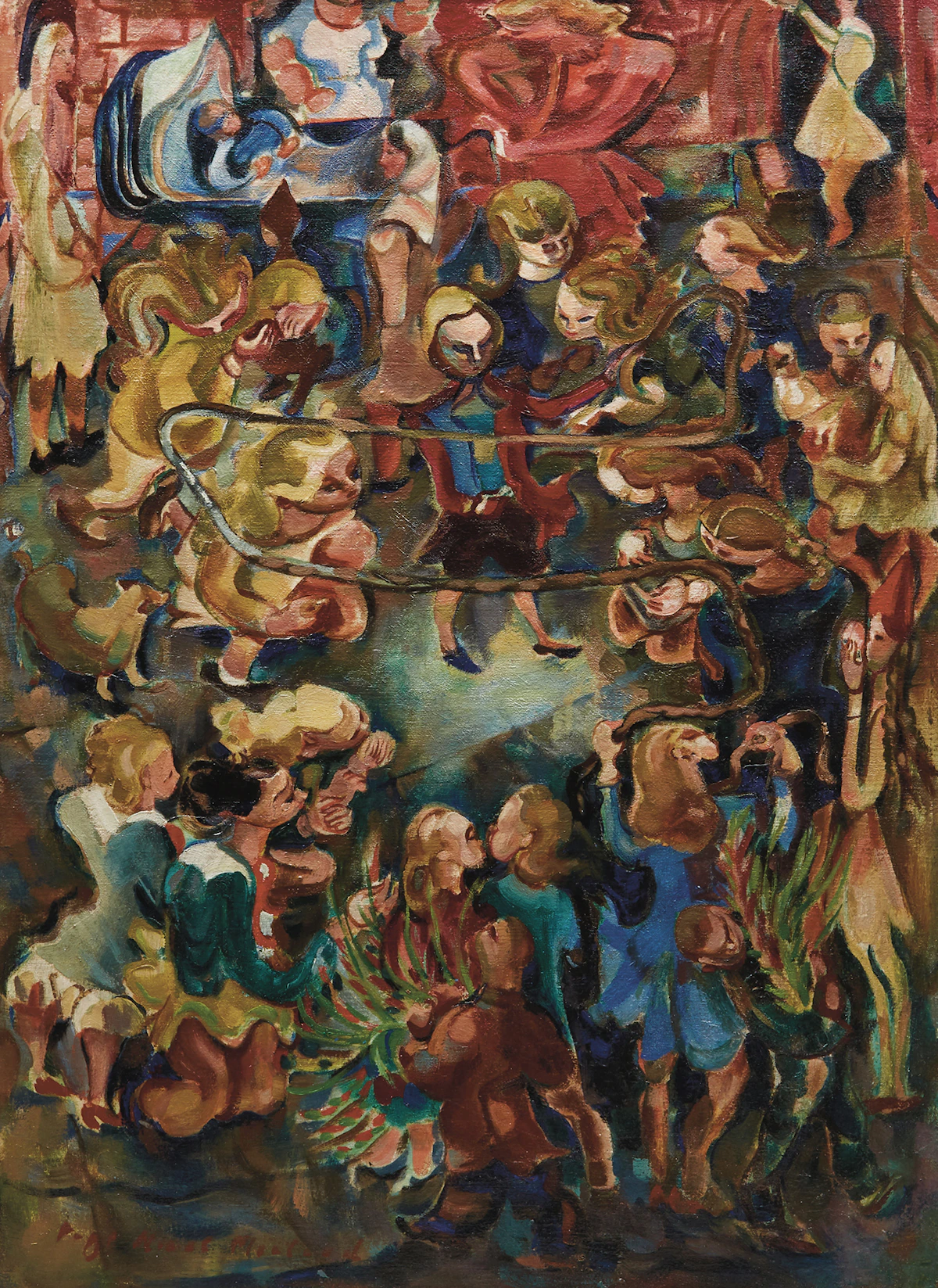
Pegi Nicol MacLeod would spend a good part of the 1940s in New York painting the view from her 88th Street apartment. MacLeod focused on specific subjects and a new compositional device, which Laura Brandon describes: “Four images in New York stayed with her from the war years: the life of the street itself, the women who watched it from their apartment windows, the pigeons that nested on the fire escape outside her kitchen, and, at the end, the victory parades in the street below.” Brandon continues: “...she had perfected a compositional device - the perspective on the street below her apartment, the view looking steeply down.”
In 1946 MacLeod completed two large canvases inspired by the war, “When Johnnie Comes Marching Home” and “The Peace Bird”. Even though “Jump Rope” shares similar compositional elements, MacLeod has left the war behind and instead focuses on a playful scene from everyday life. Brandon discusses these two war-period works, which were part of her Manhattan Cycle, providing a wonderful description that can be applied to the liveliness of “Jump Rope”: “Pegi laid on the paint thickly, and no part of each canvas is free of her swirls and staccato marks. The canvas surface almost vibrates with energy. And yet... the structure of the street and opposite tenement building and the vertiginous viewpoint keep the pulsating and colourful paint surface in place. For all the nervous energy that emanates from these works, they hold together.”