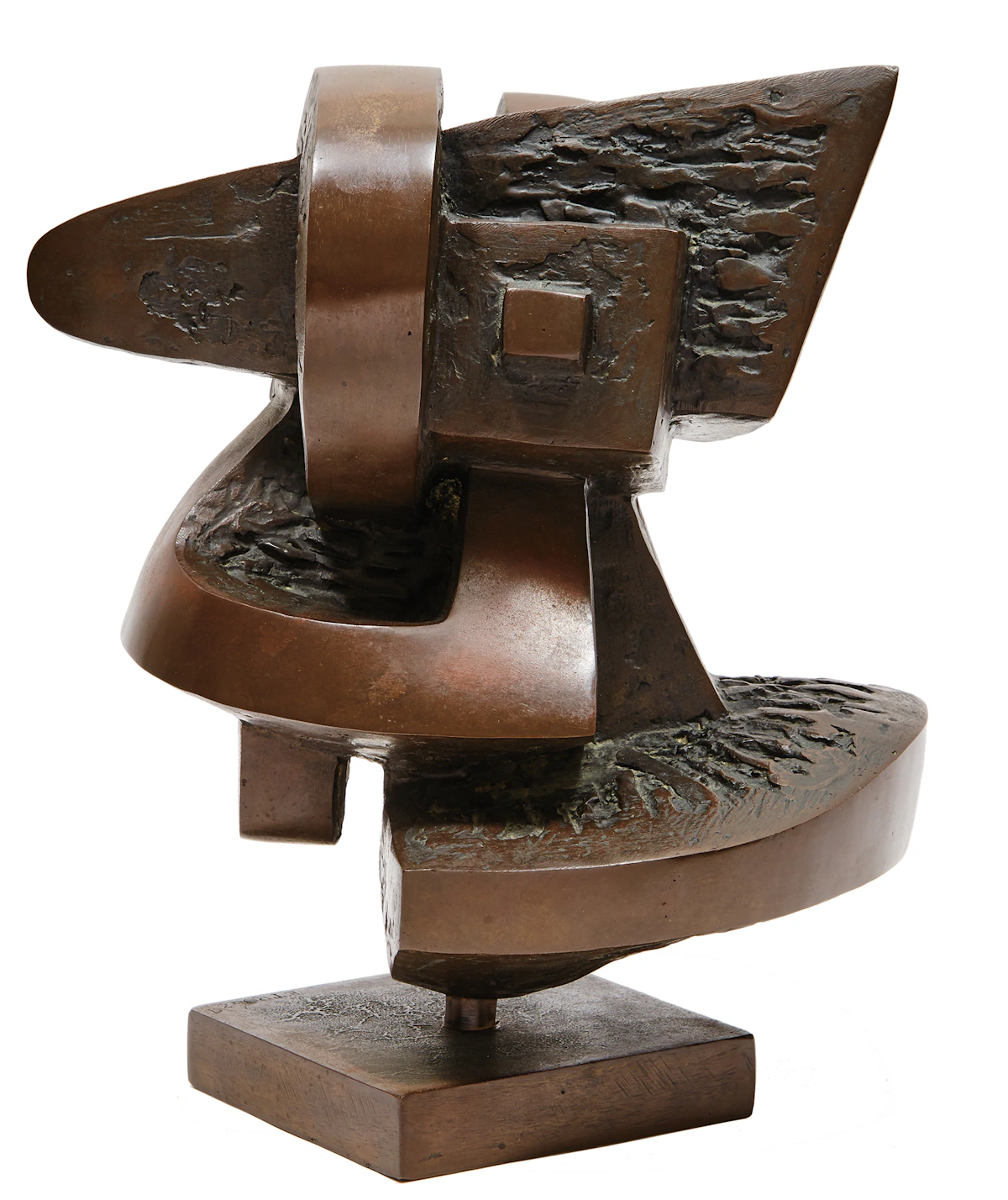
13 x 11 x 10.5 in (33.0 x 27.9 x 26.7 cm) (overall, including base)
Auction Estimate:$20,000 - $25,000
Sale date:June 15, 2022
Price Realized
$21,600
(including Buyer's Premium)
Provenance
Rose Fried Gallery, New York
Sotheby’s, auction, New York, October 1, 1985, Lot 13
Christie’s, Post War & Contemporary Art Auction, December 15, 2021, Lot 224
Private Collection, Toronto
While studying art at Tel Aviv’s Arts Institute for Painting and Sculpture in the 1950s, Sorel Etrog created three-dimensional paintings, inspired by Cubist collage, modernist music and constructivist reliefs. In 1958, he received a scholarship to attend the Brooklyn Museum of Art School. Upon his arrival in New York City, Etrog was drawn to African and Oceanic art due to their expressive shapes and began incorporating these elements into his work. While trying to find gallery representation in New York City, Etrog befriended the prominent Jewish-Canadian art collector, Samuel J. Zachs. Zachs purchased one of Etrog’s paintings and invited him to spend the summer of 1959 on Lake Huron with him in Southampton. While on this sojourn, Etrog created his first sculptures, out of wood, plaster and later, bronze.
“Study for Hasidic Head” was created in this same year, when Etrog was first breaking into sculpture. The subject likely references Hasidic Jews, who have large populations in both Israel and Brooklyn, thus linking Etrog’s new and former countries of residence. The small bronze sculpture reflects the stylistic influence of Henry Moore, Barbara Hepworth and Constantin Brancusi - artists whose works were collected by Sam Zachs. Etrog’s first Canadian exhibition also took place in 1959, held on October 1st at Gallery Moos in Toronto. The small bronze sculpture served as a preparatory work for a four-foot-tall final version, completed only seven years later in 1966.