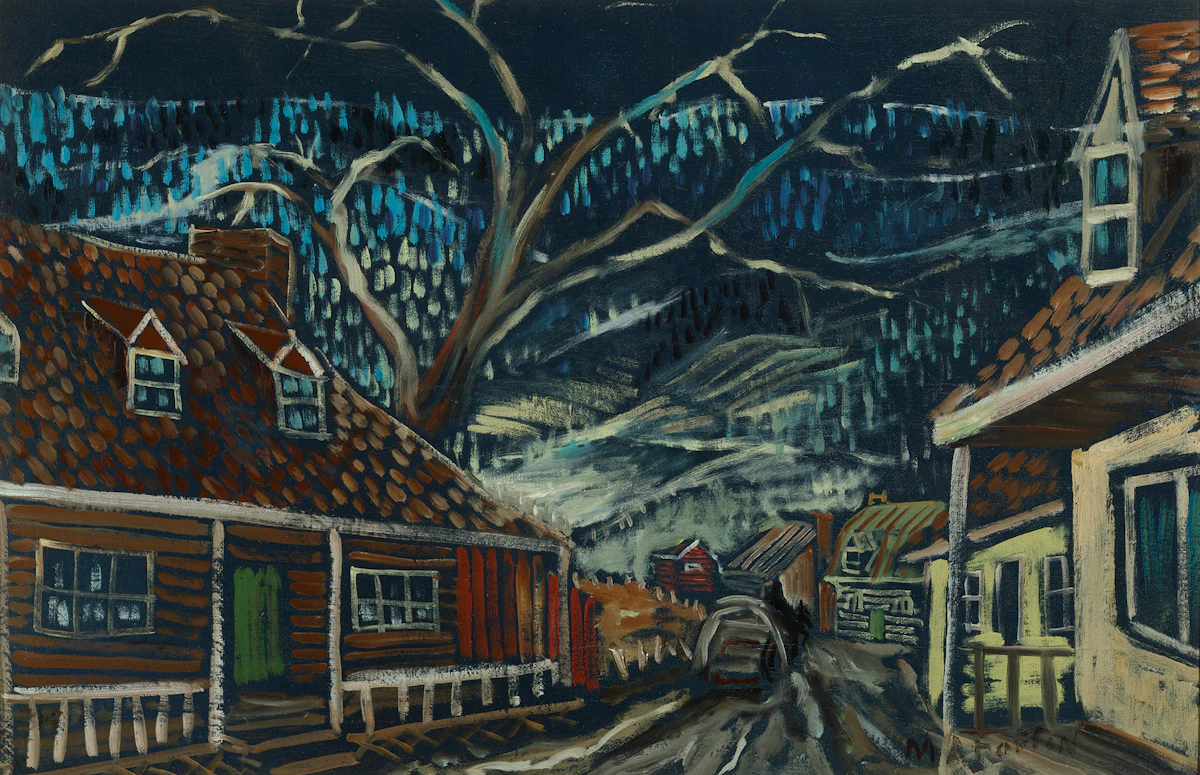
Born in Sainte-Rose, Marc-Aurèle Fortin’s early artistic training came at home under the tutelage of artists including Ludger Larose and Edmond Dyonnet before his studies would take him to Chicago, New York, Boston and, later, to France. It was after a brief trip to France in 1920 that Fortin began to work full-time as a painter and to show his work, which included scenes of the island of Montreal, predominantly rural at the time, and of his birthplace Sainte-Rose, north of the island. During the summers, he travelled to Quebec City, Île d’Orléans and the Charlevoix region, sketching and painting houses and rural scenes. Fortin became renowned for capturing the charm of small-town Quebec in his vibrant works, as exemplified in this oil painting “Maisons, Ste-Rose”.
In this enchanting scene of the artist’s hometown, Fortin skillfully rendered his varied and decorative colour palette, demonstrated in the brown, yellow and blue lines and dotted brushstrokes. The painting reflects the distinctive high-contrast colour palette that Fortin adopted in the late 1930s, known as the ‘black period’. After an inspirational year-long sojourn in France between 1934 and 1935, the artist returned to Sainte-Rose and began experimenting with the application of pure colours onto a black surface. Using a support of wood, canvas or metal, Fortin painted a thick layer of black pigment, which he left to dry before painting his subject in brushstrokes dipped in vivid colours. By deliberately leaving the black paint of the first layer visible in certain areas, the artist achieved luminous and brilliant colour juxtapositions, as seen in this nocturnal scene of Sainte-Rose.