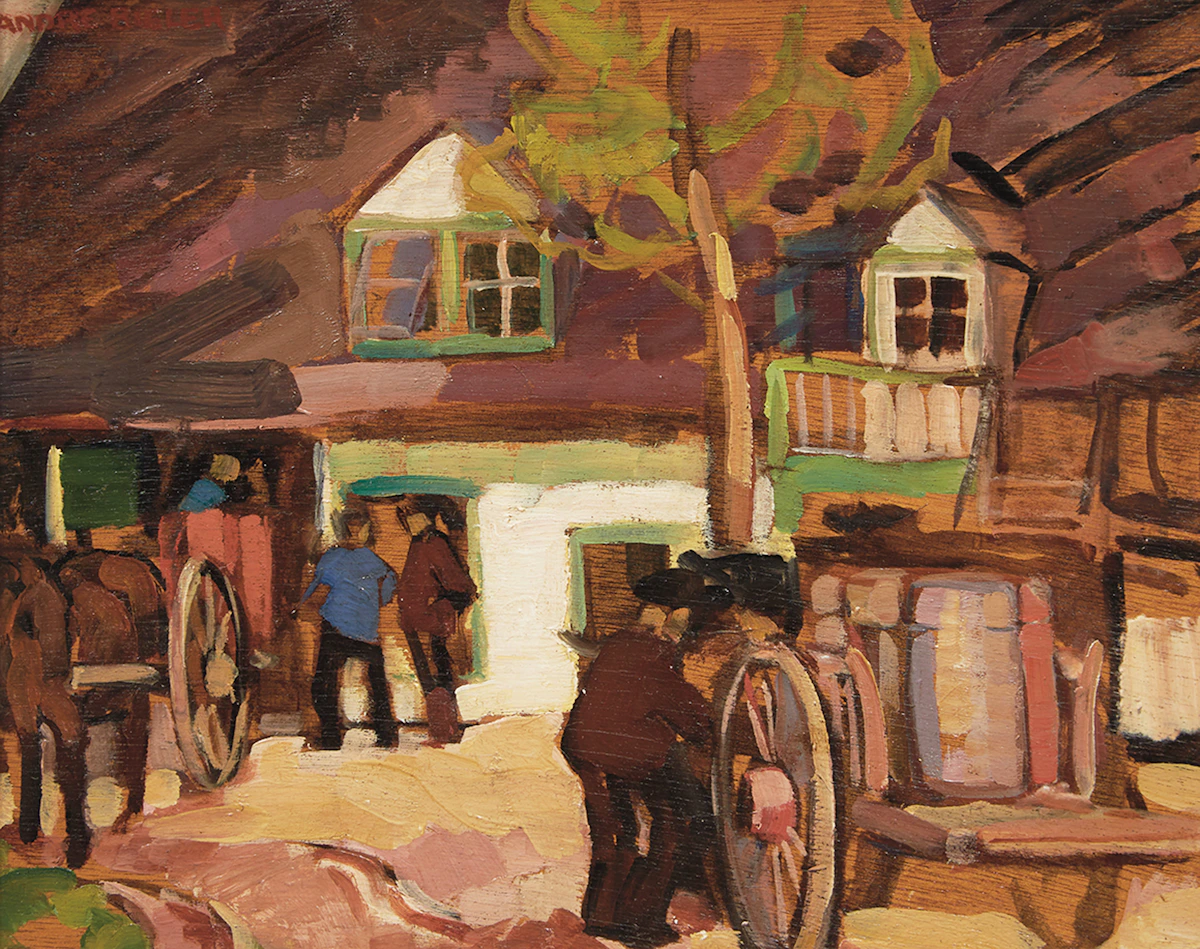
Walter Klinkhoff Gallery, Montreal
Canadian Fine Arts, Toronto
Private Collection, Toronto
Literature
Frances K. Smith, André Biéler: An Artist’s Life and Times, Richmond Hill, Ontario, pages 50-58, reproduced page 58
Upon his return to Canada in 1926, André Biéler sought to explore the remote regions of Quebec. He wished to be in relative isolation there and continue the creative exploration he had so enjoyed in Switzerland. The romanticism of the rural villages of Quebec and the regionalism of its inhabitants sparked the artist’s interest, especially after reading the novel “Maria Chapdelaine”, with its nostalgic woodcut illustrations. Biéler settled in Sainte-Famille-de-l’Île d’Orléans in 1927, where life was completely centred around the village, churches and a traditional rural lifestyle.
André Biéler roamed the island, recording the details of everyday life in his oil sketches, portraying the colour of the region and the rhythm of the land and culture. As Frances K. Smith notes, “One of the very satisfying and colorful small compositions which emerged from the daily life and activities of the community is “La laiterie, Île d’Orléans”. The scene of farmers delivering milk to be made into butter is an intimate one on a small wood panel but carries great expressive power in the handling of line and color.” Biéler’s works from this period possess a directness of realism and expression, successfully fusing his love of shape and form with that of human subjects. Smith explains: “In no other phase of his large output has the art of André Biéler been so consistently shaped by the interactions of people and place as in his record of the life and land of rural Quebec. There he found maturity as a painter. He belonged to no school or group, but belonged to Canada. This growing sense of identification – without any hint of sentimentality – is clear in the paintings and sketches of this period, in which he actually shared the life, customs and traditions of the people.”
André Charles Biéler - La laiterie, Île d’Orléans | Cowley Abbott