Exhibited
Exhibition of Paintings by John Lyman, W. Scott & Sons, Montreal, February 21 - March 4, 1931, no. 27 as “Regatta (San Sebastián)”
Literature
Journals of John Lyman, choice of texts and annotations by Hedwidge Asselin, Montreal, Ministère des Affaires culturelles / Bibliothèque nationale du Québec, 1980
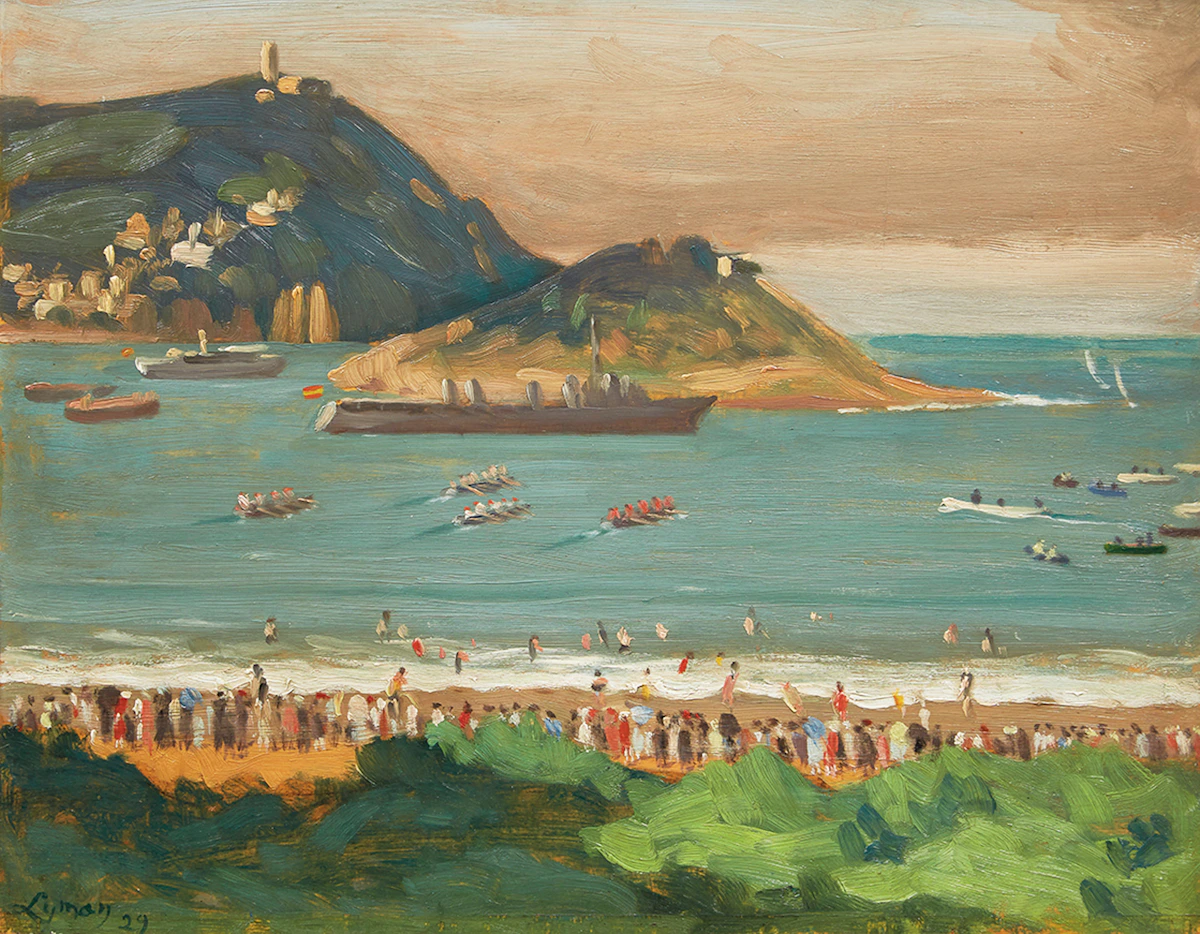
On September 1929, John Lyman attended the famous rowing regatta which had been held since 1879 in the Bay of La Concha in San Sebastián on the Basque coast of Spain. In May of that year, Lyman and his wife Corinne had moved into the La Chaumière villa in Saint- Jean-de-Luz, a fishing village they had often visited since 1926. On the second Sunday of the regatta, Lyman travelled the 27 kilometres to San Sebastián to lunch with the author and philosopher Marius Latour whose house on Mount Igueldo offered a magnificent view of the shell- shaped Bay (hence its name La Concha, Spanish for “shell”). From his “mirador”, or gazebo, one could admire the island of Santa Clara and the Castillo de La Mota perched on the hilltop of Monte Urgull which closes the bay towards the west.
In a few brushstrokes, Lyman captures the festive atmosphere of the Bay of La Concha on a bustling regatta day. He paints the spectators of the competitions in small dabs of colour stretching in a line across the beach. Beneath a cloudy sky, other bright touches evoke swimmers seeking cooling refuge from the humidity which had been particularly stifling on the coast that summer. Further offshore, the four competing rowboats are speeding along, surrounded by a variety of boats in the harbour that day: barges, canoes, motor boats, sailboats and a ship flying a Spanish flag.
John Lyman painted “Regatta at San Sebastián” two years before his permanent return to Canada in 1931. In 1913, the artist had rushed to leave the country after an exhibition of his modern works at the Art Association of Montreal had not been well received and caused somewhat of a scandal. Exiled for nearly 18 years in Europe, he would often escape from the cold Parisian winters, favouring the gentler climates of the Mediterranean coast of Tunisia (1919-1922) and Cagnes-sur-Mer (1923-1924). But from 1926 onward, John and Corinne preferred the Atlantic coast. Until 1931, they spent extended months in Saint-Jean-de-Luz, making frequent excursions into Spain.
On the back of the small panel, we discover an undocumented sketch for “On the Beach (Saint-Jean-de-Luz)”, one of John Lyman’s masterpieces. This oil sketch is one of several similar ones already known and which are held along with the finished painting at the National Gallery of Canada. The uniqueness of this sketch, however, is that it contains a draft of the principal theme of the final painting, namely the couple sitting on the beach beneath a bright red parasol. Close scrutiny of the other figures in the small study reveals the silhouette of the swimmer in a red bathing suit who, in the finished painting, is entering the water at the right in the composition. The woman standing with a light parasol in the sketch also appears in the finished painting at the extreme left-hand of the composition, partially hidden by the “gendarme”. This sketch offers a most important insight into the creative process of one of Lyman’s finest paintings.
A few months before the artist’s definitive return to Montreal, Gallery W. Scott & Sons presented “Exhibition of Paintings by John Lyman” from February 21 to March 4, 1931. Among the 39 works exhibited were four views of the beach at Saint-Jean-de-Luz (nos. 2831) as well as the “Regatta (San Sebastián)” (no. 27). To our knowledge, this was the only public showing of this small painting. John Lyman never tired of painting beach and regatta scenes. They inspired remarkable pieces he painted in Quebec (”The Beach, Lac Ouimet”, c.1939; “Boat Club, North Hatley”, 1948), on the American coast (”The Main Beach”, 1957) and in Barbados (”The Lobster Trap” and “Hauling up the Fishing Boat”, 1962).
We extend our thanks to Michèle Grandbois, Canadian art historian and curator at the Musée national des beaux-arts du Québec from 1987-2014 for contributing the preceding essay, originally prepared for this artwork’s exhibition by Alan Klinkhoff Gallery, Montreal/ Toronto.