Provenance
Dominion Gallery, Montreal
Joyner Fine Art, auction, Toronto, May 18, 1993, Lot 46
Private Collection, Ontario
Literature
Marius Barbeau, Cornelius Krieghoff: Pioneer Painter of North America, Toronto, 1934, pages 3, 5, 6, 28
J. Russell Harper, Krieghoff, Toronto, 1979, page 8
Dennis Reid, Krieghoff: Images of Canada, Vancouver/Toronto, 1999, pages 45-46
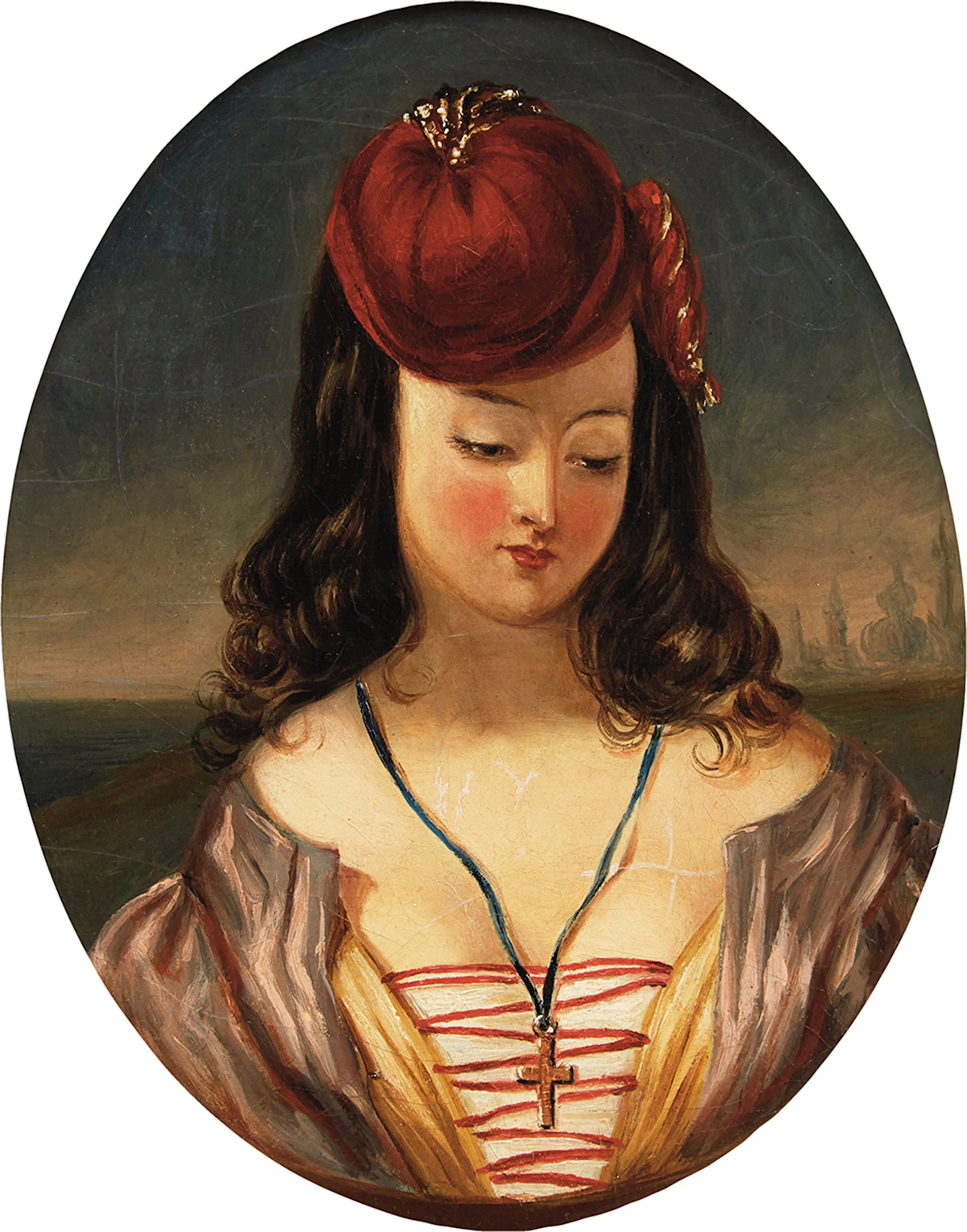
In many of Cornelius Krieghoff’s paintings, it is believed that the artist’s wife was his model. Her features often appear in various compositions throughout Krieghoff’s life, including his celebrated paintings of habitant life and his early compositions, such as Scottish “Officer Sparking” and “Nude (Leda and the Swan)”. Marius Barbeau, respected historical biographer of Krieghoff, states that in 1837, the twenty-two-year-old Cornelius Krieghoff married a young French- Canadian girl, Louise Gautier dit Saint-Germain, after meeting her in a New York hotel. “Louise was a beautiful young woman, with dark eyes, an oval face and perfect, rather Italian features. Her charm and cleverness from the very first held Krieghoff spellbound.”
According to J. Russell Harper, “We know little about the circumstances of his [Krieghoff’s] marriage other than Marius Barbeau’s statement that ‘Krieghoff was very young when he landed at New York [from Germany]. At the hotel where he had put up, he became acquainted with a young French-Canadian girl...Louise Gautier dit Saint-Germain, and he married her.’ Nothing has been found to verify this assertion and it seems to contain at least one error: the wife’s name, according to her death certificate, was ‘Emily (Émilie)’, not ‘Louise’, and her surname was ‘Saintaguta’. Émilie’s family lived, it seems, at Boucherville just downriver from Montreal on the south shore of the St. Lawrence.”
Dennis Reid goes on to state that at present, there are only three pieces of documentation from this early period in Krieghoff’s life that can be provided as evidence regarding his union with Émilie and the timeline of this stage of the artist’s life. Reid remarks, “The first is the record of the baptism, 18 June 1840, of one Henry Krieghoff at the parish church of Ste-Famille in Boucherville, on the south shore of the St. Lawrence downriver from Montreal. Born some five weeks earlier, according to this document, ‘of the legitimate marriage of Cornelius Krieghoff and Émilie Gauthier of this parish’. The next document sadly records his burial a year later in Montreal, 14 June 1841...The third document is a notice in a Rochester, New York, newspaper, 30 May 1843, of an upcoming exhibition of Krieghoff’s paintings in that city.” It is thought that a daughter was born soon after the death of Henry. Although, as Reid describes it, “Less securely fixed within this thin web of evidence is a daughter, with the same name as her mother but apparently spelled Emily, for whom no record of birth has been found.” Within this time period, Krieghoff moved his family to Rochester, visiting Buffalo and Toronto on the way. Rochester was a growing city, and many artists were drawn there in search of commissions, which Krieghoff diligently sought while teaching music.
“Portrait of Louise” appears to be a depiction of Émilie as a young woman, perhaps executed around the time of her arrival with Krieghoff in the city of Rochester. Krieghoff has portrayed his young wife with tenderness. His admiration is evident in the way he has depicted her delicate facial features. Émilie’s eyes are downcast, her cheeks are rosy, and her eyelashes, mouth and chin are clearly defined. Her elegant dress is accentuated by a crucifix at her neck and a deep rouge hat sitting perfectly atop her long, dark hair. This portrait is akin to another the artist completed of his wife, “Young Woman Gathering Grapes”. Both render the female model in an oval shape, set against a landscape milieu. The union of Émilie, a supposed country girl from Boucherville, with the worldly Krieghoff is one that remains an enduring mystery.