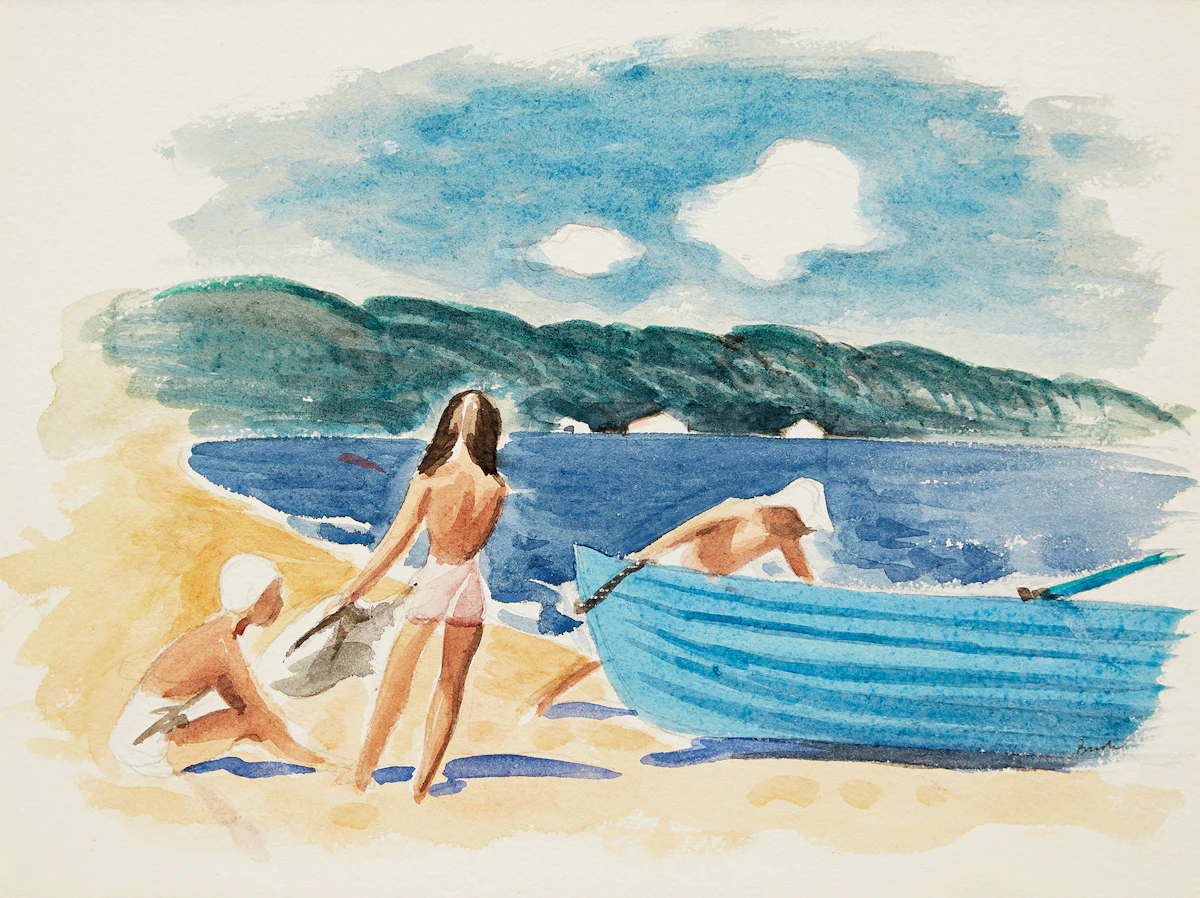
signed, titled, dated “July 1946” and inscribed “Thunder Bay” and #31 (Bush inventory number) on the reverse
11.5 × 15.75 in (29.2 × 40.0 cm) (sheet)
Auction Estimate:$3,000 - $5,000
Sale date:September 24, 2020
Price Realized
$4,320
(including Buyer's Premium)
Provenance
Acquired directly from the artist by a Private Collection, Toronto
By descent to a Private Collection, Toronto
Gallery Gevik, Toronto
Private Collection, Toronto
Prior to his large and brightly coloured non-representational canvases of the 1950s to 1970s, Jack Bush painted for three decades in a figurative manner that gradually evolved into abstraction. In the late 1920s his interest in fine art grew through contact with members of the Group of Seven, the Ontario Society of Artists and the Canadian Group of Painters. In 1929, artist Charles Comfort hosted weekly life model drawing sessions in his Toronto studio and Bush would attend periodically, sketching alongside A.Y. Jackson, George Pepper and Kathleen Daly. Throughout the 1930s Bush worked as a commercial artist while taking night classes at the Ontario College of Art, developing a significant body of figurative work prior to his arrival at abstraction in the late 1950s.
Bush’s delicate 1946 watercolour, “Summer Morning”, portrays one of the preferred locations of the Group of Seven and many Canadian artists, Georgian Bay. The picturesque area of Lake Huron remains to this day a popular destination for summer vacations as well as for sketching the many views of beaches, shorelines and forests. While Bush inscribed the watercolour with a note of “Thunder Bay”, he was in fact referring to the community of Thunder Beach, which is located in Tiny Township, in the southern Georgian Bay region. The area is shaped like a curving bay, so it is possible that the terms “Bay” and “Beach” were used interchangeably at the time. The name “Thunder Beach” may derive from the loud booms and storms that the area receives.
This artwork will be included in the forthcoming “Jack Bush Paintings: A Catalogue Raisonné” by Dr. Sarah Stanners.