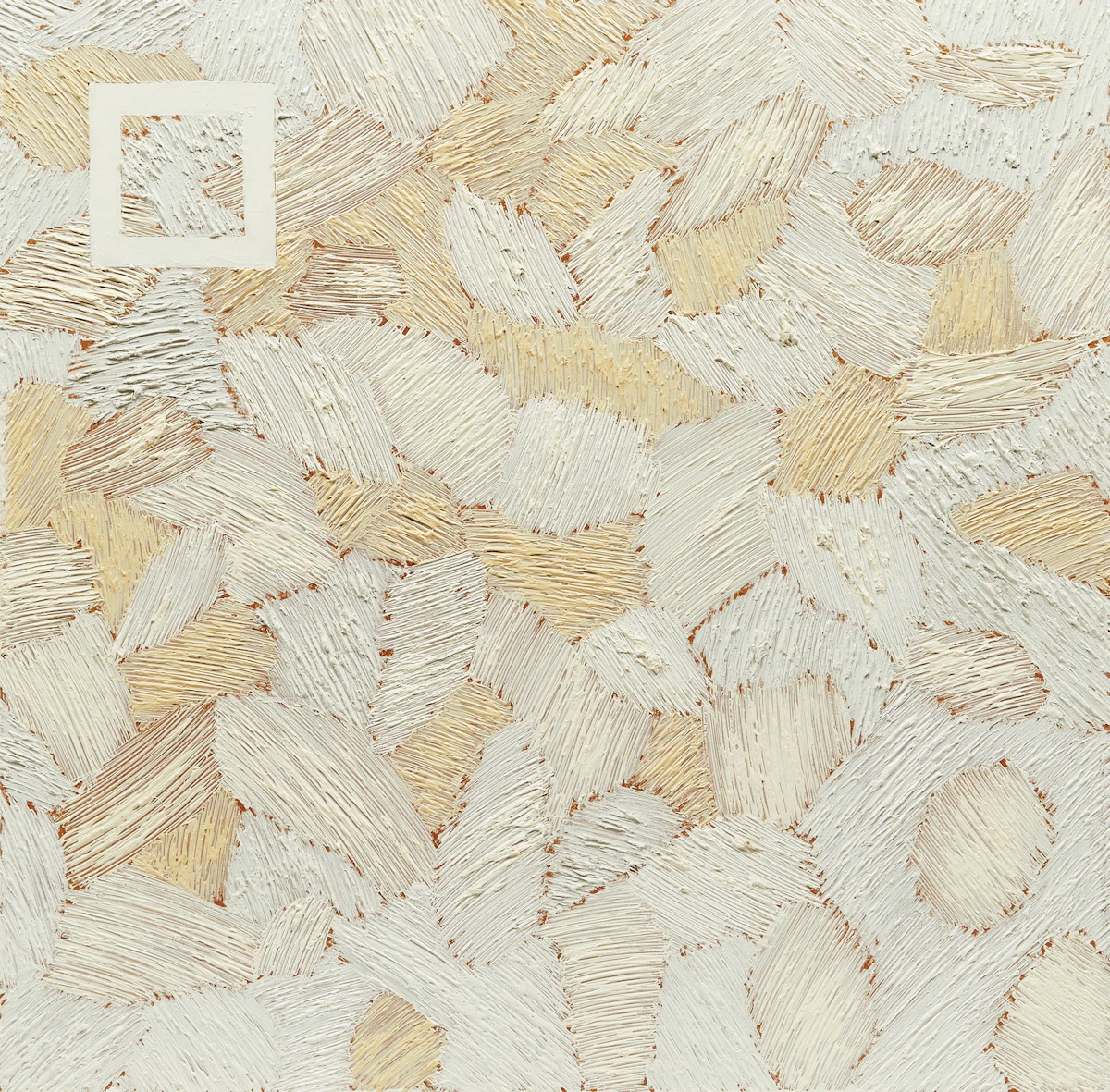
An influential figure in Canadian post-war abstract art, Ronald Bloore was a founding member of the Regina Five. Bloore studied archaeology and travelled extensively, finding inspiration in the remains of ancient cultures in diverse regions. By limiting his palette and experimenting widely with painted surfaces and textures, he infused his abstractions with a poetic sense of the universal.
Rather than approach abstract painting with improvisation, Bloore carefully preconceived and planned his compositions. The artist employed a rich variety of techniques, often building up thick, impasto layers of paint, then removing material with scraping or sanding. This allowed him to achieve subtle tonal shifts and varied surfaces imbued with rich associations. Bloore insisted his paintings were not actually monochromatic, instead incorporating dozens of near-white tones, varying delicately between warm and cool, creams and greys. In this untitled work, a composition of interwoven organic forms is complemented with a white square, pulling the viewer’s eye to the upper left. The solitary white square echoes the overall shape of the canvas, drawing attention to the painting as a material, sculptural object. Employing his deep knowledge of art, history and archaeology, Bloore created works that resonate with poetic meaning.