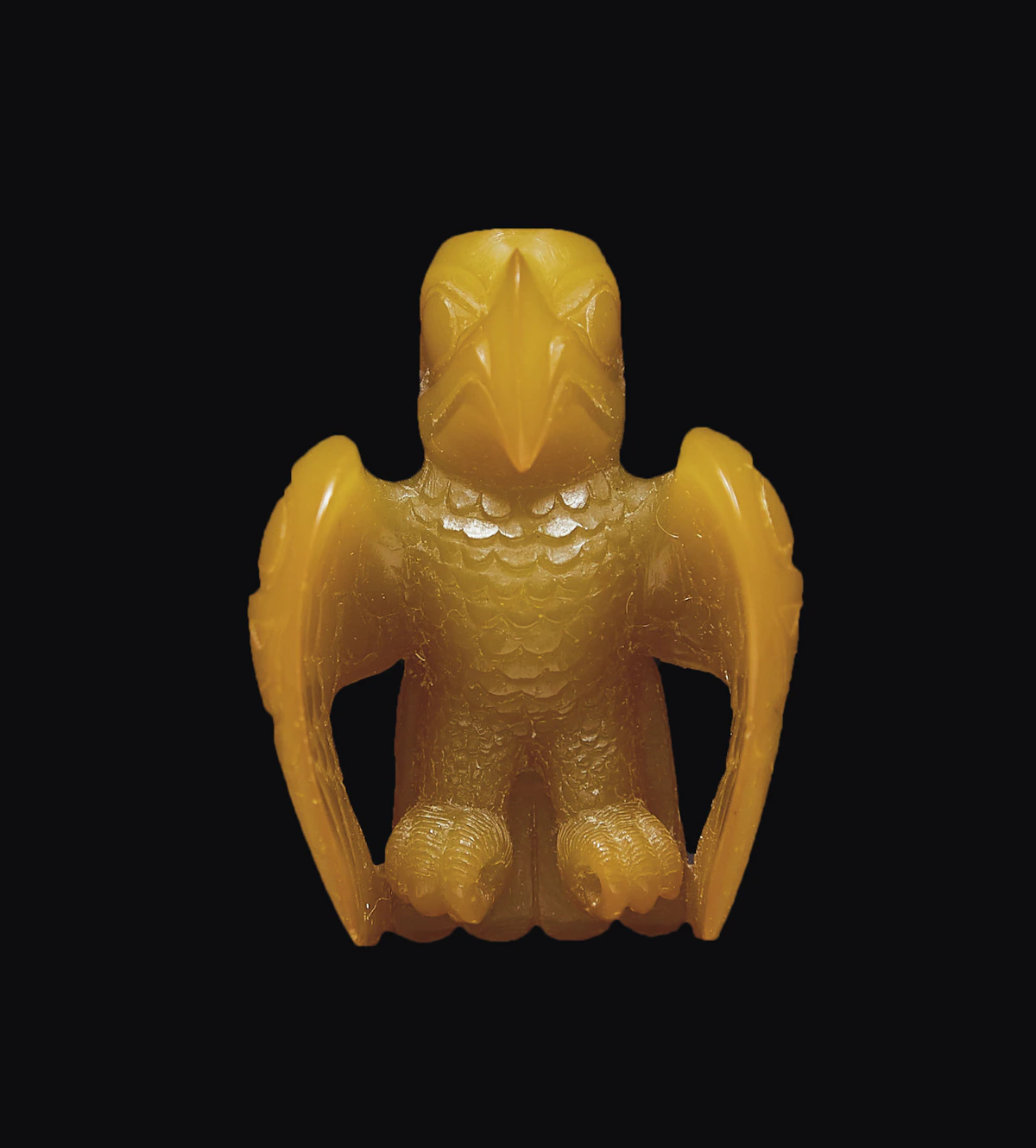
Gift of the artist to a Private Collector, British Columbia
Private Collection, Vancouver
Literature
Martine J. Reid, Bill Reid Collected, Douglas & McIntyre/ The Bill Reid Foundation, Toronto, 2016, page 83 for related work, Eagle Pendant (1969)
Karen Duffek, Beyond the Essential Form, University of British Columbia, Vancouver, 1986, page 43
Peter L. Macnair, Alan L. Hoover and Kevin Neary, The Legacy: Tradition and Innovation in Northwest Coast Indian Art, Toronto/Vancouver, 1984, pages 85-86
The fusion of Haida traditions with a modernist technique is quintessential to Bill Reid’s artwork, resulting in the creation of exquisite works ranging from the diminutive to the monumental. Reid mastered several media, including carving in silver, gold, wood and argillite, referring to himself as “a maker of things” rather than an artist. He crafted objects of adornment that were variations on traditional crest designs or identity symbols, such as this delicately carved pendant. “Eagle” exemplifies Reid’s mission to express the visual traditions of his ancestors in a contemporary form, mastering his complexity of three-dimensional forms. Reid had studied the culture and myths of the Haida in the course of his research, adapting carving designs and works illustrated in anthropological literature, seeking to reference the fundamental techniques of historical Haida art. The figure of the Eagle is an important being in the oral history of the Haida, respected for its intelligence and power as a hunter.
“Eagle” is an elegantly executed Haida-inspired design, related to a 1969 fossil ivory work, “Eagle Pendant” (Collection of Sherrard Grauer). As noted by Karen Duffek, “A pendant of fossil ivory made in 1969 presents the Eagle in a manner still related to past imagery but already hinting at Reid’s forthcoming carving, ‘The Raven Discovering Mankind in a Clamshell’ (1970, Museum of Anthropology, UBC). It is primarily in the finely carved feathers, the arched wings, and the configuration of two-dimensional elements that a continuity of image can be seen.”
Reid’s artwork was inspired by the rich environment of Haida Gwaii and its inhabitants – animal, human and mythical. Reid left his mark in the art world with the intention to impact Haidi Gwaii and the legacy of the Haida people, fondly remembered as “the man who mastered its secrets and popularized it widely.”