Roger Burford Mason, A Grand Eye for Glory: A Life of Franz Johnston, Toronto, 1998, page 40
In the fall of 1918, Frank Johnston joined his colleagues, Lawren Harris, Dr. MacCallum and J.E.H. MacDonald on his first boxcar trip into Algoma country, where he found inspiration in the rugged wilderness. He immersed himself in the grandeur of Agawa Canyon, Agawa River and the surrounding landscape for almost a week. It was during this time that Johnston began to employ tempera as his predominant medium, whilst his fellow artists painted mostly in oils. Johnston became very proficient in tempera, using its qualities to create subtle patterns of colour and form.
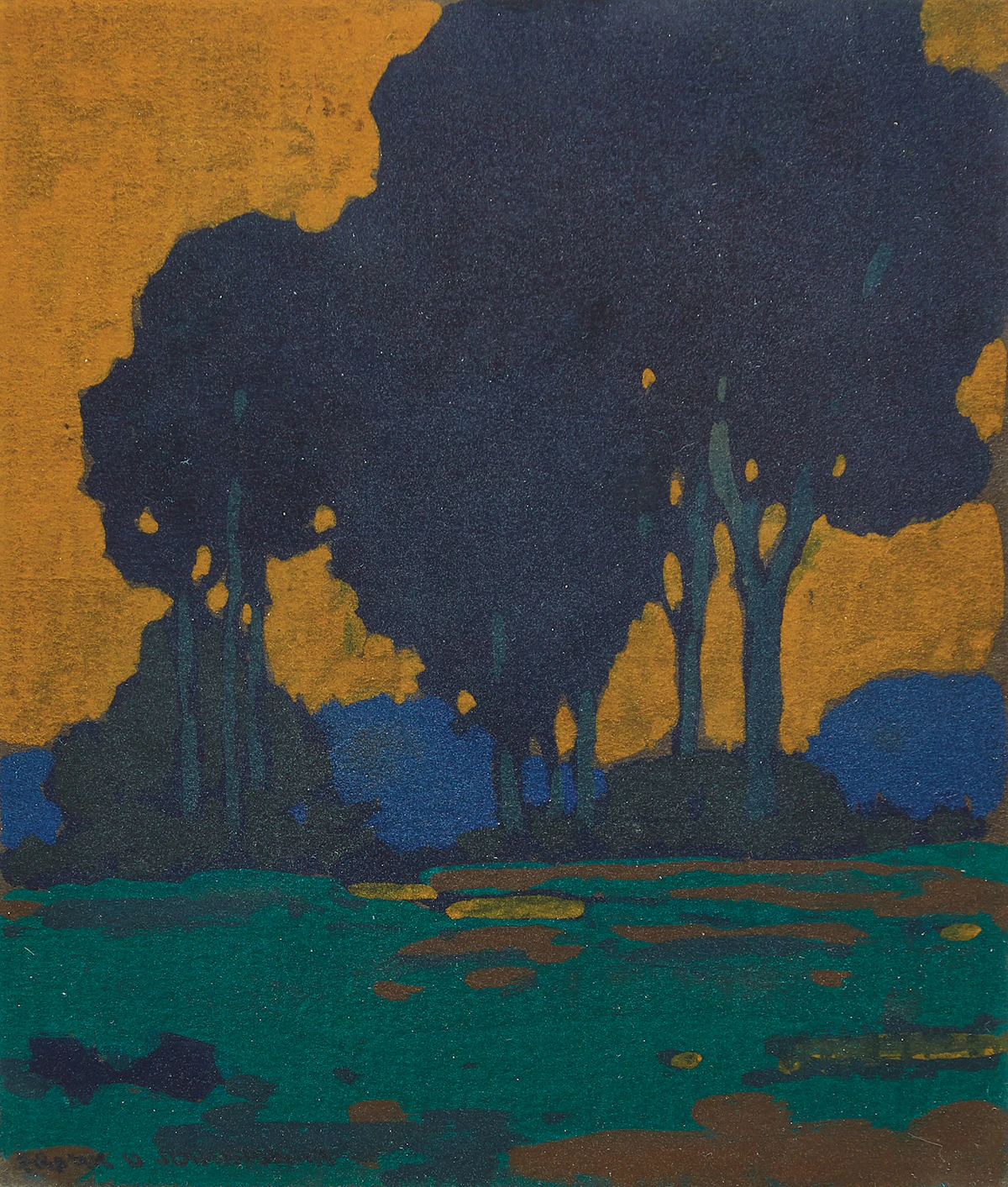
“Old Elms” may have been inspired by this boxcar trip into Algoma, having being executed in 1919. Johnston has captured the regal Elm tree of the region in this diminutive work, employing tempera to illustrate a play of light, depth, colour and pattern. “Old Elms” is a charming, atmospheric painting, with its delicate and decorative nature, and as a critic wrote of Johnston’s work, “He has a gift for finding subjects that appeal to the imagination and he gives them an imaginative treatment.”