Provenance
Private Collection, Alberta
Christopher Varley Art Dealer Inc., Toronto
Private Collection, USA
Literature
Maria Tippett, Emily Carr: A Biography, Markham, Ontario, 1982, pages 167, 186-88, and 226-30
Doris Shadbolt, The Art of Emily Carr, Toronto, 1979, page 112
Emily Carr, Hundreds and Thousands: The Journals of Emily Carr, Toronto, 1966, pages 132-33
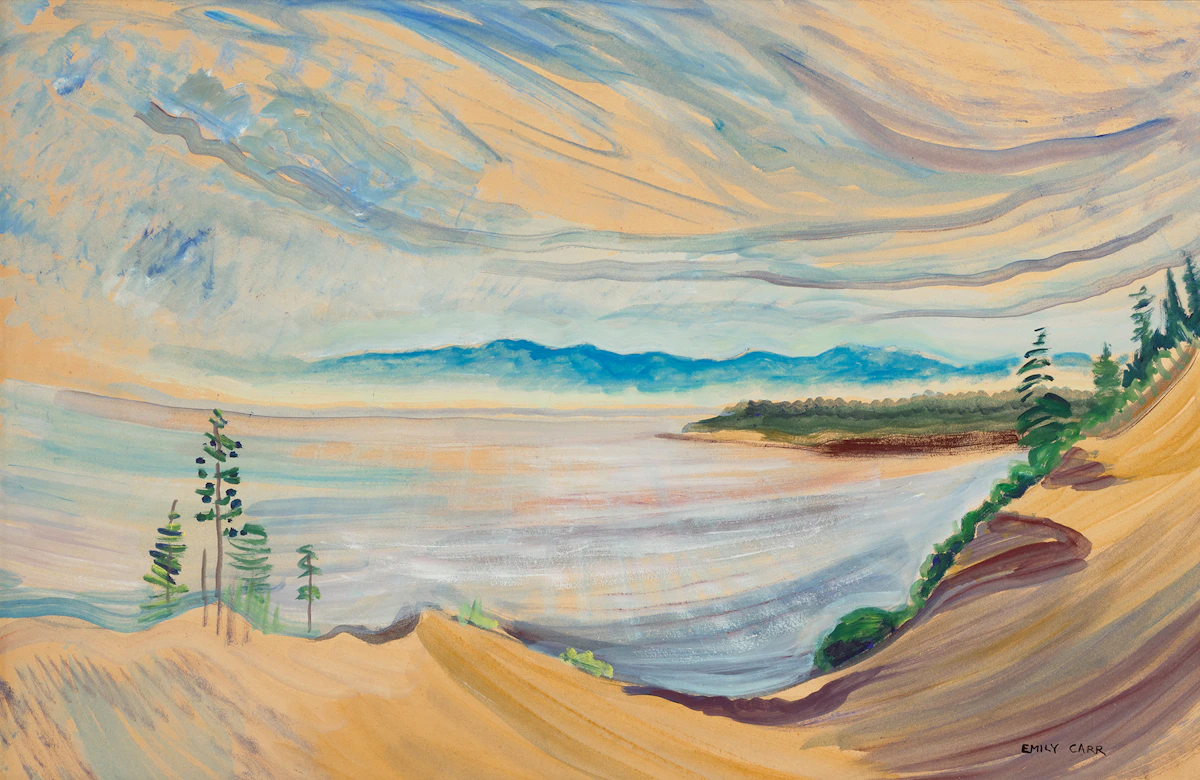
One of Canada’s most iconic and influential artists, Emily Carr is celebrated for her landscape compositions that represent a personal interpretation and spiritual connection with British Columbian terrain. “Untitled (Strait of Juan de Fuca from the Gravel Pit)” showcases her success in her new oil on paper medium of the 1930s, which Carr believed helped her achieve a unity with God, nature, and painting.
Emily Carr embarked on a noteworthy trip to Eastern Canada in 1927. First she visited Ottawa, to see her paintings included in the Exhibition of Canadian West Coast Art, followed by Toronto, where she met members of the Group of Seven and began what would become a lifelong correspondence with Lawren Harris. The main theme of her work at the time was Indigenous villages and the nature that surrounded them. Carr followed Harris’ suggestion in 1929 to abandon this subject matter to express the spirit of British Columbia in its exotic forests and shoreline landscapes.
In the following decade, Carr set out on many sketching trips in the woods, seeking to reach a level of consciousness where she was at one with God and nature. The artist became increasingly spiritual in the 1930s, which influenced her stylistic interpretation of the landscape. She deepened her relationship with God through nature, which enabled her to create art through his inspiration. The artist experimented with a variety of philosophies and religions during these years, including the ‘Theosophy’ preferred by Harris, though never officially aligned with a particular movement.
“Untitled (Strait of Juan de Fuca from the Gravel Pit)” was painted during one of Carr’s many ‘spiritual’ sketching excursions throughout British Columbia. In the sweeping strokes of the sky and water in this oil on paper work, Carr renders the composition with emotion and energy, and a more personal vision. In the early 1930s, the artist made a significant change in her sketching method by adopting the new medium of oil on paper. Carr sought to combine the spontaneity of watercolour sketching with the intensity of oil pigments, and she found this to be possible by diluting oil paint with generous amounts of turpentine and applying the mixture to Manila paper. She was able to attain the structure of oil paint with this medium as well as the delicacy of watercolour. It also dried immediately, was easy to layer pigments, and retained its colour intensity - all providing additional convenience. Carr was excited by this discovery; she described the new medium in a letter to Eric Brown, who had mistaken one of the sketches for a watercolour: “it is a kind of sketchy medium I have used for the last three or four years. Oil paint thinned with gasoline on paper... it is inexpensive, light to carry and allows great freedom of thought and action. Woods and skies out west are big. You can’t squeeze them down.”
Carr’s oil on paper works, such as “Untitled (Strait of Juan de Fuca from the Gravel Pit)” constitute a significant portion of her work from 1932 onward. This painting exemplifies the freshness that Carr was able to obtain in this new medium of painting en plein air. The Strait of Juan de Fuca is a 154 kilometre-long waterway that serves as the Salish Sea’s outlet to the Pacific Ocean, as well as the international boundary between Canada and the United States. It was named after the Greek navigator Juan de Fuca who sailed in a Spanish expedition in 1592 to seek the semi-mythical Strait of Anián. The strait’s northern boundary follows the shoreline of Vancouver Island, where Carr would have been stationed to paint this composition.
Emily Carr continued to exhibit with the local art societies in Victoria and Vancouver throughout the 1930s, and received many laudatory reviews of her preferred new medium. Lawren Harris praised her oil on paper works and her increasingly expressive and reductive style. He encouraged Carr to pursue the approach further into complete abstraction, but she replied in a letter that doing this would cause her to lose touch with nature. Carr maintained a lifelong dedication to expressing the spirit and sublime nature of British Columbia.