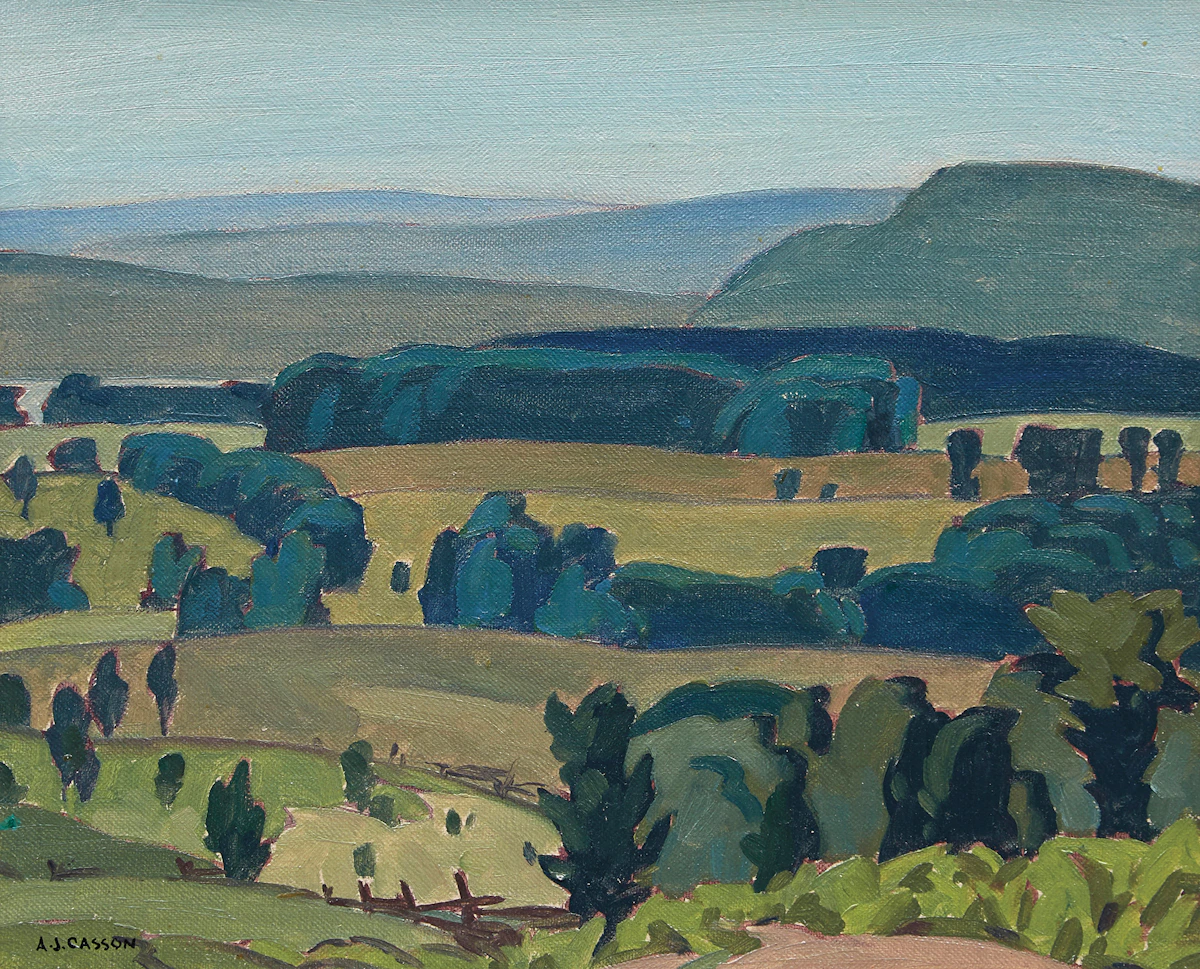
signed lower left; signed, titled and dated 1939 on the reverse
9.5 × 11.25 in (24.1 × 28.6 cm)
Auction Estimate:$20,000 - $30,000
Sale date:September 24, 2020
Price Realized
$18,000
(including Buyer's Premium)
Provenance
Private Collection, St. John’s
Literature
Peter Mellen, The Group of Seven, Toronto, 1970, page 158
Paul Duval, A.J. Casson, Toronto, 1980, page 12
Haliburton is a well-known cottage area that borders Algonquin Provincial Park, where many Canadians enjoy vacationing during all four seasons. Its natural system of lakes, hills, streams and rapids change beautifully throughout the year, generating a picturesque environment that attracted artists such as A.J. Casson and Tom Thomson. The other members of the Group of Seven often travelled around Canada, but Casson rarely left his home province of Ontario.
In his 1939 work, “Haliburton”, we see his passion come to life in the form of art as he captures the vast scenery of hills, trees and forests, using different shades of light and dark to produce an effect of depth. Casson focuses on the natural beauty of the province, bringing the viewer’s attention to his familiarity with the countryside through different hues of blue and green. This work is an early example of Casson’s experimentation with depth and vantage points, which direct the viewer’s eye into the distance, guided by the layered cross sections of the landscape. As he draws the viewer’s gaze into the landscape from a unique perspective, Casson demonstrates what many artists at the time were not yet exploring. Furthermore, instead of capturing a direct representation of Haliburton, he transforms the landscape into moderately abstracted shapes, symbolizing his individual style as he broke away from fellow group member Franklin Carmichael’s influence during the 1920’s. Known as both a “rebel” and a “traditionalist”, this work displays both characteristics of the Group and elements of abstracted design, reminiscent of his work as a graphic designer.