Private Collection, Calgary
Paul Kuhn Gallery, Calgary
Private Collection, Calgary
Literature
Roald Nasgaard, Abstract Painting in Canada, Toronto/Vancouver, 2007, page 184
Roald Nasgaard and Ray Ellenwood, Automatiste Revolution: Montreal, 1941-1960, Toronto, 2009, pages 78, 92 and 97
David Burnett and Marilyn Schiff, Contemporary Canadian Art, Toronto/Edmonton, 1983, page 162
In 1955, Molinari visited New York for the first time “and had obviously looked long, hard and analytically at the modern work on the walls of the city’s galleries and museums. He returned to Montreal with an astute understanding of the issues at stake for painting within the larger international context.” On Molinari’s work and objective in painting, Claude Tousignant recounted that he, “turned the painting—which up until that period had been an object or representation, expression or decoration—into an object of perception...It became an autonomous object, with its own internal organization and dynamic interplay that had nothing to do with the expression of nature.”
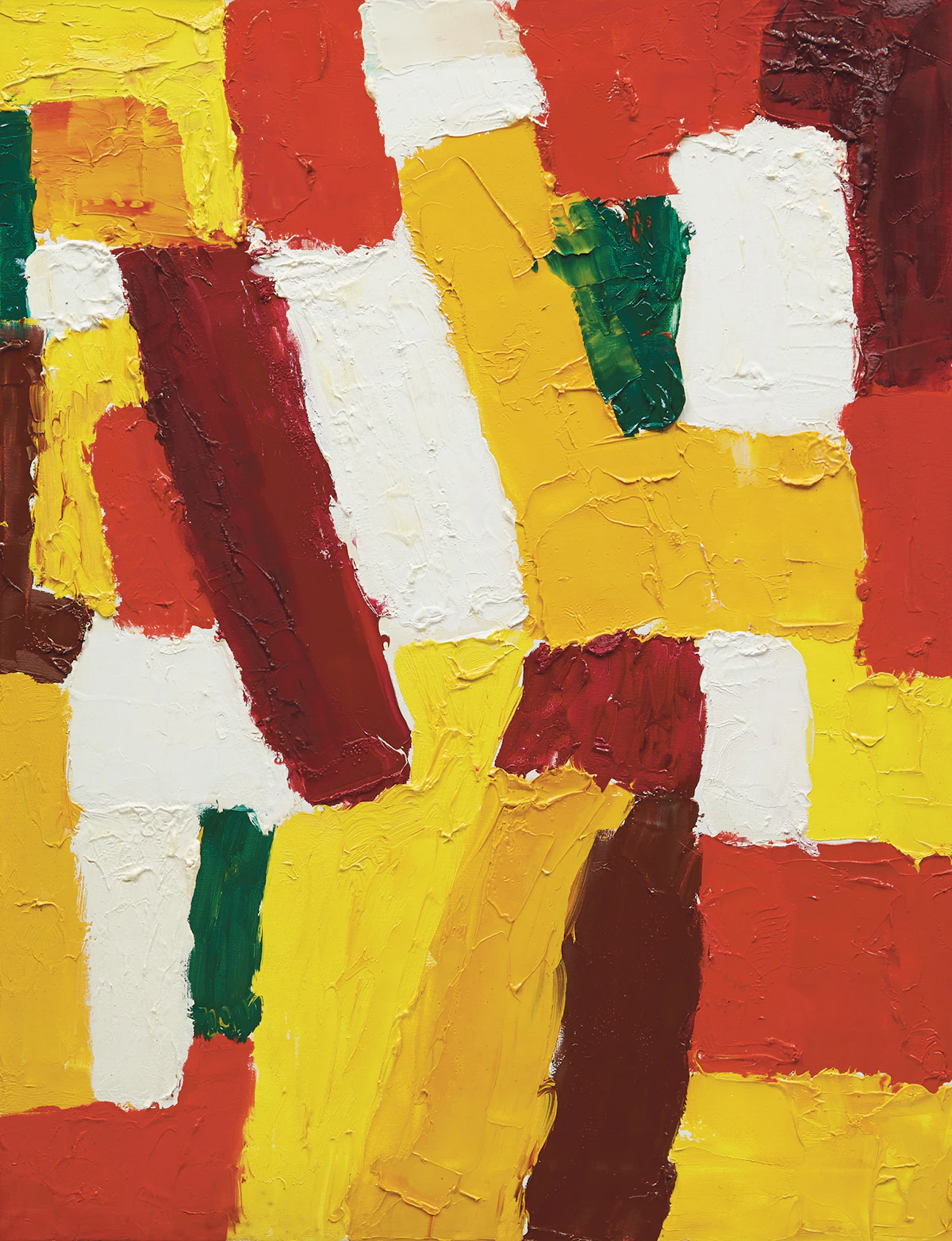
Moving into 1954 and 1955, Molinari’s works were “tachist like the Automatistes’ but they are constructed of gestures that are relatively impersonal...the paint sits unequivocally on top of the canvas like real coloured stuff—that is, literal matière, thick and gooey, that permanently shuts off Surrealist space. And they offer up colour, pure and unmixed, which still seems startling when compared with the muted palette and tonalities that prevail in the contemporary paintings of Borduas or Barbeau.” The strokes of paint in these works are more organized and geometric imbued with intention rather than automation. On works from 1954 and 1955 like this “Untitled”, Roald Nasgaard argues that they are, “quite anti- or is it Post-Automatiste, in how they divest themselves as surrealist illusionary space and reject the muted colours and tonalities of the Automatistes and, for that matter, of the first Plasticiens. In contrast, they favour pure colours, colour form places next to colour form, laid out literally on top of the canvas support.” The wide bands of red, ochre, white and pops of green pigment have been thickly applied to the canvas in a vertical fashion—both elements of the work forecasting Molinari’s evolution to hard-edge abstraction with an emphasis on a dramatic verticality of sharp bands of colour.