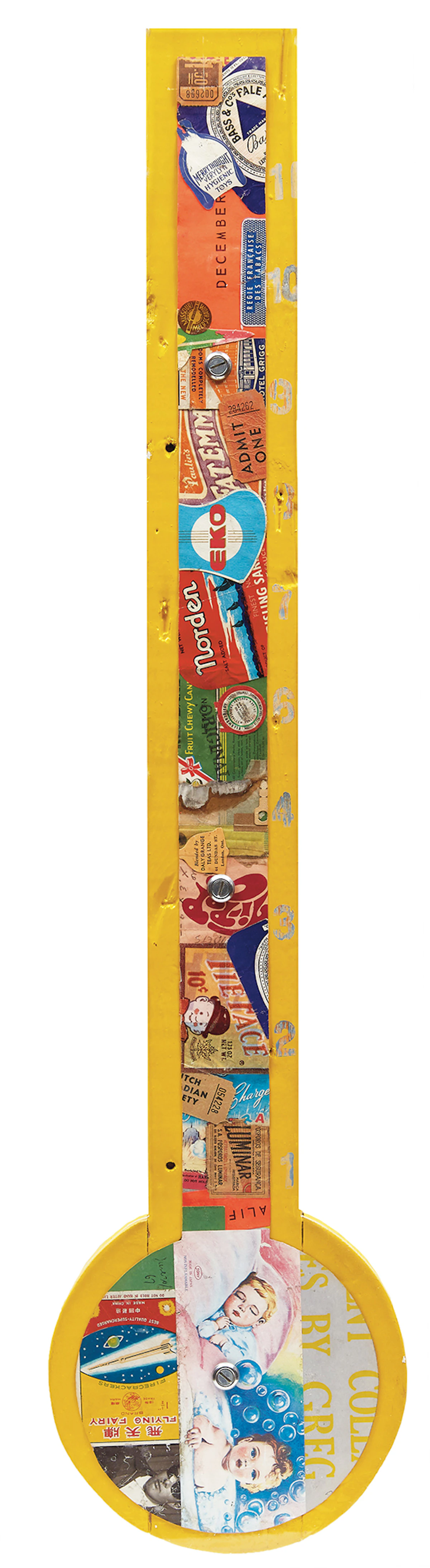
collage, stamp-pad ink on paper, Plexiglas, screws, cup-washers, screw eye on painted wood
dated “June 30/67” towards lower edge; titled and dated June 30, 1967 on the reverse
34 × 8.25 × 1 in (86.4 × 21.0 × 2.5 cm) (overall)
Auction Estimate:$6,000 - $8,000
Sale date:May 28, 2019
Price Realized
$8,850
(including Buyer's Premium)
Provenance
Isaacs Gallery, Toronto
Thielsen Galleries, London
Private Collection, Toronto
Masters Gallery, Calgary
Private Collection, Calgary
Exhibited
CUTOUT: Greg Curnoe, Shaped Collages 1965-68, Museum London, January 22 - April 17, 2011
Literature
Robert Fones et al., CUTOUT: Greg Curnoe, Shaped Collages 1965-68, exhibition catalogue, Museum London, January 22 - April 17, 2011, pages 7-73, reproduced page 72
James King, The Way it Is: The Life of Greg Curnoe, Toronto, 2017, page 186
Sarah Milroy, “Greg Curnoe: Time Machines”, in Greg Curnoe: Life & Stuff, Dennis Reid and Matthew Teitelbaum (eds.), Art Gallery of Ontario, Toronto, 2001, pages 59-60
In June of 1967, Greg Curnoe created the second of at least three thermometer-shaped collages. To say that the artist’s career had been warming up prior to Canada’s centenary would have been accurate: earlier that year, the National Gallery of Canada informed Curnoe that his work would be included in the Centennial group show “Three Hundred Years of Canadian Art.” With this selection, scholar Sarah Milroy notes, the artist had secured his place in art history. “Curnoe had made it into the Canadian art pantheon.” Robert Fones explains that although Curnoe had been making collages since the early 1960s, his activities shifted and intensified after 1965 with the creation of a series of about 50 collages mounted on painted wooden supports. The body of work to which “Thermometer #2” belongs is significant within Curnoe’s practice for its distillation of his principal interests and ethos; as a means by which the artist could develop techniques that demonstrated his commitment to Regionalism and placed his work in dialogue with a broader avante-garde tradition.
As Fones explains, though Curnoe may have derived the idea of mounting a finished paper collage on a cutout wooden shape from his own assemblages, the objects mark a significant departure from his previous methods. It was while devising the cutouts that Curnoe first experimented with unconventional framing materials, introducing a system constructed from readily available scraps of wood fastened with clinch nails and protected by clear Plexiglas. Suggesting both an economic motivation as much as the self-sufficient Pop sensibility of the age, this innovative means of display would become “a hallmark of all Curnoe’s subsequent framed work.”
Curnoe’s choice of materials was not only responsive to his immediate formal concerns and to his love of popular culture, but to his abiding connection to place. The thermometer’s hardware itself demonstrated the artist’s commitment to Regionalism: Curnoe sourced the eyelets, cup washers, and screws used to hang and fasten the collages from a local hardware store and, as Fones notes, he likely purchased the clear plastic from London Glass and Mirror on York Street. The paper materials affixed to the support-a cigarette carton, beer bottle label, ticket stubs, candy wrapper, and tea bag tag-were manufactured or sold by single- proprieter businesses in the thriving creative community in which Curnoe lived and worked. Though the artist’s collages are frank visual records of his daily experiences and encounters with his immediate material world, as Fones observes, Curnoe’s combinations of text and image are neither arbitrary, nor isolated: “The neo-Dada affinities of artists of 1950s New York and London that led to what we know as Pop art doubtlessly had immediate impact on Curnoe.” Like the other shaped collages of this brief but key period-moustaches, revolvers, ties, noses, and blimps-Curnoe’s thermometers not only demonstrate the irreverent humour he shared with his neo-Dada predecessors and Pop contemporaries, but, Ben Portis notes, reveal how engaged Curnoe was with creative activities and processes that had the potential to transform discarded commercial waste into “shapes that referenced the abstracted, archetypal body and the machine.” Curnoe’s thoughtfully arranged source materials further reveal the extent to which issues of authorship and self-referentiality, too, were at stake for the artist: a silver and green paper fragment within the thermometer bulb contains the text “BY GREG”, literally situating the regional artist within an established international avant-garde tradition of collage.